Most companies treat external help like a drive-thru—you place an order and hope the bag has the right burger inside. In 2026, that “order-and-wait” style of outsourcing is basically a death sentence for your velocity. If you aren’t integrating your external partners directly into your source code and daily stand-ups, you’re just paying for technical debt.
Enter co-development software models. It’s a bit of a buzzword, sure. But underneath the jargon is a simple reality: your in-house team and your partner team should be indistinguishable. They use the same Jira boards. They argue in the same Slack channels. and also commit to the same repo. It’s about building with someone, not just paying them to build for you.
What is Co-Development Software, Really?
Forget the textbook definitions. Co-development software is a shared engineering setup. You hire an external firm, but you don’t give them a “project.” You give them a seat at the table.
Think of it as a virtual extension of your own office. You aren’t just buying “code”; you’re buying access to a brain trust that follows your specific rules, sprints, and culture.
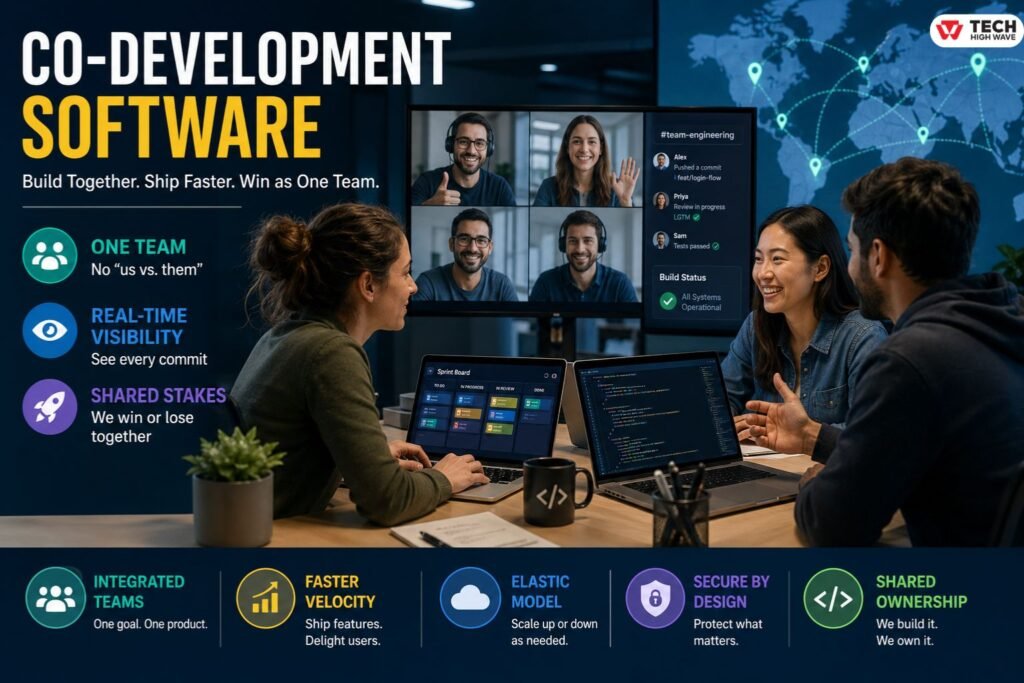
- One Team: No “us vs. them.”
- Real-Time Visibility: You see every single commit as it happens.
- Shared Stakes: If the product crashes, both sides feel the heat.
How the Model Actually Plays Out
A co-development partnership doesn’t start with a contract; it starts with a “tech sync.” Your partner needs to live and breathe your CI/CD pipeline.
Typically, it looks like this:
First, you do a Technical Audit. You look at where your current team is drowning—maybe you’re great at UI but your backend is a mess. Then comes Resource Integration. You don’t just get random devs; you hand-pick specialists who fit your stack. From there, it’s just Active Development. No weekly “status updates” that hide problems for six days. Just work.
Case Study: How ScaleHealth Cut Cycle Time by 40%
The Mess: ScaleHealth was stuck in “monolith hell.” Every update broke three other things, and their internal team was too small to fix it while building new features.
The Move: They brought in five co-developers specializing in Kubernetes. Instead of a separate project, these devs joined the daily morning stand-ups.
The Result: > * Cycle Time dropped by 40% because the feedback loop was instant.
- Knowledge Transfer: The internal team actually got smarter by working alongside the experts.
- Zero Friction: The migration to microservices happened in the background while the product stayed live.
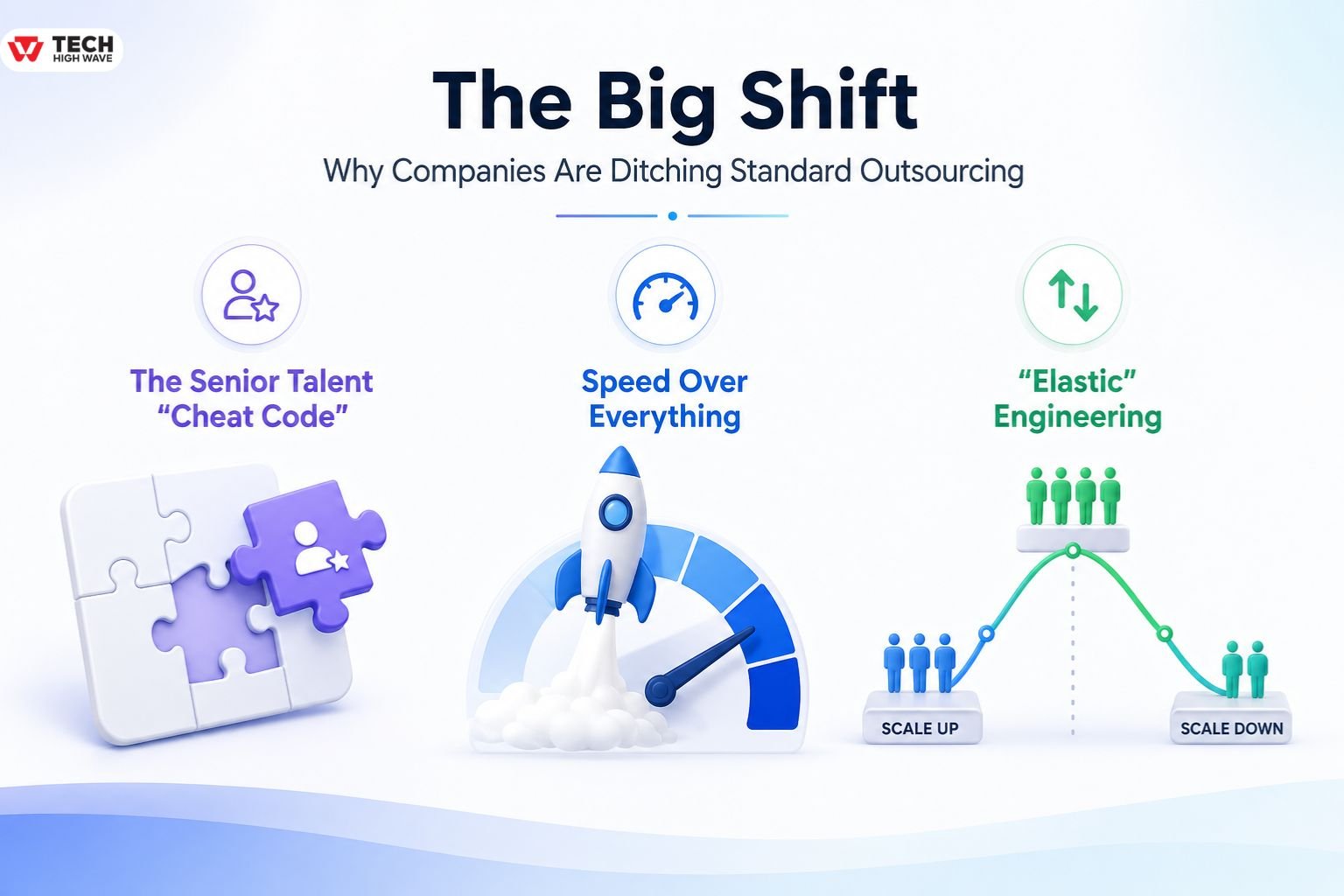
The Big Shift: Why Companies Are Ditching Standard Outsourcing
The world has changed. Search engines and users in 2026 can smell “automated” or “cheap” products from a mile away. You need synergy.
-
The Senior Talent “Cheat Code”
Let’s be real: hiring a senior AI or Cloud Architect is a nightmare. It takes six months and a massive signing bonus. Co-development lets you skip the line. You “plug in” that expert for the six months you need them, then scale back when the heavy lifting is done.
-
Speed Over Everything
Traditional vendors are slow because every change needs a Change Order. In a co-development model, you just pivot during the morning meeting. You move at the speed of a startup, even if you’re a 500-person enterprise.
-
“Elastic” Engineering
Why pay for 50 developers during a slow Q1? Co-development is elastic. You scale up for the big launch and lean out for the maintenance phase. It keeps the CFO happy and the codebase clean.
| The Old Way (Outsourcing) | The 2026 Way (Co-Development) |
| Hand-offs and “Black Boxes” | Integrated “One Team” culture |
| Limited visibility into daily work | Full transparency into every line of code |
| Fixed scopes that die when things change | Agile pivots based on real-time data |
Strategy: Making It Work Without the Headaches
You can’t just hire people and hope for the best. You need a plan.
Pick a Single Source of Truth.
If your internal team is on Linear and your partners are on Jira, you’ve already lost. Force everyone into one tool. If it’s not in the shared board, the work doesn’t exist.
Cultural Alignment Matters.
If your partners don’t know why you’re building this, they’ll write “technically correct” code that is useless for your users. Invite them to the all-hands. Let them see the vision.
Lock Down the Security.
Sharing your “secret sauce” is scary. Use MFA on everything. Follow the “Least Privilege” rule. You aren’t being paranoid; you’re being professional.
Pro Tip: Use the “Buddy System.” Pair one of your veterans with an external dev for code reviews. It’s the fastest way to make sure the “co-development” doesn’t turn into a mess of conflicting styles.
Why Modern Enterprises Are Shifting to Co-Development
The surge in interest for “co-development software” highlights a shift in how businesses view external help. It is no longer about finding the cheapest labor; it is about finding the best collaborative synergy.
Bridging the Talent Gap
Finding senior-level developers in specialized fields like AI, blockchain, or cloud architecture is a grueling and expensive process. Co-development allows you to “plug in” high-level expertise instantly. You gain access to a global talent pool without the long-term commitment of full-time hiring.
Increased Speed to Market
When you co-develop, you bypass the friction of traditional vendor hand-offs. Because the teams are integrated, the feedback loop is instantaneous. Features are pushed to production faster because the external team understands the internal context of the product.
Cost Efficiency and Scalability
Co-development provides an “elastic” engineering team. You can scale the number of developers up during a heavy product launch and scale back down during maintenance phases. This prevents the “bench time” costs associated with large internal teams.
| Feature | Traditional Outsourcing | Co-Development Software Model |
| Communication | Occasional updates / Milestones | Daily stand-ups / Real-time chat |
| Code Ownership | Handover at the end | Shared access from day one |
| Integration | Siloed / Separate teams | Fully integrated “One Team” |
| Transparency | Black box development | Full visibility into every commit |
Strategic Implementation: Best Practices for Success
To succeed with co-development software initiatives, you must treat the partnership as a strategic alliance rather than a simple transaction.
-
Establish a Single Source of Truth
Confusion is the enemy of velocity. Ensure that both your internal and external teams are using the same project management tools. Whether it’s Jira, Linear, or Trello, every task should be visible to everyone. This transparency prevents duplicate work and ensures that the “co-development” remains truly collaborative.
-
Prioritize Cultural Alignment
A developer who doesn’t understand your company’s “why” will never write code as effectively as one who does. Invite your co-development partners to company-wide meetings and product demos. When they feel like part of the mission, the quality of the software improves.
-
Define Clear Security Protocols
Sharing your codebase with an external partner requires trust, but it also requires rigorous security. Implement:
- Multi-factor authentication (MFA) for all shared repositories.
- Clearly defined access levels (Least Privilege Principle).
- Regular automated security audits.
Pro Tip: Use a “Buddy System” for code reviews. Pair an internal developer with an external co-developer for peer reviews. This ensures knowledge transfer and maintains your internal coding standards.
Common Challenges in Co-Development (and How to Avoid Them)
While the benefits are significant, co-development isn’t without its hurdles. Being aware of these pitfalls is the first step toward avoiding them.
- Communication Silos: If the internal team makes decisions in private meetings without documenting them, the external team will fall behind. Use asynchronous communication (like Slack or Notion) to document every decision.
- Tooling Friction: If your partner uses different version control or testing frameworks, you’ll waste weeks on setup. Standardize the co-development software stack before the first line of code is written.
- Time Zone Disparities: Working with a team 12 hours away can lead to a 24-hour delay in feedback. Aim for a “nearshore” partner or ensure at least a 3–4 hour overlap in working hours.
- Meeting Fatigue: Don’t drag the external team into every 2-hour brainstorming session. Keep it lean.
- The “Wait and See” Trap: If your partner is waiting 24 hours for a code review, you’re wasting money.
- Bad Time Zones: If they’re sleeping while you’re working, velocity dies. Aim for at least 4 hours of overlap.
Conclusion: Stop Owning, Start Accessing
The old way of building software was about “headcount.” The new way is about access. You don’t need to own the developers; you need to own the results.
Co-development isn’t just a different way to pay people. It’s a different way to think about your company’s potential. When you break down the walls between “us” and “them,” you stop managing vendors and start building a future.
FAQ
Q1: What’s the main difference between co-dev and outsourcing?
Outsourcing is a “transaction”—you buy a result. Co-development is an “integration”—you add experts to your existing team to work as one unit.
Q2: How do we handle security with external devs?
You don’t give them the keys to the castle on day one. Use shared VPNs, multi-factor authentication, and “least privilege” access so they only see what they need to see.
Q3: Can a 3-person startup use this?
Absolutely. It’s actually better for startups. You can hire a “Fractional CTO” or a specialized DevOps person via co-development for 10 hours a week instead of hiring a $200k-a-year employee you can’t afford yet.
Q4: What software do we need for co-development?
You need a “Collaboration Stack.” Think GitHub for the code, Jira or Linear for the tasks, and Slack for the “water cooler” talk. Standardize it before you start.
Q5: How do I know if it’s working?
Look at your “Velocity.” If you’re pushing more features with fewer bugs than you were before the partner joined, it’s working. If you’re spending all day in meetings explaining things, it’s not
Visit For More: TechHighWave