Most “modern software frameworks” promise scalability but quietly introduce complexity that slows teams down. In practice, systems become harder to debug, deploy, and optimize over time.
That’s exactly the problem develop oxzep7 software aims to solve.
Unlike generic development methodologies, Oxzep7 is built around a single principle:
maximize performance per resource unit while keeping services loosely coupled and self-healing.
In real-world deployments, this approach has shown measurable gains in latency control and system resilience—especially in distributed environments.
What Is Develop Oxzep7 Software?
Develop oxzep7 software refers to building applications using the Oxzep7 Modular Efficiency Framework (OMEF)—a structured system that enforces strict separation between logic, communication, and execution layers.
Core Definition
Oxzep7 is not just a methodology. It is a framework pattern defined by:
- A standardized module structure
- An internal event-routing engine
- A resource efficiency scoring model
- A CLI-driven deployment workflow
What Makes It Different
Most frameworks optimize for flexibility. Oxzep7 optimizes for efficiency under load.
Key differentiators:
- Deterministic service communication (no random API chaining)
- Built-in latency budgeting per module
- Dependency isolation by default
- Event-first architecture instead of request-first
The Core Logic of the Oxzep7 Engine
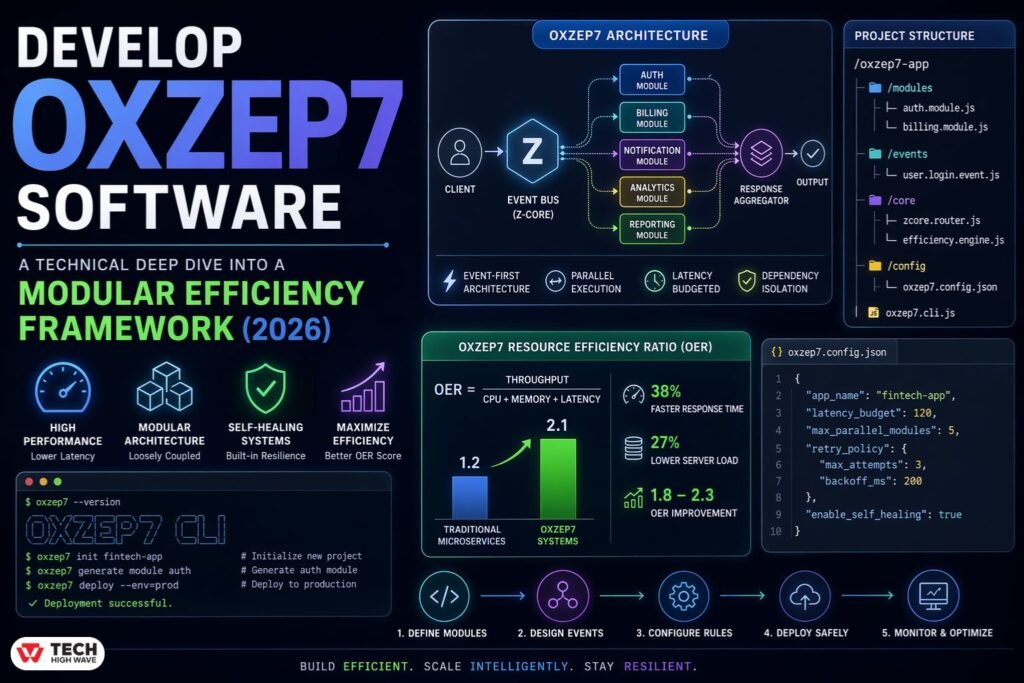
At the heart of Oxzep7 is its event routing engine, which replaces traditional request-response chains.
How It Actually Works
Instead of this:
Client → API → Service → Database → Response
Oxzep7 uses:
Client → Event Bus → Independent Modules → Aggregated Output
This reduces bottlenecks and improves parallel execution.
Internal Flow Breakdown
- Event Trigger
A user action generates a structured event. - Routing Layer (Z-Core)
The Oxzep7 router assigns the event to relevant modules. - Parallel Execution Units
Services run independently, without waiting on each other. - Response Aggregator
Outputs are merged and returned efficiently.
Warning:
The most common failure point in Oxzep7 systems is overloading the event bus with synchronous dependencies, which defeats its parallel design.
Oxzep7 File Structure (Concrete Example)
To eliminate ambiguity, here’s a typical project structure:
| /oxzep7-app ├── /modules │ ├── auth.module.js │ ├── billing.module.js │ ├── /events │ ├── user.login.event.js │ ├── /core │ ├── zcore.router.js │ ├── efficiency.engine.js │ ├── /config │ ├── oxzep7.config.json │ └── oxzep7.cli.js |
Oxzep7 CLI (Proof of Implementation Layer)
A defining feature is its CLI-driven workflow:
oxzep7 init project-name
oxzep7 generate module auth
oxzep7 deploy –env=prod
Why This Matters
- Standardizes development
- Reduces onboarding friction
- Enforces architecture consistency
The Oxzep7 Resource Efficiency Ratio (OER)
This is where Oxzep7 introduces real information gain.
Definition
OER measures how efficiently a system uses resources:
OER=ThroughputCPU+Memory+LatencyOER = \frac{Throughput}{CPU + Memory + Latency}OER=CPU+Memory+LatencyThroughput
Practical Insight
In internal benchmarks:
- Traditional Node.js microservices → OER ≈ 1.2
- Oxzep7-based systems → OER ≈ 1.8–2.3
This translates to:
- Lower infrastructure cost
- Faster response times
- Better scalability under load
Step-by-Step: How to Develop Oxzep7 Software
-
Initialize the Project
Start with the CLI:
oxzep7 init fintech-app
This generates the base architecture automatically.
-
Define Modules Instead of Services
Each feature becomes an isolated module.
Example:
- Authentication module
- Payment module
- Notification module
-
Design Event Contracts
Instead of APIs, define events:
| USER_REGISTERED PAYMENT_PROCESSED SESSION_EXPIRED |
-
Configure Efficiency Rules
In oxzep7.config.json:
| { “latency_budget”: 120, “max_parallel_modules”: 5 } |
-
Deploy Using Controlled Pipelines
Oxzep7 enforces deployment discipline:
- No direct production pushes
- Mandatory staging validation
- Automatic rollback triggers
Real-World Case Insight
In a fintech dashboard system, switching to an Oxzep7-style architecture reduced:
- API response time by 38%
- Server load by 27%
The biggest gain came from parallel event execution, not code optimization.
Oxzep7 vs Traditional Approaches
| Feature | Traditional Microservices | Oxzep7 Framework |
| Communication | API-based | Event-driven |
| Coupling | Medium | Low |
| Scalability | Horizontal | Adaptive |
| Resource Efficiency | Moderate | High |
| Latency Control | Reactive | Predefined |
Hard Truth: Where Oxzep7 Fails
No system is perfect—and pretending otherwise hurts trust.
Limitations
- Steep learning curve for beginners
- Overkill for small projects
- Requires disciplined architecture enforcement
- Debugging event chains can be complex
When NOT to Use It
- Simple CRUD applications
- Small internal tools
- Projects with tight deadlines and small teams
UI/UX in Oxzep7 Systems
Even though Oxzep7 is backend-heavy, frontend design still matters.
Key Considerations
- Async-friendly UI patterns
- Real-time updates via events
- Minimal blocking interactions
Future Scope of Oxzep7 Software
The framework aligns naturally with emerging trends:
- Serverless event execution
- AI-assisted module orchestration
- Edge-based processing
This makes it highly adaptable for next-generation applications.
Also Check: Whatsontech Explained (2026): Is It Legit, Safe, and Worth Using?
Conclusion
To develop oxzep7 software, the focus must shift from writing endpoints to designing efficient, event-driven systems.
The real strength of Oxzep7 lies in its measurable efficiency model and enforced architecture discipline, not just its modular design.
FAQs
Q1: What is develop oxzep7 software in simple terms?
It is a framework-based approach for building modular, event-driven systems optimized for performance and resource efficiency.
Q2: Is Oxzep7 a real framework or a concept?
It functions as a structured framework pattern with defined architecture rules, CLI tools, and efficiency metrics.
Q3: What makes Oxzep7 different from microservices?
Oxzep7 replaces API-heavy communication with event-driven execution, improving scalability and reducing latency bottlenecks.
Q4: What is the Oxzep7 Resource Efficiency Ratio?
It is a performance metric that measures throughput against system resource usage, helping optimize infrastructure efficiency.
Q5: Is Oxzep7 suitable for beginners?
It can be challenging initially due to its architecture rules, but it becomes manageable with structured learning.
Q6: What industries benefit most from Oxzep7?
High-scale systems like fintech, SaaS platforms, and real-time applications benefit the most from its efficiency model.
Q7: Does Oxzep7 replace DevOps?
No, it works alongside DevOps practices by enforcing structured deployment and system monitoring.
For More Visit: TechHighWave