For years, gaming trends followed a predictable pattern—better graphics, bigger worlds, faster hardware.
That’s no longer the case.
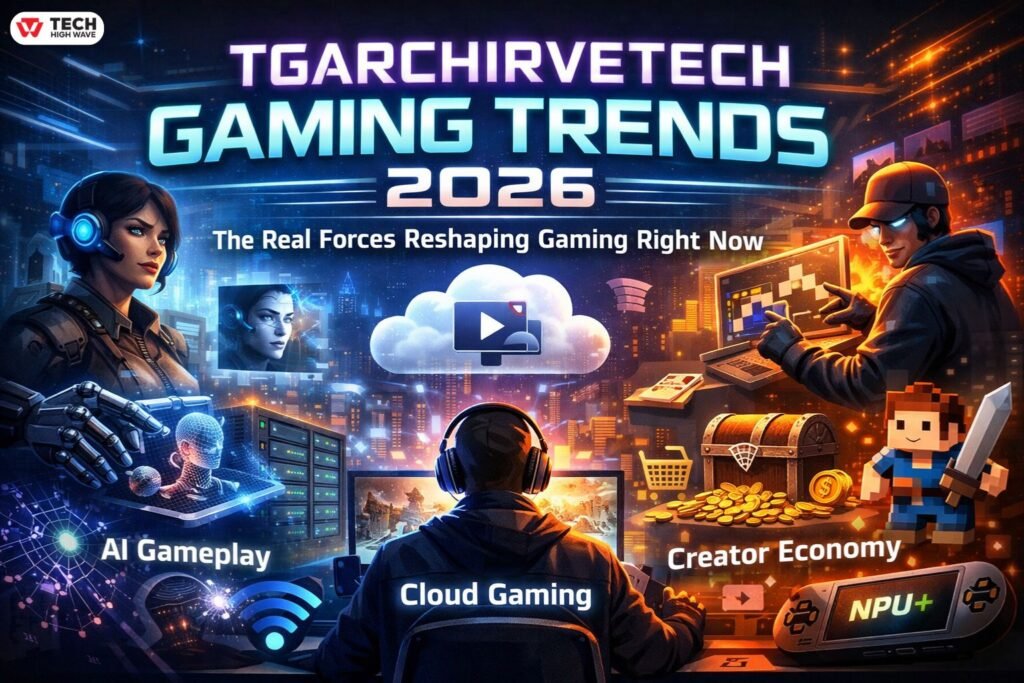
What we’re seeing now, often grouped under tgarchirvetech gaming trends, isn’t just incremental progress. It’s a structural shift in how games are built, delivered, and experienced.
The scale explains why. The global gaming industry has now surpassed $255 billion in 2026, with billions of active players worldwide. This isn’t just entertainment anymore—it’s infrastructure.
And when an industry reaches that level, small changes stop being small.
They compound.
This guide breaks down what tgarchirvetech gaming trends actually represent, how they work in practice, and where they’re heading next—without leaning on hype or vague predictions.
What Is Tgarchirvetech Gaming Trends?
Tgarchirvetech gaming trends are best understood as a cluster of modern gaming shifts, rather than a single concept.
It brings together several high-impact developments:
- AI-driven gameplay and development
- Cloud-based gaming access (GaaS models)
- Hybrid gaming ecosystems (social + content + gameplay)
- Data-driven personalization systems
It’s not a formal industry term like “Game-as-a-Service,” but it functions as a bridge keyword—connecting multiple high-volume topics into one narrative.
Why It’s Gaining Traction
The term is surfacing because it captures something real:
- Gaming is no longer tied to hardware
- Player behavior is shaping design decisions
- Technology layers are merging (AI + cloud + real-time data)
In other words, the industry is no longer evolving in straight lines—it’s evolving in systems.
How Tgarchirvetech Gaming Trends Works
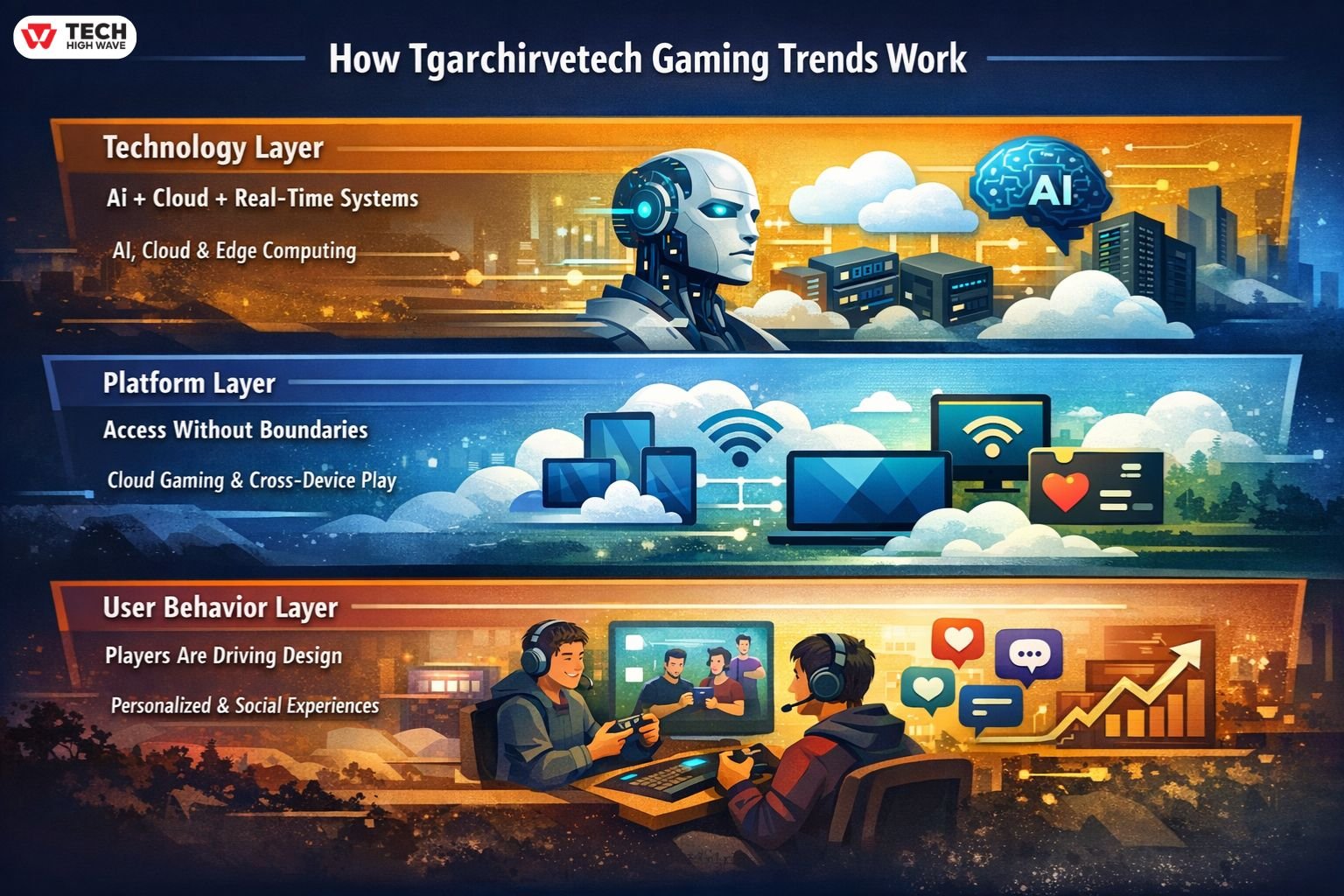
Instead of thinking of this as a single trend, it helps to break it into layers.
Technology Layer (AI + Cloud + Real-Time Systems)
Modern games now rely on converging technologies:
- AI for NPC behavior, automation, and content generation
- Cloud infrastructure for streaming and scalability
- Edge computing for faster response times
This convergence is what enables adaptive gameplay at scale.
A key shift in 2026 is the rise of Agentic AI, where NPCs behave less like scripted bots and more like decision-making entities. Some studies now show up to 25% improvement in player retention in games using these systems.
That’s not experimental anymore—that’s production-level impact.
Platform Layer (Access Without Boundaries)
Gaming is becoming platform-agnostic.
Cloud gaming alone is projected to reach $23.7 billion in 2026, a massive jump from early-stage adoption just a few years ago.
This enables:
- Instant access without downloads
- Cross-device continuity
- Subscription-based ecosystems
But here’s the reality check:
Cloud gaming still struggles in regions with unstable internet. The promise is real—but not evenly distributed.
User Behavior Layer (Players Are Driving Design)
This is where things get interesting.
We’re seeing players shift toward:
- Personalized experiences over fixed narratives
- Social interaction over solo progression
- Short sessions with deeper engagement loops
Developers are reacting accordingly.
Games are no longer just designed—they’re continuously adjusted based on player data.
Key Tgarchirvetech Gaming Trends to Watch
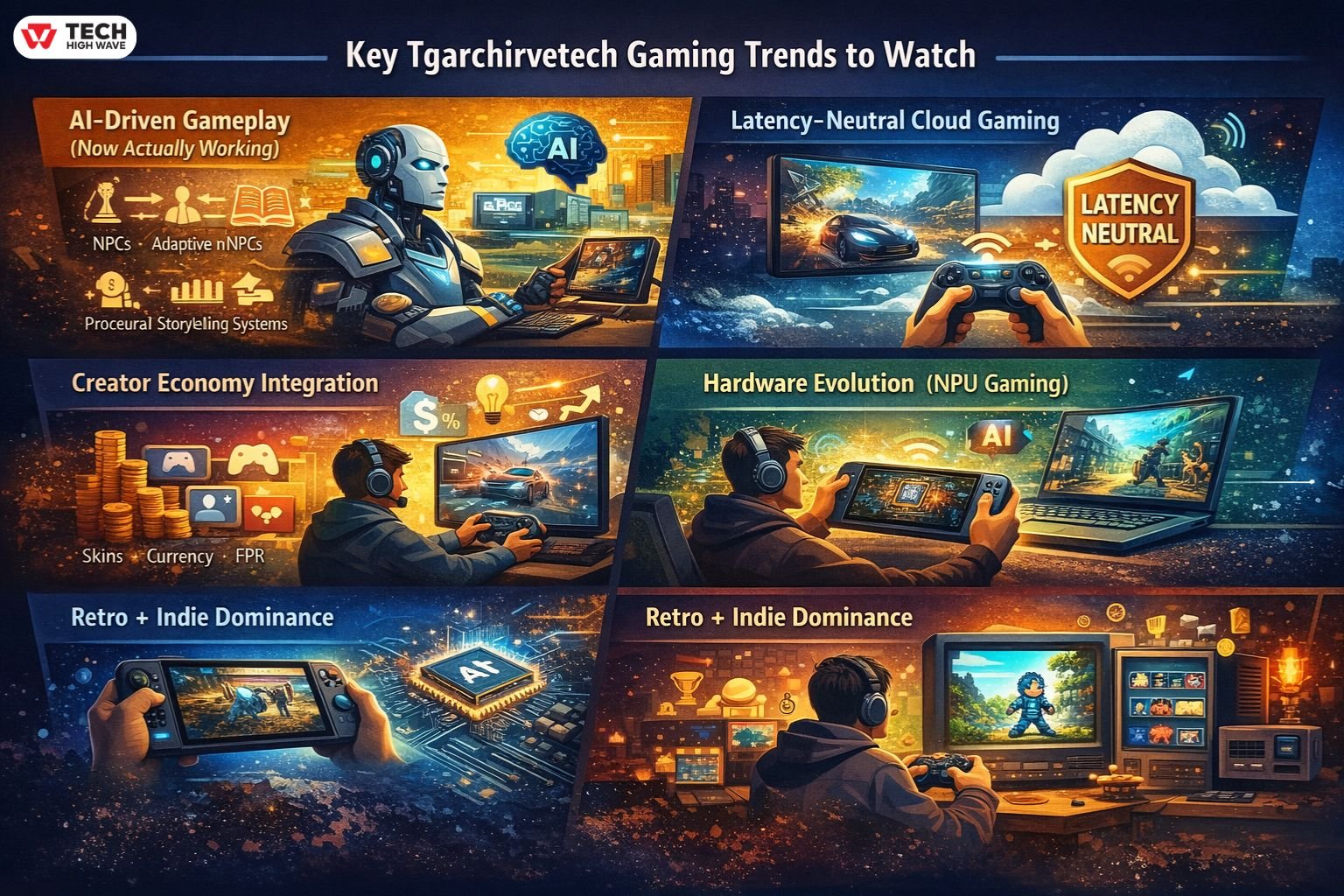
AI-Driven Gameplay (Now Actually Working)
AI isn’t just a feature anymore—it’s becoming the backbone.
Modern implementations include:
- NPCs that adapt to player decisions
- Procedural storytelling systems
- Real-time difficulty balancing
We’re also seeing a shift behind the scenes:
- Developers using AI for asset generation
- Automated testing pipelines
- Faster content iteration cycles
Reality check: Poorly implemented AI still feels repetitive. The gap between good AI and bad AI is very noticeable.
Latency-Neutral Cloud Gaming
This is one of the most important 2026 breakthroughs.
The old problem: cloud gaming latency.
The new solution: edge computing + local input processing
This creates what’s now being called:
“Latency-neutral gameplay”
- Inputs are processed locally
- Visuals are streamed from the cloud
- Response feels nearly instant
This is what finally makes competitive cloud gaming viable.
Creator Economy Integration
Games are no longer closed systems.
They are becoming platforms where users can:
- Create and sell in-game assets
- Monetize content directly
- Build micro-economies inside games
This goes beyond skins.
We’re seeing:
- In-engine monetization tools
- Creator revenue-sharing models
- User-generated game modes
This is one of the biggest underreported shifts in gaming right now.
Hardware Evolution (NPU Gaming)
A major missing piece in most trend discussions is hardware.
2026 devices now include NPUs (Neural Processing Units) that handle AI tasks locally.
This enables:
- On-device NPC intelligence
- Reduced server costs
- Faster AI responses without cloud dependency
New handhelds and laptops are already using this model.
This quietly solves one of the biggest limitations mentioned earlier—server reliance.
Hybrid Gaming Ecosystems
Games are turning into platforms.
Not just places to play—but places to:
- Socialize
- Create
- Compete
- Earn
This includes:
- Integrated streaming tools
- Community-driven events
- Persistent online worlds
We’re moving from “games” to interactive ecosystems.
Retro + Indie Dominance
Here’s something unexpected.
While tech is advancing rapidly, many successful games are going in the opposite direction visually.
- Pixel art
- Simplified mechanics
- Nostalgia-driven design
Indie titles are often outperforming AAA games in engagement and creativity.
Players don’t always want more complexity. They want better experiences.
Real-World Example (What Actually Happened)
A cloud-only multiplayer title launched in late 2025 with heavy expectations.
On paper, it had everything:
- No downloads
- Cross-platform access
- High-end visuals
But players quickly pushed back.
Why?
- Input lag during peak hours
- Server instability
- No offline fallback
The result: strong launch numbers, but a rapid drop-off in active players.
This is a perfect example of tgarchirvetech gaming trends in action—where execution matters more than innovation.
Step-by-Step: How to Use These Trends (Without Getting Lost)
Step 1: Pick a Layer
Focus on one:
- AI systems
- Cloud infrastructure
- Content/creator economy
Trying to cover everything leads to weak positioning.
Step 2: Follow Player Behavior, Not Just Tech
Technology drives change—but players decide what survives.
Watch:
- Retention trends
- Community feedback
- Engagement patterns
Step 3: Build Around Systems, Not Features
Instead of adding features, think in systems:
- How does AI connect with gameplay?
- How does monetization connect with user behavior?
That’s where long-term value comes from.
Sustainability & Ethical Concerns (Often Ignored)
This is where competitors are starting to focus—and for good reason.
Key Issues:
- Cloud gaming increases energy consumption
- AI-generated content raises authorship concerns
- Data-driven design raises privacy questions
These aren’t just side topics anymore.
They’re becoming decision-making factors for players and developers.
Quick Comparison: Then vs Now
| Aspect | Traditional Gaming | Tgarchirvetech Trends |
| Access | Hardware-based | Cloud + cross-platform |
| Gameplay | Fixed | Adaptive & AI-driven |
| Design | Developer-led | Player-influenced |
| Economy | Closed | Creator-driven |
| Performance | Local hardware | Hybrid (edge + cloud) |
Limitations and Reality Check
Not everything here is perfect.
- Cloud gaming still depends on infrastructure
- AI systems can feel artificial if poorly trained
- Market saturation makes discovery harder
- Industry layoffs show instability behind the scenes
The industry is evolving—but it’s also correcting itself after rapid growth.
Future Direction
Looking ahead, a few things are becoming clear:
- Games will feel more like interactive films
- Hardware limitations will matter less
- Player-driven ecosystems will dominate
And most importantly:
Gaming is shifting from products to platforms.
FAQs
Q1: What are tgarchirvetech gaming trends?
They refer to a group of modern gaming developments including AI gameplay, cloud gaming, and hybrid gaming ecosystems shaping the industry in 2026.
Q2: Is tgarchirvetech a real company?
No, it is not a company. It is a conceptual keyword used to group emerging gaming trends and technologies.
Q3: How big is the gaming industry in 2026?
The gaming industry has surpassed $255 billion globally, making it one of the largest digital entertainment sectors.
Q4: What is latency-neutral gaming?
Latency-neutral gaming uses edge computing and local input processing to reduce delay in cloud gaming, making gameplay feel more responsive.
Q5: How does AI improve gaming experiences?
AI enhances personalization, adapts gameplay in real time, and improves NPC behavior, increasing engagement and retention.
Q6: What role does the creator economy play in gaming?
It allows players to create, monetize, and share content within games, turning games into interactive platforms.
Q7: What are the biggest challenges in modern gaming trends?
Key challenges include infrastructure limitations, ethical concerns around AI, and increasing competition in a saturated market.
Conclusion
Tgarchirvetech gaming trends aren’t about a single innovation.
They represent a deeper shift—where AI, cloud systems, hardware evolution, and player behavior are all converging at once.
Some trends will fail. Others will define the next decade.
The real advantage comes from knowing the difference.
For More Visit: TechHighWave