Health is often treated like a checklist—eat better, move more, sleep enough. On paper, that sounds complete. In reality, something still feels off for many people. Energy dips. Stress lingers. Motivation fades for no clear reason.
That disconnect usually comes down to balance.
The health triangle offers a more grounded way to look at well-being. Instead of focusing on one area, it brings together physical health, mental clarity, and social connection. These aren’t separate tracks—they overlap constantly. When one side starts slipping, the effects tend to show up elsewhere, sometimes in ways that aren’t immediately obvious.
Understanding this model helps make sense of those gaps. It also gives a clearer path forward—one that feels realistic rather than forced.
What Is Health Triangle?
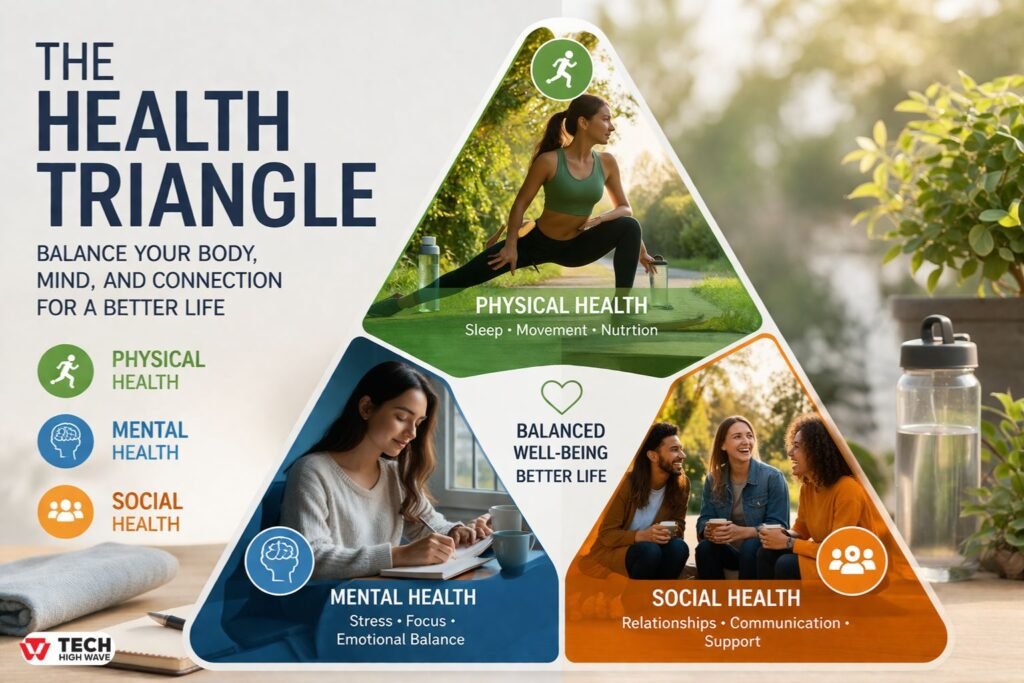
The health triangle is a simple model built around three connected areas: physical health, mental (emotional) health, and social health.
Each side represents a different part of everyday life:
- Physical health – sleep, movement, nutrition, and how the body functions day to day
- Mental health – stress, focus, emotional stability, and the ability to cope
- Social health – relationships, communication, and a sense of connection
The idea is straightforward: these three sides support each other. When one weakens, the others don’t stay untouched.
Someone might be physically active and still feel drained because stress is high. Another person might have strong relationships but struggle with low energy due to poor sleep. It rarely comes down to just one thing.
There are broader wellness models that go beyond these three areas—adding things like environment or purpose—but the triangle remains the most practical place to start. It keeps things clear without oversimplifying them.
Why Is the Health Triangle Important?
The value of the health triangle shows up in everyday situations.
It explains why doing “the right things” doesn’t always feel like enough. A solid workout routine won’t cancel out constant stress. Good social support won’t fix ongoing physical exhaustion.
It also helps shift attention away from quick fixes. Instead of chasing one solution at a time, it encourages a more balanced view.
Most importantly, it brings awareness to what’s often overlooked. Mental fatigue, for example, can quietly build even when everything else seems fine on the surface. The triangle helps connect those dots.
How Health Triangle Works
The three sides of the triangle are always interacting, whether that’s obvious or not.
- Poor sleep can make small problems feel bigger
- Ongoing stress can drain physical energy
- Lack of connection can slowly reduce motivation
These changes don’t happen in isolation. They build on each other.
A common pattern looks like this: one area gets most of the attention, while the others fall behind. Over time, that imbalance starts to show. Not all at once—but gradually.
Also Read: What Is Foenegriek? Benefits, Uses, Dosage & the Science Behind Fenugreek
Health Triangle at a Glance
| Health Triangle Side | Focus Area | Everyday Examples |
| Physical | Body | Sleep, movement, nutrition |
| Mental | Mind | Stress, focus, emotional balance |
| Social | Connection | Relationships, communication, support |
Health Triangle Self-Assessment (Quick Check)
A quick way to spot imbalance is to rate each area from 1 to 10:
- Physical: energy, sleep, activity
- Mental: stress, mood, focus
- Social: interaction, support, connection
The numbers don’t need to be precise. Even a rough estimate can reveal patterns. If one score stands out as much lower, that’s usually where attention is needed.
Sometimes the gap is obvious. Other times, it takes a moment to notice.
Signs Your Health Triangle Is Out of Balance
Imbalance doesn’t always show up clearly at first. It tends to build in small ways.
- Feeling tired even after rest
- Losing focus more easily than usual
- Pulling away from conversations or social plans
- Struggling to stay consistent with routines
- Feeling “off” without a clear reason
None of these point to just one issue. They often reflect overlap between multiple areas.
Health Triangle Examples (Real-Life Scenarios)
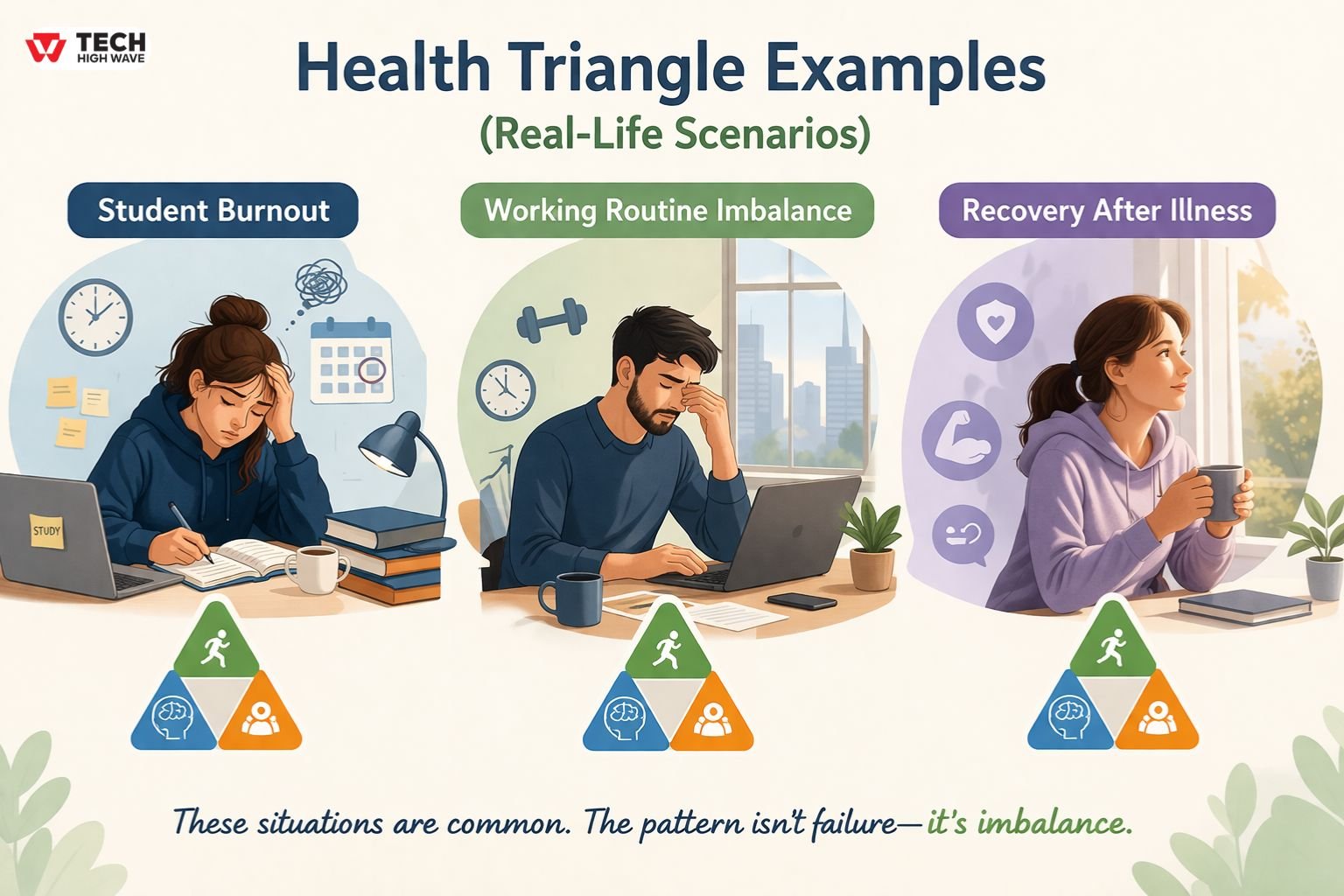
Student burnout
Strong academic focus can come at the cost of sleep and social time. Over time, that pressure builds, even if performance stays high.
Working routine imbalance
A consistent gym schedule may be in place, but long work hours and stress slowly drain energy and motivation.
Recovery after illness
Physical strength may return first, while confidence and social engagement take longer to catch up.
These situations are common. The pattern isn’t failure—it’s imbalance.
Best Uses for Health Triangle
The model works best when applied to real situations, not just understood in theory.
- Reviewing daily habits
- Adjusting routines during stressful periods
- Supporting student or workplace well-being
- Rebuilding after burnout or illness
It’s less about strict structure and more about awareness.
Who Should Use Health Triangle?
The simplicity of the model makes it widely usable.
- Students building habits early
- Professionals balancing work and personal life
- Educators and wellness practitioners
- Anyone trying to feel more stable day to day
It may feel too broad for highly specific medical needs, but as a starting point, it’s effective.
How to Choose the Right Health Triangle Approach
A simple approach usually works best.
- Notice which area feels most off
- Start small instead of changing everything
- Keep tracking simple and consistent
- Check progress occasionally
- Adjust based on real life, not ideal plans
The goal isn’t perfect balance—it’s steady alignment.
Simple Daily Health Triangle Checklist
- Get consistent sleep
- Move regularly
- Take short breaks to reset mentally
- Stay in touch with at least one person
- Avoid long periods of isolation
These don’t need to be done perfectly. Consistency matters more.
Common Mistakes to Avoid
Focusing only on one area
Physical health often gets the most attention, while mental and social sides fall behind.
Waiting too long to adjust
Small imbalances are easier to fix early.
Overcomplicating routines
Complex plans tend to break down quickly.
Inconsistent tracking
Without some form of awareness, patterns are easy to miss.
Expecting quick results
Balance takes time. Sudden changes rarely last.
Future Trends in Health Triangle (2026 Outlook)
The way people approach health is gradually shifting.
- Tools are becoming more integrated, tracking multiple areas at once
- Mental well-being is receiving more attention than before
- Broader models are expanding beyond the triangle while still building on it
- Digital communities are making support easier to access
- Preventive habits are becoming more common than reactive ones
Even with these changes, the core idea stays the same: balance matters.
FAQs
Q1: What is the health triangle?
The health triangle is a model of well-being made up of physical, mental, and social health, showing how these areas work together.
Q2: What are the three sides of the health triangle?
The three sides are physical health, mental health, and social health.
Q3: What are the 3 aspects of health?
They are physical, mental (emotional), and social health.
Q4: Why is the health triangle important?
It highlights balance and explains why focusing on one area alone often isn’t enough.
Q5: What happens if one side is weak?
It usually affects the others, leading to reduced overall stability.
Q6: How can the health triangle be improved?
Through consistent habits across all three areas, including sleep, stress management, and connection.
Q7: Can the health triangle change over time?
Yes, it shifts with lifestyle changes, which is why regular awareness matters.
Final Verdict
The health triangle doesn’t try to complicate health. It brings attention back to something simple but often overlooked: everything is connected. When one part starts to slip, the others tend to follow. Keeping that balance in check—imperfectly but consistently—is what makes the difference over time.
Also Check: What to Avoid When Taking Glutathione (2025 Safety Guide)