Here’s a hard truth most vendors won’t say out loud: the majority of software products that fail were built competently. The code ran. The features launched. But somewhere between the kickoff call and the third sprint, the team stopped building the right thing and started building the agreed thing.
Software product development services, done well, exist to prevent exactly that gap. They’re not just about writing code — they’re about making durable technical decisions, managing long-term product health, and knowing when to slow down so you don’t pay for speed twice.
This guide covers how these services actually work in 2026, where most engagements go wrong, what AI-first development has changed, and — critically — when not to hire an external team at all.
What Are Software Product Development Services?
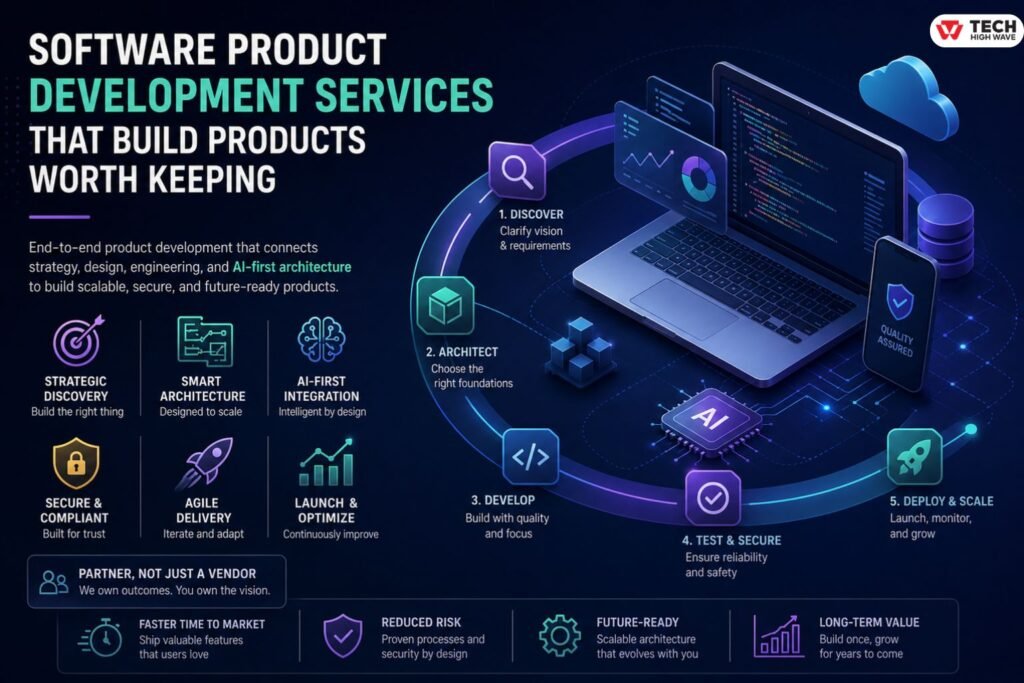
Software product development services are structured, end-to-end engagements that take a software idea from concept to a live, scalable product. This includes web applications, SaaS platforms, mobile apps, enterprise tools, and AI-powered systems — anything that delivers value through a digital interface.
The distinction that matters: this is not staff augmentation. It’s not “we provide developers.” A real product development service owns outcomes. It connects business strategy to technical architecture, treats the software as a long-term asset, and is accountable to product performance — not just task completion.
In practice, a full-service engagement covers discovery, UX/UI design, frontend and backend engineering, QA, DevOps, and post-launch iteration. But the quality of that service lives in the decisions made between those phases — not the phases themselves.
How Software Product Development Services Work
Discovery — and the 5 Documents You Should Own After It
Discovery is the most undervalued phase in the entire lifecycle. Most teams treat it as a formality. In practice, a rigorous discovery phase costs roughly 10–15% of the total project budget and prevents the kind of rework that consumes 40–60% of it.
A properly run discovery process — typically two to four weeks — should produce five specific deliverables that the client owns permanently:
- Event Storming Map — a visual model of every domain event, command, and business rule that the software must handle
- User Story Map — a two-dimensional view of user journeys and feature priorities, not just a flat backlog
- Technical Feasibility Brief — a written assessment of stack options, integration risks, and infrastructure requirements
- Architecture Decision Record (ADR) — documented rationale for key technical choices, so future teams understand why, not just what
- Definition of Ready and Done — agreed acceptance criteria that prevent scope disputes mid-sprint
If a vendor can’t define what the client receives after discovery, that’s a signal the discovery phase is mostly a sales ritual.
Architecture — Monolith vs. Microservices vs. Modular Monolith
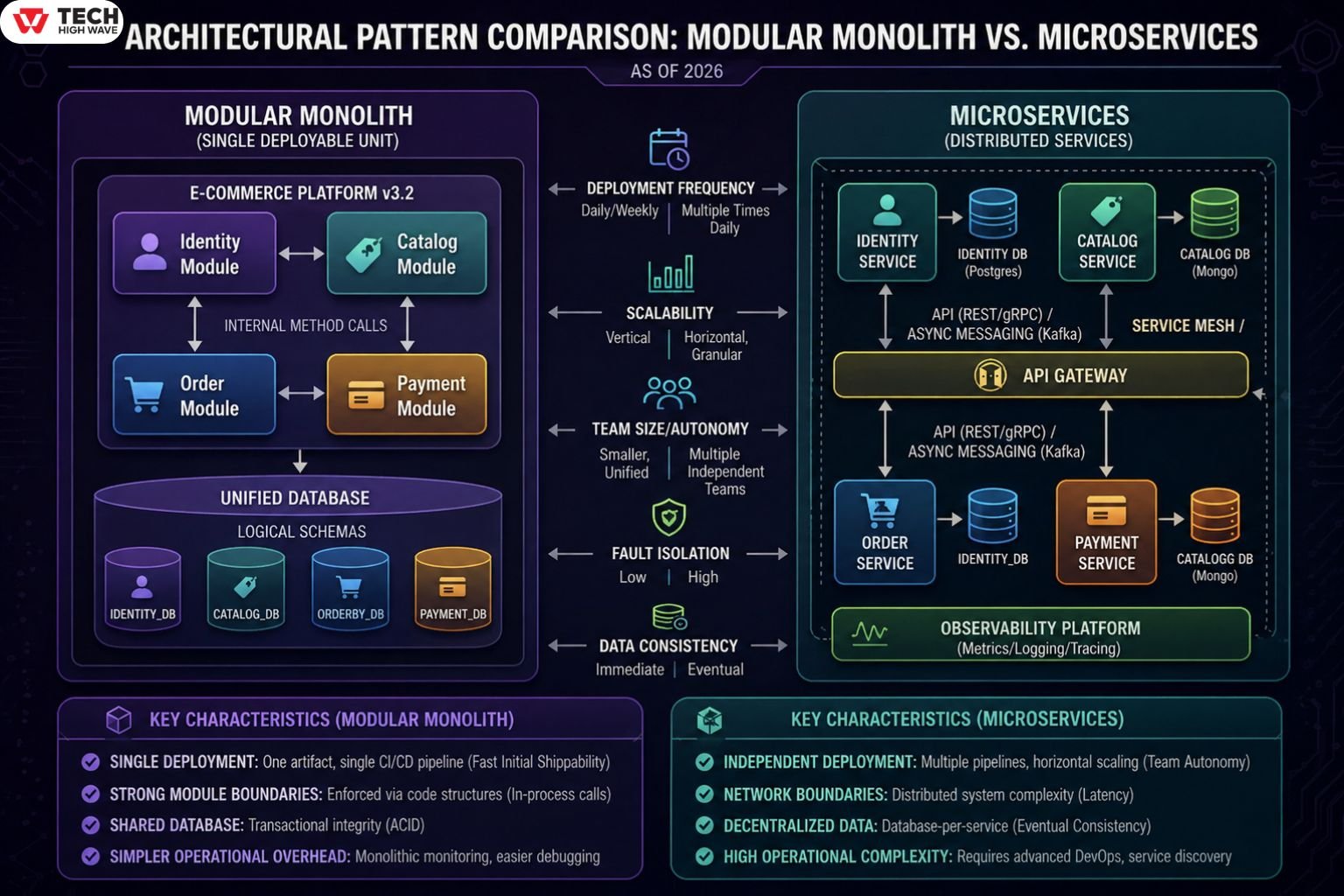
This is where opinionated advice matters more than neutral descriptions. There are three dominant patterns in 2026, and each has a real cost:
Monolithic architecture ships fastest in the first three to six months. At scale (typically 50,000+ concurrent users or six-plus independent teams), it becomes a coordination bottleneck. For MVPs and early-stage products, it’s often the right call — and engineers who push microservices from day one on an unvalidated product are optimizing for the wrong problem.
Microservices offer horizontal scalability and team autonomy but introduce operational complexity that most early-stage companies aren’t equipped to manage. Running twelve services in production requires proper observability tooling, distributed tracing, and a DevOps culture that takes years to build.
Modular monolith is the pattern most serious product teams are gravitating toward in 2026 — a single deployable unit with strong internal module boundaries that can be extracted into services when the business justifies it, not before.
The right choice depends on expected user scale, team size, and operational maturity — not on which pattern sounds most sophisticated.
AI-First Architecture — What’s Actually Changed in 2026
This section didn’t exist in product development guides two years ago. It’s now unavoidable.
“AI-first architecture” doesn’t mean bolting a chatbot onto the product. It means making deliberate decisions about where LLMs, vector databases, and retrieval-augmented generation (RAG) pipelines belong in the system design — and where they don’t.
Practical examples of where AI integration is being embedded into standard product builds:
- Vector databases (Pinecone, Weaviate, Qdrant) for semantic search, recommendation engines, and knowledge retrieval features — replacing traditional keyword search in most content-heavy products
- LLM-powered workflow automation embedded in internal tools and B2B SaaS products, reducing manual data processing steps
- AI-assisted QA using models fine-tuned on the codebase to generate edge-case test scenarios, reducing manual QA time by 30–40% on complex flows
- Agentic features — multi-step, tool-using AI components that handle tasks like document processing, data extraction, or customer onboarding steps autonomously
What hasn’t changed: these features require the same rigorous requirements gathering, edge-case testing, and fallback planning as any other component. LLM outputs are probabilistic. Any system that relies on them in a critical path needs human-in-the-loop checkpoints and graceful degradation when models underperform.
Agile Development — What the Sprint Reviews Don’t Show
Most clients see sprint demos and assume the project is healthy if the demo works. That’s not always true. Three things that don’t show up in demos but determine long-term product health:
Test coverage trends. A product with 20% unit test coverage and no integration tests is accumulating silent risk every sprint. Healthy products track coverage as a first-class metric alongside velocity.
Dependency freshness. Third-party libraries and cloud service dependencies age. A product built on outdated dependencies in month one becomes a security liability by month twelve. Good teams run automated dependency audits on a fixed cadence.
Architecture drift. The system design agreed in phase two tends to erode under sprint pressure. Healthy teams conduct a lightweight Architecture Health Review every four to six sprints — a structured check of whether the codebase still reflects the intended design.
This last item is what some teams now call a “Technical Debt Insurance” clause — a committed, recurring allocation (typically 15–20% of each sprint) specifically for refactoring, dependency management, and architecture alignment. Without it, technical debt isn’t managed; it’s deferred.
QA, Security, and Compliance
Quality assurance in 2026 is no longer just functional testing. Regulatory pressure across fintech (PCI-DSS), healthtech (HIPAA, SOC 2), and enterprise SaaS (ISO/IEC 27001) has made security testing a standard line item, not an optional add-on.
A baseline QA framework for a production-grade product now typically includes:
- Automated unit and integration test suites running in CI/CD pipelines on every commit
- End-to-end test coverage of critical user paths (checkout flows, authentication, data exports)
- Load testing benchmarked against realistic traffic projections — not just “can it handle 100 users”
- OWASP Top 10 vulnerability assessment before every major release
- Penetration testing annually (or before enterprise sales cycles that require it)
Deployment, DevEx, and the Post-Launch Reality
Deployment is infrastructure. DevEx — developer experience — is culture. The best software product development services in 2026 are competing on both.
DevEx refers to how efficiently the internal engineering team (client-side or vendor-side) can understand, extend, and operate the codebase. A product built with clean architecture, thorough documentation, and fast local development environments transfers well. A product with undocumented spaghetti logic and no runbooks doesn’t.
Specific DevEx signals worth asking about before signing an engagement:
- Average time from commit to production (world-class is under 15 minutes for most product types)
- Onboarding time for a new engineer to become productive (under two weeks is reasonable)
- Availability of architecture diagrams and decision records at handoff
Post-launch is not a maintenance contract — it’s the beginning of the real product feedback loop. User analytics, error monitoring (Sentry, Datadog), and feature flagging infrastructure should be in place before launch, not retrofitted after the first incident.
Types of Software Product Development Services
| Service Model | Best For | Typical Timeline | Key Trade-off |
| Full-cycle development | Net-new products | 4–18 months | High upfront cost, full alignment |
| Outsourced product development | Teams without in-house engineers | Ongoing | Requires strong communication process |
| Dedicated development team | Long-term product evolution | Ongoing | Best unit economics at 6+ months |
| MVP development | Startups validating early ideas | 8–16 weeks | Speed over scalability |
| Product modernization | Legacy system overhauls | 3–12 months | Risk of scope expansion |
| AI-augmented development | Products integrating LLM features | Varies | Requires clear fallback design |
On outsourced software product development services and talent geography.
The 2026 picture has shifted noticeably. Eastern Europe remains strong in backend and systems engineering. India continues to lead in volume capacity. The most notable trend is LATAM — particularly Colombia, Mexico, and Argentina — gaining significant ground for teams that need real-time collaboration with US-based stakeholders. Time zone overlap is a concrete productivity factor, not just a sales pitch, and it shows up in sprint velocity data.
Common Mistakes — Including the Ones No One Admits
Most MVPs are too large. A true MVP tests one assumption with the minimum functionality required to generate a real signal. In practice, most “MVPs” are feature-complete v1 products that took eight months to build. If the first launch doesn’t cause some embarrassment about what’s missing, the scope was probably over-engineered.
Treating the tech stack decision as permanent. A stack chosen for a ten-person startup will require reevaluation at 200 employees. The mistake isn’t picking an imperfect stack — it’s building as if the choice is irreversible. Good architecture preserves optionality.
Outsourcing without a product owner on the client side. External teams can’t make business decisions. Without a dedicated, empowered product owner on the client side who can make daily trade-off calls, sprint velocity drops and vendor teams fill the decision vacuum — usually incorrectly.
Underinvesting in monitoring before launch. Launching without error tracking, performance monitoring, and alerting in place means the first sign of a production issue is a user complaint, not a dashboard alert.
Treating cost conversations as uncomfortable. Vague cost estimates protect vendors, not clients. A structured discovery process should produce a cost range with identified risk factors — not a single number or a deflecting “it depends.”
When Not to Hire an External Software Product Development Team
This is worth saying directly, because not every situation calls for an external partner.
Don’t outsource if the core product is the competitive differentiator. If the software is the intellectual moat — the proprietary algorithm, the unique data model, the thing competitors can’t replicate — building it internally preserves that advantage. External teams learn the domain in depth, and that knowledge walks out the door.
Don’t outsource if the team doesn’t have capacity to engage. External product development requires active participation from the client side: product decisions, feedback on demos, access to domain experts. Teams that expect to “hand it off and get a product back” consistently get products that don’t fit their actual needs.
Don’t outsource if the requirement is still undefined. An external team can help with discovery, but if the business model itself is in flux, a long-term development engagement will burn budget while the strategy catches up.
Don’t outsource to cut corners on process. If the goal is to find a team that will skip documentation, avoid testing, and ship fast without guardrails, those shortcuts will materialize as emergency fixes and rewrites within twelve to eighteen months.
Conclusion
Software product development services have evolved well beyond writing clean code and hitting sprint targets. In 2026, the bar is architecture that holds at scale, AI integration that’s thoughtful rather than performative, and post-launch product health that compounds over time rather than decaying.
The right engagement partner thinks in terms of long-term product assets, not short-term deliverable lists. That means rigorous discovery, honest technical trade-offs, built-in processes for managing debt, and the self-awareness to tell a client when they shouldn’t be hiring externally at all.
Before starting any engagement, it’s worth running through a structured Product Readiness Assessment — a short diagnostic covering team capacity, requirements maturity, budget realism, and build-vs-buy trade-offs. It takes twenty minutes and prevents the kind of misalignment that costs twenty months.
Frequently Asked Questions
What are software product development services?
Software product development services are end-to-end engagements covering strategy, design, engineering, testing, and post-launch iteration — treating software as a long-term product asset rather than a one-time delivery.
How long does software product development take?
An MVP typically takes 8–16 weeks. A full-featured SaaS platform ranges from 6–18 months. Timeline accuracy depends heavily on the quality of the discovery phase and how clearly requirements are defined before development begins.
What is the difference between custom and outsourced software product development?
Custom development means building a solution tailored to specific business logic rather than using off-the-shelf software. Outsourced development means delegating that build to an external team — the two approaches are frequently combined.
How much do software product development services cost in 2026?
MVP engagements typically range from $30,000 to $150,000. Mid-complexity SaaS products run $150,000 to $600,000. Enterprise-grade platforms with compliance requirements and AI features can exceed $1M. Geography, team seniority, and scope complexity are the primary cost variables.
What is AI-first architecture in software product development?
AI-first architecture means designing systems that integrate LLMs, vector databases, and AI-powered workflows as native components — not add-ons. It includes retrieval-augmented generation, semantic search, and agentic automation features built with proper fallback handling.
What is technical debt, and how should product development services manage it?
Technical debt is the accumulated cost of shortcuts — undocumented code, outdated dependencies, architectural drift. Responsible development teams allocate 15–20% of each sprint specifically to debt management, preventing the compounding cost of deferred maintenance.
When should a business not use external software product development services?
External teams are a poor fit when the software is a core competitive differentiator that must stay in-house, when internal capacity for active engagement is too low, when requirements are still undefined, or when the goal is to skip process rather than accelerate it.
Visit For More: TechHighwave