Most Snowflake AI agent failures in production do not come from missing features or weak models. They come from overconfidence in partial implementations.
A common pattern in 2026 looks like this: a team builds a Cortex Analyst-powered assistant, connects it to a sales model, defines a few metrics, and tests it successfully in a controlled environment. Then the system goes live. Suddenly, finance numbers drift, “profit” is interpreted inconsistently, and support teams report mismatched answers across different queries.
The issue is rarely the model. It is almost always missing semantic precision, weak instruction design, or a lack of orchestration boundaries.
In 2026, Snowflake has evolved into a fully agentic data platform where AI systems are no longer prompt-based utilities. They are governed execution layers built on Semantic Views, Cortex Analyst, Cortex Search, and Snowflake Intelligence. This guide explains how these systems actually function in production, including the overlooked engineering details that determine whether an agent succeeds or fails.
What an AI Agent in Snowflake Means in 2026
A Snowflake AI agent is not a chatbot layered over a warehouse. It is a governed reasoning and execution system that translates natural language into structured, policy-aware operations across data, documents, and services.
This shift reflects a broader move toward modern AI agent development approaches, where systems are no longer built as simple conversational interfaces but as full execution layers embedded into enterprise infrastructure.
Unlike earlier RAG-based systems, modern Snowflake agents are not free-form generators. They operate within strict semantic boundaries, meaning every response is grounded in explicitly defined business logic, relationships, and security rules.
The key shift is this: the agent does not “interpret” data freely. It navigates a constrained system of meaning defined by the Semantic Layer, then executes reasoning through Cortex Analyst and Cortex Search.
This structural constraint is what makes enterprise reliability possible.
The Real Architecture of Snowflake AI Agents
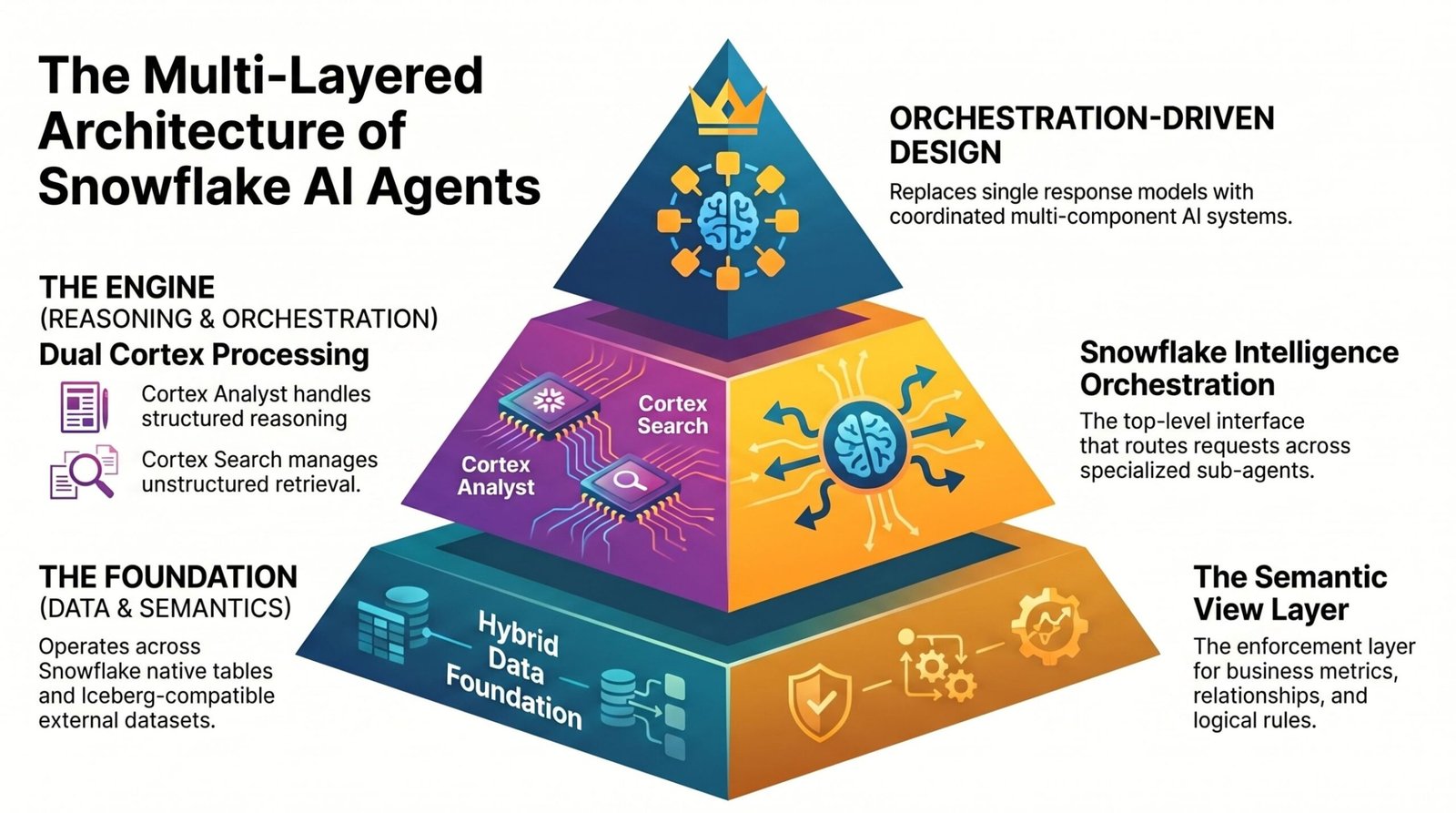
Modern Snowflake AI agents are not single-model systems. They are layered orchestration systems where each component has a strict responsibility.
At the base is the data layer, which now commonly includes Snowflake native tables and Iceberg-compatible external datasets. This enables agents to operate across both internal and open data ecosystems.
Above that sits the Semantic View layer, which defines business meaning. This is not just schema documentation. It is the enforcement layer for metrics, relationships, and logical rules.
Cortex Analyst operates on top of this layer and handles structured reasoning, while Cortex Search manages unstructured retrieval from documents, tickets, and knowledge bases.
At the top sits Snowflake Intelligence, which serves as the interaction and orchestration interface. In advanced deployments, it also routes requests across multiple specialized sub-agents.
This evolution aligns with advances in conversational AI systems, where traditional chatbots are increasingly replaced by orchestration-driven architectures that coordinate multiple AI components instead of relying on a single response model.
Semantic Views: Where Most Production Systems Succeed or Fail
Semantic Views are the foundation of Snowflake AI agent reliability.
In 2026, they will no longer be treated as optional metadata layers. They are governed objects with strict validation rules, RBAC enforcement, and deep integration into Cortex reasoning engines.
What makes them powerful is not just structure, but behavioral control.
A key addition in modern Semantic Views is Custom Instructions, which allow engineers to encode business-specific reasoning logic directly into the semantic layer.
For example, instead of relying on the model to interpret “Profit,” you can explicitly define:
If the user queries “Profit,” always calculate it as Gross Revenue minus Returns unless the user explicitly requests a different definition.
This eliminates ambiguity at the source layer rather than trying to correct it after inference.
Another important capability is synonym mapping, which ensures that different business terms (“income,” “earnings,” “revenue”) map consistently to the same metric definition. Without this, even well-designed agents can drift in interpretation under load.
Cortex Analyst and Structured Reasoning Boundaries
Cortex Analyst is responsible for structured reasoning, particularly SQL generation grounded in Semantic Views. It enforces validation before execution, ensuring outputs remain aligned with governed business logic.
This type of constrained reasoning is increasingly seen in agentic AI in security systems, where autonomous AI agents are used in fraud detection and identity verification pipelines that require strict execution boundaries rather than open-ended reasoning.
The critical design change in 2026 is that Cortex Analyst no longer operates as a generic text-to-SQL engine. It is a constrained reasoning system that enforces semantic correctness before execution.
It reads the Semantic View first, validates whether a metric exists, confirms join paths, and only then generates SQL.
However, a common misconception is that this guarantees perfect accuracy. In reality, even well-designed systems can still fail when semantic naming overlaps or when multiple metrics are too similar in definition. The system does not guess arbitrarily, but it can still select the wrong interpretation if the semantic design is ambiguous.
This is why production systems rely heavily on Semantic View DDL validation, ensuring that all entities, metrics, and relationships are explicitly mapped and unambiguous before deployment.
Cortex Search and Hybrid Context Intelligence
Structured data alone cannot answer enterprise questions.
Most real-world queries require unstructured context—documents, tickets, logs, and operational notes. Cortex Search fills this gap by enabling retrieval-augmented reasoning within the same governed environment.
In practice, this creates a hybrid system:
structured reasoning through Cortex Analyst and contextual grounding through Cortex Search.
Together, they form a dual-layer intelligence model where numerical accuracy and contextual relevance are handled independently but merged at response time.
Multi-Agent Orchestration in Snowflake Intelligence
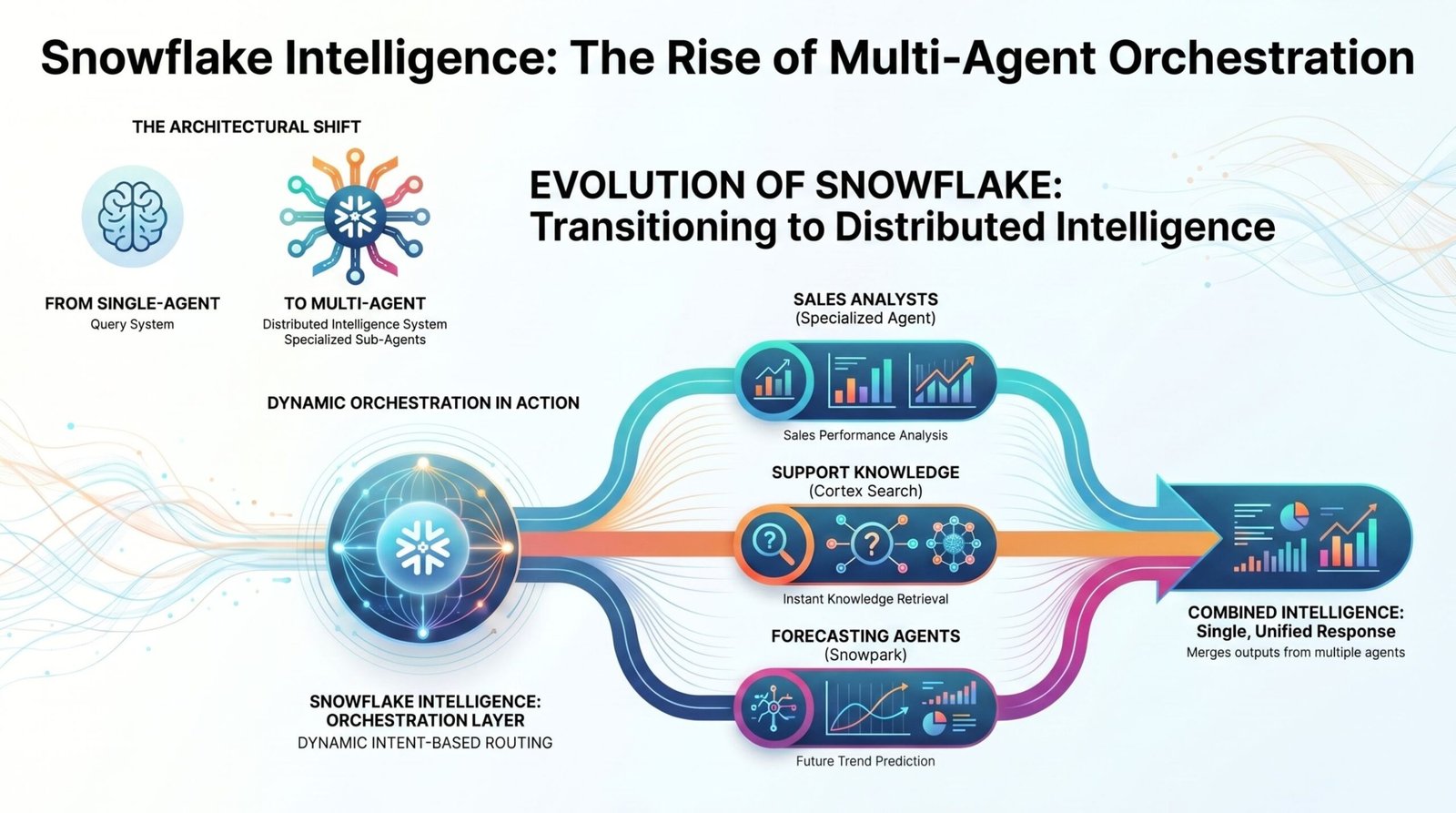
One of the most significant changes in 2026 is the shift from single-agent systems to multi-tool orchestration inside Snowflake Intelligence.
Instead of a single AI agent handling all tasks, modern architectures use specialized sub-agents routed dynamically based on intent.
A typical production setup may include:
- a Sales Analyst agent for financial queries
- a Support Knowledge agent powered by Cortex Search
- a Forecasting agent running via Snowpark Container Services
Snowflake Intelligence acts as the orchestration layer, determining which agent should handle which part of the request and combining outputs when needed.
This is a major architectural shift because it moves Snowflake from “query system” to “distributed intelligence system.”
Execution Layer: Snowpark Container Services and External Actions
Not all tasks are analytical. Some require execution.
This is where Snowpark Container Services (SPCS) becomes critical. It allows AI agents to:
- run Python-based logic
- Execute forecasting models
- call external APIs such as Slack or CRM systems
- perform multi-step workflows
For example, a single request like “analyze sales drop and notify the finance team” may involve:
structured analysis via Cortex Analyst, anomaly detection via Python in SPCS, and an external API call to Slack.
This is where Snowflake agents become operational systems rather than analytical tools.
Updated 2026 Architecture Reference Model
For clarity, modern Snowflake AI agent systems can be summarized as follows:
| Layer | Component | 2026 Production Standard |
|---|---|---|
| Interface | Snowflake Intelligence | Native RBAC-governed UI replacing custom chat apps |
| Logic Brain | Semantic Views | Must include synonyms + custom instructions for accuracy |
| Structured Reasoning | Cortex Analyst | Strictly grounded in semantic DDL, no free-form SQL |
| Unstructured Context | Cortex Search | Hybrid RAG across Iceberg + document sources |
| Execution | SPCS / Python UDFs | Multi-step workflows and external API calls |
Reality Check: Hallucinations Still Exist (Even in 2026)
A common misconception is that modern Snowflake agents eliminate hallucinations. That is not accurate.
What has changed is where failure occurs. Instead of hallucinating SQL logic, modern agents typically fail due to:
- ambiguous semantic naming
- overlapping metric definitions
- insufficient synonym mapping
This is why semantic design quality matters more than model sophistication.
In production systems, correctness is enforced structurally, not assumed probabilistically.
FAQs
Q1. What is an AI bot agent in Snowflake in 2026?
An AI bot agent in Snowflake is a governed system that uses Semantic Views, Cortex Analyst, and Cortex Search to convert natural language into structured SQL queries and contextual insights. It operates within Snowflake’s security and governance framework, ensuring all responses are based on defined business logic rather than free-form model predictions.
Q2. How does Cortex Analyst work in Snowflake AI agents?
Cortex Analyst works by reading Semantic Views before generating any SQL. It maps user questions to predefined metrics, validates relationships between tables, and only then produces structured queries. This ensures that outputs remain consistent with business definitions instead of relying on the model to infer logic independently.
Q3. What is the role of Semantic Views in Snowflake AI agents?
Semantic Views define the meaning of data inside Snowflake AI systems. They specify metrics, relationships, and business rules such as how revenue, profit, or customer value should be calculated. In 2026, they also support synonyms and custom instructions, allowing agents to interpret business language more accurately and consistently.
Q4. Can Snowflake AI agents still produce incorrect results?
Yes, Snowflake AI agents can still produce incorrect results if the Semantic Layer is poorly designed. Errors typically occur when metric definitions overlap, relationships are missing, or synonyms are not properly mapped. While Cortex Analyst prevents SQL hallucination, it still depends entirely on the accuracy and clarity of the Semantic Views.
Q5. What is the difference between Cortex Analyst and Cortex Search?
Cortex Analyst handles structured data by converting natural language into SQL using Semantic Views. Cortex Search, on the other hand, retrieves unstructured data such as documents, logs, and knowledge bases. Together, they form a hybrid intelligence system that allows Snowflake AI agents to answer both analytical and contextual questions.
Conclusion
Building an AI bot agent in Snowflake in 2026 is not an exercise in prompt engineering. It is an exercise in systems design.
The real differentiator is not the model, but the architecture beneath it—Semantic Views that define meaning, Cortex Analyst that enforces structured reasoning, Cortex Search that provides context, and Snowflake Intelligence that orchestrates everything into a unified interface.
When these layers are properly designed, the system becomes more than an AI agent. It becomes a governed intelligence layer embedded directly into the enterprise data infrastructure.
The difference between a working demo and a production system is not complexity. It is precision in how meaning is defined, enforced, and executed.
For More Visit: TechHighWave