Let’s start with something most industry pieces won’t tell you upfront: most of the vendors claiming “agentic AI expertise” in 2026 are selling you rebranded workflow automation with a coat of GPT paint. The actual market for serious, production-grade AI agents is smaller than the marketing noise suggests — and picking the wrong partner can cost you six months and six figures with nothing to show for it.
So this guide skips the hype. It’s a practical breakdown of what to look for, who the credible players actually are, and how to avoid getting burned.
What an AI Agent Development Company Actually Does
A real AI agent doesn’t just respond to inputs — it reasons about them. It can read context, pull data from multiple systems, make a judgment call, act on it, and then learn from what happened.
That’s a fundamentally different thing from a chatbot. Understanding the difference matters more than most buyers realize — because the two categories involve completely different architecture, development timelines, and vendor skillsets.
Here’s a concrete example. A keyword-matching support bot sees “refund” and returns a canned script. An AI agent reads the full message, checks the customer’s order history in your CRM, reviews your refund policy, decides whether the case qualifies, and either processes it or escalates it with a summary already written. That’s not automation — that’s autonomous decision-making.
The companies building these systems handle the complete stack: architecture design, model selection, integration with your existing tools, testing under real conditions, and long-term maintenance. The demo isn’t the product. The deployed system is.
AI Agent Market Growth and Industry Trends (2026)
According to Grand View Research, the global AI agents market was valued at $7.63 billion in 2025 and is projected to reach $182.97 billion by 2033 — a near-50% compound annual growth rate. Gartner’s enterprise forecast is equally striking: fewer than 5% of enterprise applications had task-specific AI agents built in during 2025; that figure is expected to hit 40% by end of 2026.
That pace creates a specific problem. The number of vendors claiming AI agent expertise is growing much faster than the number actually shipping production-grade systems. The result is a market full of convincing pitches backed by thin experience.
Top AI Agent Development Companies in 2026
A curated list of leading AI agent development companies helping enterprises build autonomous, production-grade AI systems in 2026.
LeewayHertz
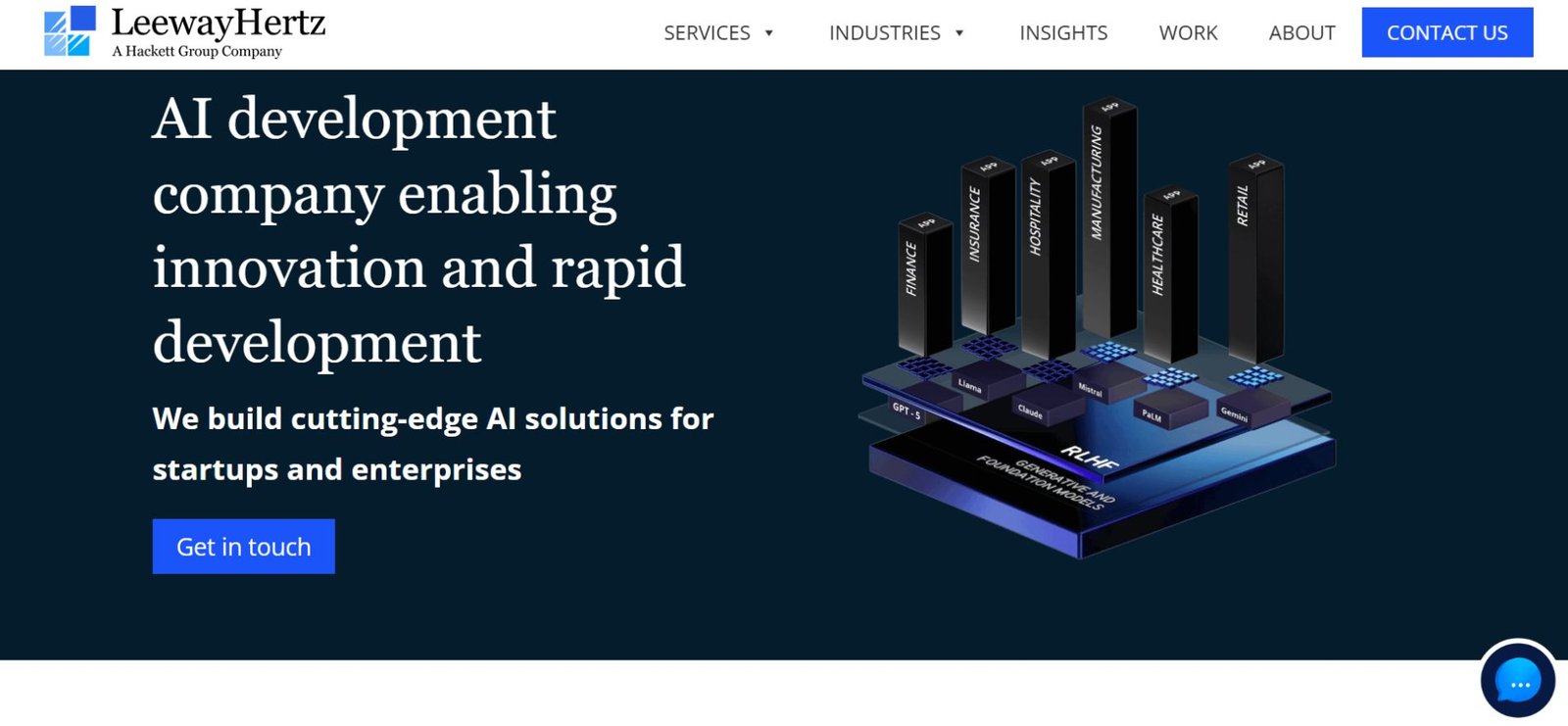
LeewayHertz was founded in 2007 and acquired by The Hackett Group in late 2024, LeewayHertz brings both engineering depth and institutional credibility. Their proprietary ZBrain platform lets regulated industries — finance, healthcare, defense adjacents — keep all agent infrastructure within their own environment. They’ve done documented work for Coca-Cola, P&G, and Siemens. Gartner and Forbes have both recognized them publicly.
LeewayHertz Best for: Enterprises with $100K+ projects, heavy compliance requirements (SOC 2, HIPAA, GDPR), and no appetite for shortcuts. The catch: They’re not fast and they’re not cheap. Startups should look elsewhere.
Neurons Lab
Based in the UK and Singapore, Neurons Lab is one of those rare AWS Advanced Tier Partners with dual competencies in both Generative AI and Financial Services. That combination isn’t accidental — it reflects genuine specialization in building agents for complex, regulated environments. Their ARKEN platform is built specifically for wealth management workflows. Clients include HSBC and Visa.
Neurons Lab Best for: Banks, insurers, and wealth managers who need compliance baked in from the start, not bolted on later. The catch: Premium pricing and timelines to match.
Itransition
Around since 1998, Itransition specializes in something nobody glamorizes but everyone needs: connecting modern AI to the sprawling, legacy-laden backend systems most large enterprises actually run. If your project needs to read from SAP, write to Oracle, and trigger a ServiceNow workflow, they’ve almost certainly done it before. Their recent Microsoft Azure AI Platform specialization is worth noting.
Itransition Best for: Large companies integrating agents into existing ERP and CRM systems where governance and data integrity are non-negotiable. The catch: Their process-heavy approach can feel slow for smaller or more agile projects.
Master of Code Global
In business since 2004 — well before conversational AI was a mainstream concept — Master of Code has delivered over a thousand projects for clients including T-Mobile and Burberry. Their focus is customer-facing agents where the quality of the conversation directly determines whether the product works. Their LOFT framework is designed to lower initial costs and accelerate time-to-launch.
Master of Code Global Best for: Retail, e-commerce, and telecom companies where a natural, capable customer interaction is the whole point. The catch: Internal automation is not their sweet spot.
Moveworks
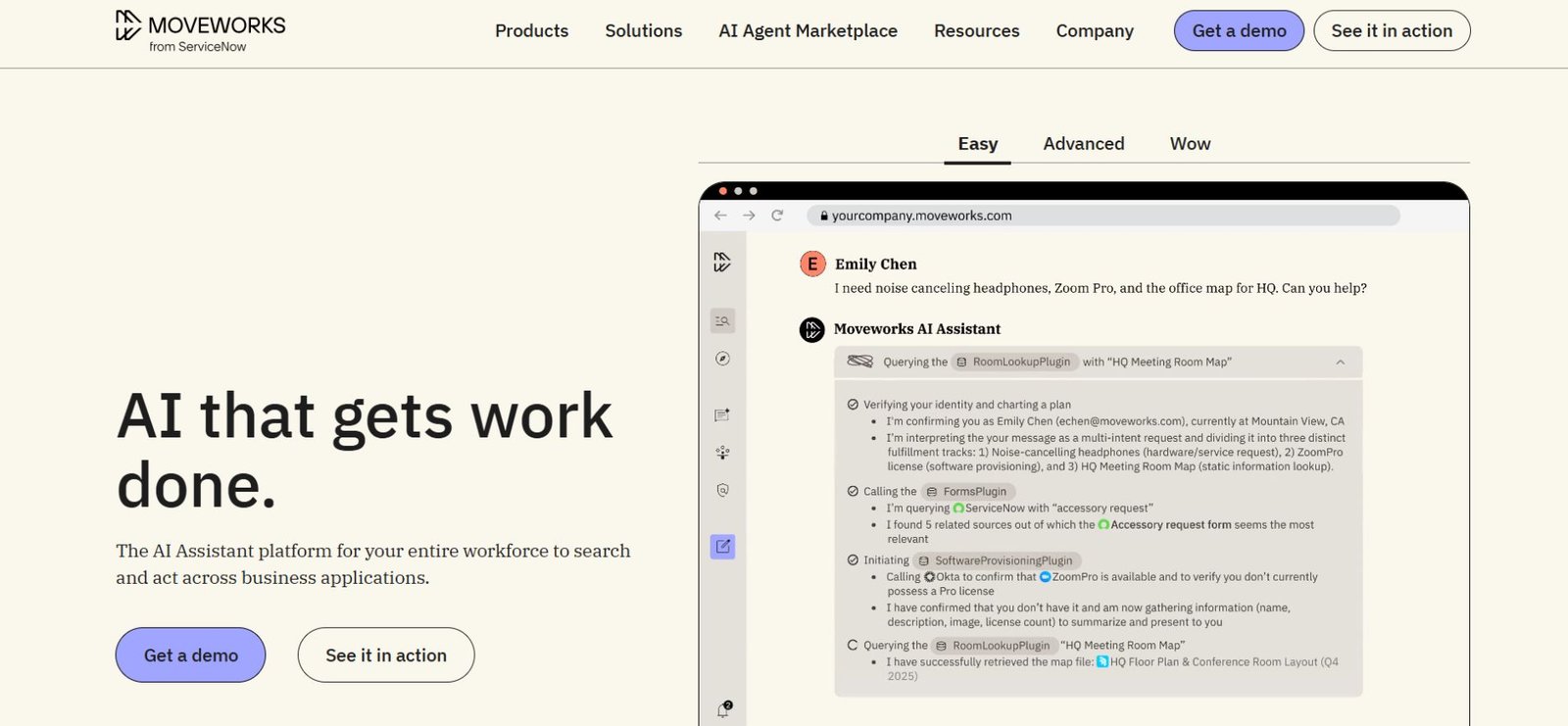
Moveworks is a product company, not a services firm. They offer pre-built autonomous agents for IT, HR, and finance support — plugging into ServiceNow, Slack, and Microsoft Teams to resolve employee requests without human involvement. Their FedRAMP authorization makes them particularly relevant for government contractors.
Moveworks Best for: Large enterprises wanting a ready-made solution for internal support volume. The catch: If your use case is unique, a pre-built product will force your workflows into its mold, not the other way around.
DevCom
US-fronted with delivery out of Ukraine, DevCom offers a practical model for the mid-market: onshore accountability with more competitive economics. Their tech stack spans LangChain, CrewAI, Google Vertex AI, and more. Unusually, their process starts with an AI readiness audit — which is a good sign that they’re not just selling you a solution before understanding your problem.
DevCom Best for: Mid-market companies that need genuinely custom work without paying enterprise-tier overhead. The catch: Smaller team means capacity limits; Fortune 500-scale compliance projects are a stretch.
SoluLab
A US-based full-cycle development firm covering healthcare, finance, and logistics. SoluLab is a solid option for growth-stage companies that need domain-specific agent logic but can’t justify the cost of a LeewayHertz engagement.
SoluLab Best for: Startups and growth-stage companies that need a capable end-to-end partner without the enterprise price point.
Intuz
Seventeen years in the business, projects across 40+ countries. Intuz covers healthcare, e-commerce, legal, and logistics — which gives them practical exposure to the integration edge cases and organizational dynamics that derail AI projects. Their experience with cross-industry variety is genuinely useful when your use case doesn’t fit neatly into one vertical.
Intuz Best for: Companies that value breadth of experience and flexibility across scales.
AI Agents vs Chatbots: Key Differences
This confusion keeps coming up, and it costs buyers real money. If you’re hiring for an AI agent and a vendor is actually delivering a sophisticated chatbot, you’ll know — but only after the project is done.
| Traditional Chatbots | AI Agents | |
| Logic | Keyword/script-based | Context-aware, goal-oriented |
| Decisions | Follows a predefined script | Evaluates options and acts |
| Learning | Manual updates required | Improves from interactions |
| Integration | Single-channel, basic | Orchestrates across systems |
| Best for | FAQs | Complex autonomous tasks |
| When it fails | Loops on the same response, hits a dead end, or drops the conversation entirely | Retries with a different approach, routes to a human with a full summary already written, or switches to an alternative tool to complete the task |
That last row is the one that actually matters in production. Failure handling separates real agent behavior from a well-dressed chatbot. How specific platforms handle failure modes is worth examining closely before you commit to any vendor’s architecture.
Three Questions That Separate Real Vendors from Good Pitchers
Most sales calls feel the same: slick slides, big client logos, vague references to “our proprietary framework.” Here are three questions that cut through that quickly.
- “Can you show me the decision logs for a failed task in one of your production systems?” Every agent fails sometimes. What separates mature deployments from fragile ones is how well those failures are captured and explained. If a vendor can’t pull up a log showing what the agent attempted, why it failed, and what happened next — they’re either not logging properly or haven’t dealt with real-world edge cases. Either way, that’s a red flag.
- “Walk me through a case where your agent’s behavior changed after it went live — and how you caught it.” Agents drift. Models get updated, data distributions shift, and what worked in month one starts producing slightly different outputs by month four. A vendor with genuine production experience will have a story about this. One who doesn’t has probably never run a system long enough to see it happen.
- “What’s your process when the agent takes a wrong action that affects a real customer or system?” This question reveals their incident response maturity. You want to hear specifics: alert thresholds, rollback procedures, human override protocols, and how they communicate the issue. Vague answers about “monitoring dashboards” aren’t enough.
How to Choose the Best AI Agent Development Company
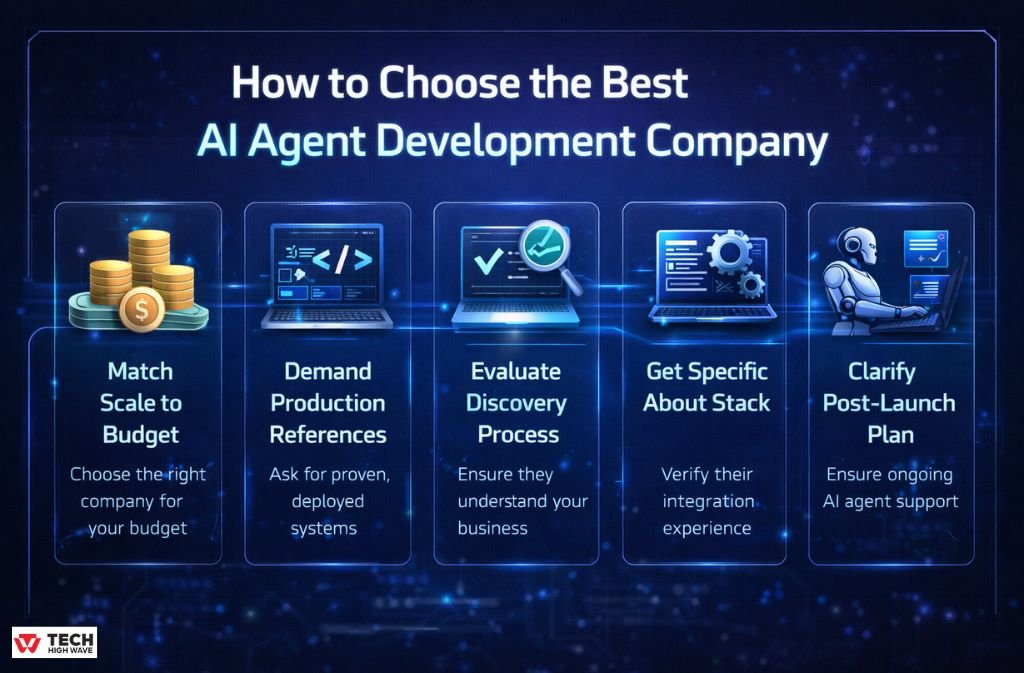
- Match scale to budget. Enterprise firms like LeewayHertz are designed for six-figure engagements. A $50K budget will go much further with DevCom or SoluLab.
- Demand production references, not slides. Ask specifically: What did you build? Who for? What systems does it connect to? What did it measurably do after six months of live operation? If they’re showing you proofs-of-concept, they may be learning on your project.
- Watch how they run discovery. If a vendor jumps to a recommended solution before spending meaningful time understanding your business, they’re selling something off the shelf. Legitimate partners ask uncomfortable questions before they pitch anything.
- Get specific about your stack. Name your actual systems. “Have you integrated with our legacy AS/400?” Vague answers indicate they haven’t, and they’re hoping it won’t come up until the contract is signed.
- Clarify the post-launch relationship. AI agents degrade without maintenance. Models drift, integrations break, edge cases multiply. If their proposal doesn’t address ongoing support, it’s not a complete proposal.
Where Agents Are Actually Delivering Results
- Financial services: Fraud detection, underwriting support, compliance monitoring — areas where speed and accuracy both matter at scale.
- Healthcare: Clinical documentation, scheduling, and insurance authorization are being automated at meaningful rates, reducing administrative burden on clinical staff.
- E-commerce and retail: Product catalog management, personalization, and post-purchase support. Master of Code Global has cited a 15x revenue lift from intelligent recommendations in some retail deployments.
- Logistics: Route optimization, demand forecasting, and supplier coordination in real time.
- Software development: Autonomous coding agents that can write, test, and iterate are now common in development environments. Research from late 2025 showed the large majority of developers already using these tools daily.
AI Agent Development Cost Breakdown (2026)
Enterprise tier (LeewayHertz, Itransition): Project minimums typically start at $100K, often considerably higher when compliance requirements and complex integrations are factored in.
Mid-market and startup tier (DevCom, SoluLab): Projects typically fall between $30K and $150K. A simple, low-code agent might get built for $5K–$10K. A custom agent with meaningful integrations is unlikely to come in under $30K–$40K.
The line item almost nobody mentions upfront: inference costs.
In 2026, running an AI agent isn’t a one-time purchase — it’s an ongoing operational expense. Every time your agent processes a request, it’s making API calls that consume tokens, which cost money. A customer-facing agent handling 50,000 interactions a month will generate meaningful monthly compute bills on top of whatever you paid to build it. The exact amount depends on the model being used, how many steps each task requires, and how much context gets passed with each call — but it’s not uncommon for inference costs to run $2,000–$15,000 per month for medium-scale deployments.
Ask every vendor, explicitly: Who pays for inference, how is it metered, and what does a high-traffic month actually cost us? If that conversation hasn’t happened before you sign, you’re going to have it after your first billing cycle — and it won’t be a pleasant one.
One honest warning: whatever the initial quote says, your actual costs will likely run 30% higher once you account for data preparation, integration complexity, post-launch tuning, and ongoing inference. If a vendor’s proposal doesn’t mention any of these items, they’re leaving things out.
AI Agent Trends in 2026
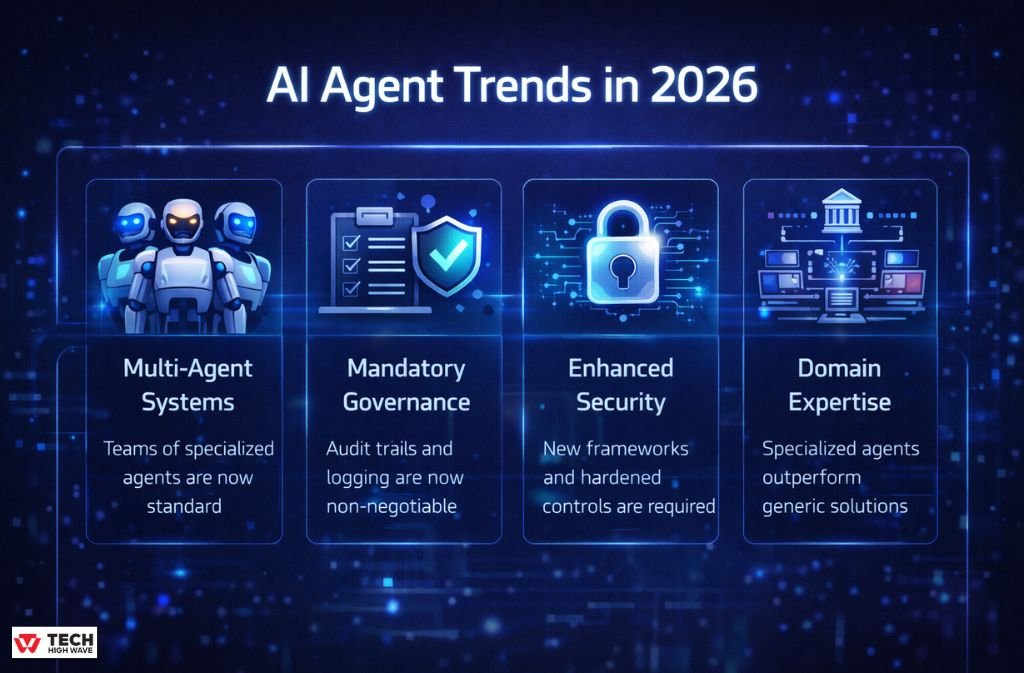
Multi-agent systems have become the default. Rather than one large, monolithic agent trying to do everything, serious deployments now use teams of specialized agents that hand off tasks to each other. It’s more reliable, easier to debug, and simpler to maintain.
Governance went from optional to mandatory. Gartner has warned that 40%+ of agentic AI projects could be cancelled by 2027 without clear governance frameworks. Audit trails, access controls, and decision logging are now table stakes — not features to negotiate out of the contract.
Security expectations are rising fast. An agent that can move money or modify records is a significant security surface. In January 2026, NIST began work on a dedicated security framework for AI agents specifically — a signal that the industry is treating this as a first-class concern rather than an afterthought. The NIST AI Risk Management Framework is the current reference document while that work continues.
Domain expertise now outperforms general capability. A generic agent built on strong models will lose to one built with deep understanding of your industry’s specific terminology, workflows, and compliance rules. Vendors who specialize in a vertical are increasingly outperforming generalists, even when the underlying technology is similar.
FAQs
Q. What does an AI agent development company do?
An AI agent development company builds autonomous software systems that can make decisions and execute multi-step tasks with minimal human input. Unlike basic chatbots, these systems handle workflows, integrate with business tools, and improve over time. Services typically include architecture design, model selection, system integration, testing, and ongoing support.
Q. How do I choose the right AI agent development company?
To choose the right AI agent development company, match the vendor’s experience and scale to your project size. Ask for real production examples instead of demos or portfolio slides. Enterprise firms are better for complex, large-scale systems, while mid-market companies offer flexibility for focused and cost-efficient solutions.
Q. How long does it take to build an AI agent?
The development timeline for an AI agent depends on complexity. Simple agents with minimal integrations usually take 6 to 10 weeks, while advanced systems involving multiple tools, data sources, and compliance requirements can take 3 to 6 months or longer.
Q. What are the common risks in AI agent development?
Common risks include unreliable outputs in edge cases, integration failures, poor data quality, and performance degradation over time. These risks can be reduced through proper testing, strong data governance, continuous monitoring, and ongoing support after deployment.
Q. What are the ongoing costs of running an AI agent?
Running an AI agent involves ongoing operational costs, mainly inference costs (API usage and compute). These costs depend on usage volume, model complexity, and task frequency. Businesses should request a detailed cost estimate based on expected usage before starting the project.
Final Words
The companies getting real value from AI agents in 2026 aren’t necessarily the ones with the biggest budgets. They’re the ones who matched the right partner to their actual situation, built systems that fit their existing infrastructure, asked the uncomfortable questions early, and treated deployment as the beginning of the project rather than the end.
For More Visit: TechHighWave
| Disclaimer: This guide is based on independent research and is not sponsored or affiliated with any company listed. No payments or incentives were received. Always evaluate vendors based on your own needs before making a final decision. |