Teijin Automotive Technologies at a Glance
|
The automotive industry is under pressure to become lighter, safer, and more efficient—without compromising cost or scalability. That’s where Teijin Automotive Technologies comes in.
If you’re researching automotive suppliers, composite materials, or EV engineering strategies, you’re likely trying to answer a practical question: Does this company actually matter in real-world vehicle production?
This guide answers that directly. You’ll understand what Teijin Automotive Technologies does, how its manufacturing processes work, where it delivers real value—and where it doesn’t.
What Is Teijin Automotive Technologies?
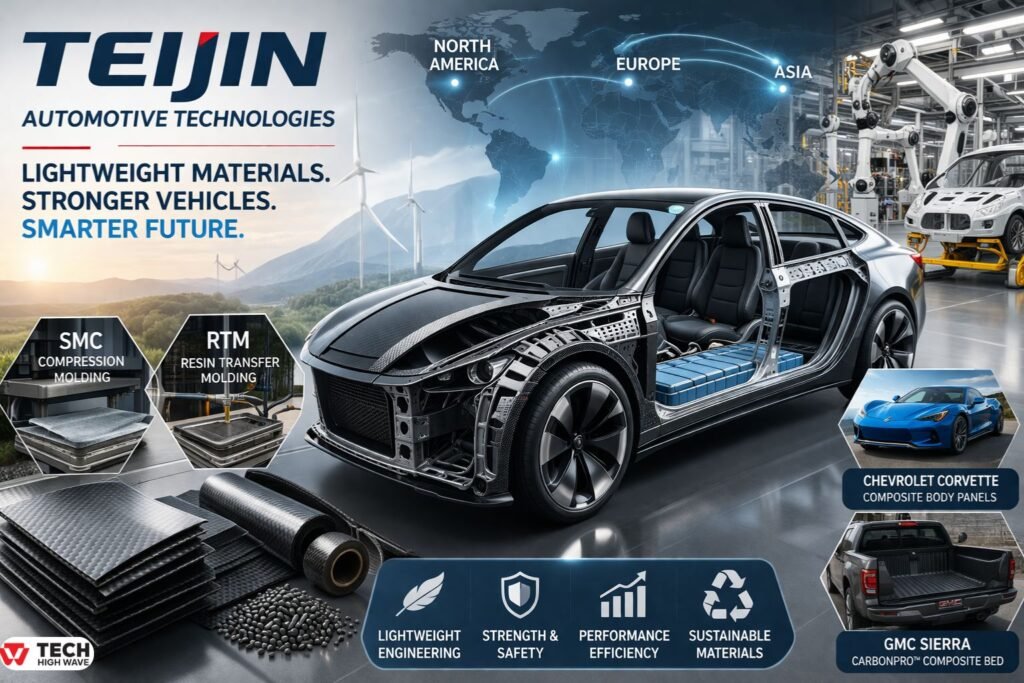
Teijin Automotive Technologies is a global manufacturer focused on advanced composite materials and lightweight vehicle components.
It helps automakers replace traditional steel or aluminum parts with carbon fiber and glass fiber composites, improving:
- Fuel efficiency and EV range
- Structural strength and safety
- Design flexibility
The company evolved from Continental Structural Plastics (CSP), which Teijin acquired and integrated into its global operations.
Who Owns Teijin Automotive Technologies?
Teijin Automotive Technologies is owned by the Teijin Group, a multinational corporation headquartered in Japan.
The parent company operates across:
- Advanced materials
- Healthcare
- IT solutions
Why this matters:
Teijin Automotive Technologies isn’t a standalone supplier—it’s backed by deep R&D and material science expertise, which directly impacts innovation speed and manufacturing capabilities.
Teijin Automotive Technologies Locations & Global Presence
This Technologies operates across key automotive regions:
- United States (Ohio, Michigan, North Carolina)
- Europe (Germany, France)
- Asia (Japan, China)
Notable U.S. footprint includes manufacturing hubs in Ohio, including North Baltimore.
Why this matters:
Proximity to OEM production lines reduces logistics complexity and improves collaboration speed—critical in large-scale automotive programs.
How Teijin Automotive Technologies Works
Understanding Teijin requires looking at how it integrates into the full vehicle development cycle.
-
Material Development
Teijin develops composite materials like CFRP (carbon fiber-reinforced plastic) and GFRP (glass fiber composites).
These materials are engineered for:
- High strength-to-weight ratio
- Durability under stress
- Design flexibility
Advanced Composite Processes: SMC & RTM in Practice
Teijin’s competitive edge lies in scalable composite manufacturing:
SMC (Sheet Molding Compound)
- Best for: High-volume exterior panels
- Process: Compression molding of fiber-resin sheets
RTM (Resin Transfer Molding)
- Best for: Structural components
- Process: Resin injection into fiber molds
These are often combined with multi-material integration, mixing composites with metals or thermoplastics.
Real insight:
In actual vehicle programs, engineers rarely replace metal entirely. They selectively use composites where weight savings justify the cost.
SMC vs RTM vs Traditional Materials (Quick Comparison)
| Material / Process | Best Use Case | Speed | Cost | Strength |
| SMC | High-volume panels | Fast | Medium | High |
| RTM | Structural components | Medium | High | Very High |
| Steel | Mass production | Very Fast | Low | Medium |
| Aluminum | Lightweight metal parts | Fast | Medium | Medium |
-
Component Design
Teijin works directly with OEMs to design full components like:
- Battery enclosures
- Floor structures
- Reinforcement systems
-
Manufacturing & Molding
Using compression molding and RTM, Teijin produces parts at scale with:
- Reduced waste
- Consistent quality
- Faster cycles than traditional composites
-
Integration into Vehicles
Composite parts often replace multiple metal components with a single integrated structure.
Result:
- Fewer assembly steps
- Lower total weight
- Improved durability
Manufacturing Process: How Composite Parts Are Made
Composite manufacturing is easier to understand visually. Watching the process highlights how fiber structure and resin curing differ from traditional metal stamping.
Engineering Capabilities & Support Systems
Simulation & Engineering Tools
Teijin supports:
- Crash simulations
- Load modeling
- Weight optimization
Why it matters:
Reduces costly trial-and-error during development.
Documentation & Compliance
Includes:
- Material traceability
- Certification records
- Testing documentation
Collaboration with OEMs
Teijin acts as a co-development partner rather than just a supplier.
Data Security
Ensures protection of proprietary engineering data and IP
Best Uses for Teijin Automotive Technologies
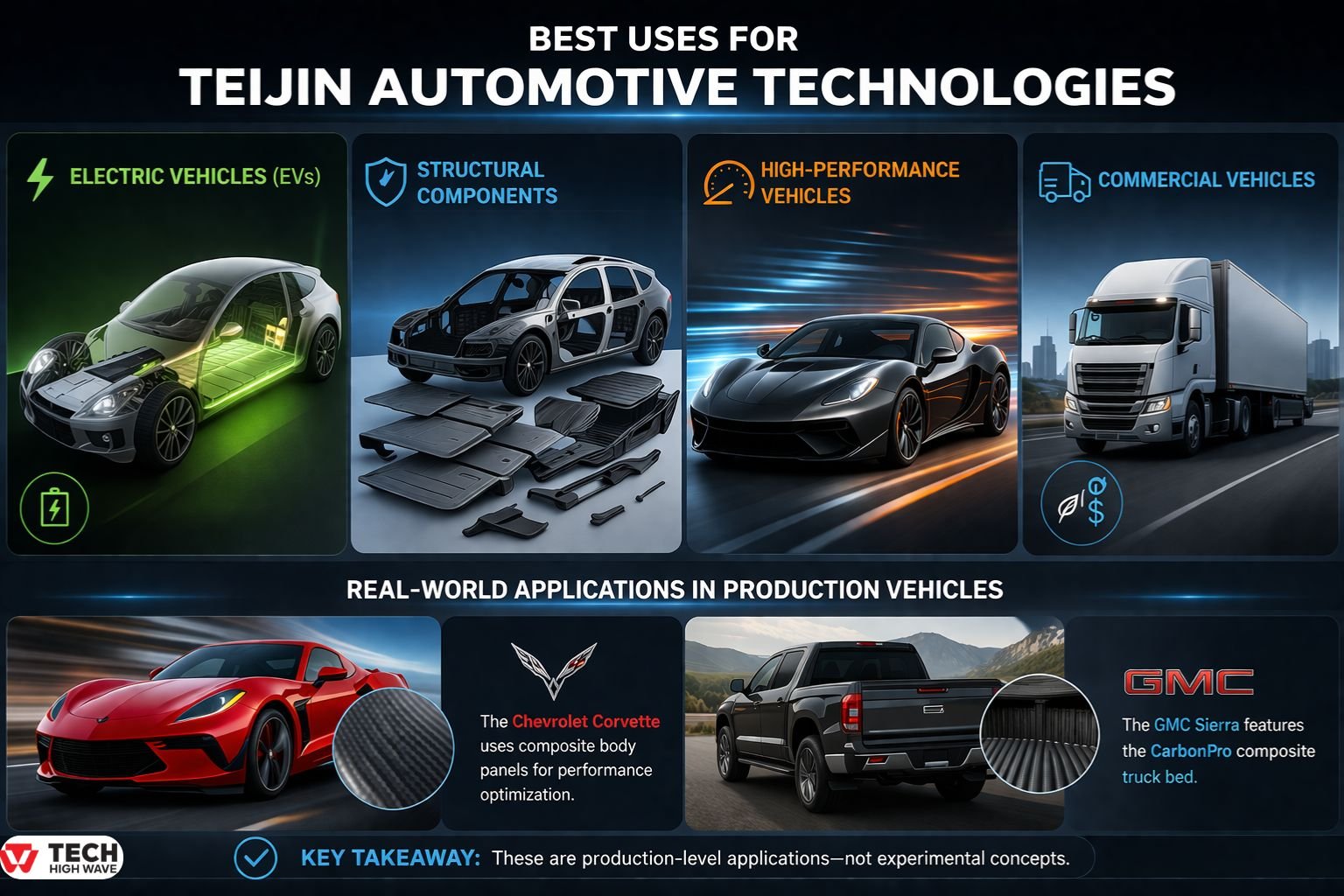
Electric Vehicles (EVs)
Battery weight is a major constraint—composites help offset it.
Structural Components
Used in:
- Floor systems
- Reinforcement structures
- Crash components
High-Performance Vehicles
Composites improve:
- Acceleration
- Handling
- Structural rigidity
Commercial Vehicles
Weight reduction directly impacts fuel efficiency and operating costs.
Real-World Applications in Production Vehicles
- The Chevrolet Corvette uses composite body panels for performance optimization
- The GMC Sierra features the CarbonPro composite truck bed
Key takeaway:
These are production-level applications—not experimental concepts.
Who Should Use Teijin Automotive Technologies?
Ideal Users
- Automotive OEMs
- EV manufacturers
- Tier 1 suppliers
- Engineering teams building new platforms
Not Ideal For
- Low-cost production environments
- Small manufacturers without composite capability
- Applications where steel already meets requirements
Key Specialties of Teijin Automotive Technologies
Lightweight Engineering
Focuses on vehicle-level optimization—not just parts.
Integrated Manufacturing
Combines materials, design, and production.
Global Production Network
Supports large-scale automotive programs.
Multi-Material Integration as a Competitive Advantage
Modern vehicles rely on multi-material architectures.
Teijin enables:
- Composite + aluminum hybrids
- Strategic material placement
- Reinforced thermoplastics
Insight:
The real advantage isn’t replacing metal—it’s using the right material in the right place.
Trade-Offs to Consider
- Higher upfront cost
- Specialized tooling required
- More complex repairs
How to Evaluate Teijin for Your Project (Checklist)
- Is weight reduction critical to performance or efficiency?
- Are you working on EV or next-gen platforms?
- Do you have access to composite manufacturing infrastructure?
- Can your budget support higher upfront material costs?
If most answers are “yes,” Teijin is a strong fit.
Common Mistakes to Avoid
Assuming Composites Replace Everything
They don’t—strategic use is key.
Ignoring Manufacturing Constraints
Composite production requires planning and tooling changes.
Underestimating Redesign Needs
Material changes often require full engineering redesign.
Overlooking Integration
Supplier alignment is critical for success.
Related: Automotive Technology: 2026 Guide to Careers, Salaries, Degrees & Modern Vehicle Systems
Future Trends in Teijin Automotive Technologies (2026 Outlook)
AI-Driven Material Optimization
AI reduces development cycles and improves performance prediction.
Automation in Manufacturing
Improves consistency and scalability.
EV-Centric Design
Lightweight materials are becoming essential—not optional.
Sustainability & Recycling
Focus on recyclable composites and closed-loop systems.
Teijin Automotive Technologies Jobs & Careers
Teijin offers roles in:
- Engineering
- Manufacturing
- Materials science
Where opportunities exist:
- Ohio and North American plants
- European automotive hubs
- Asian R&D centers
Insight:
Demand is strongest in EV-related and advanced materials roles.
FAQs
Q1: Who owns Teijin Automotive Technologies?
This Technologies is owned by the Teijin Group, a Japanese multinational focused on advanced materials and technology solutions.
Q2: What does Teijin Automotive Technologies do?
It develops lightweight composite materials and automotive components that improve efficiency, safety, and performance.
Q3: Where are Teijin Automotive Technologies locations?
It operates globally, with major facilities in the U.S., Europe, and Asia, including manufacturing sites in Ohio.
Q4: Is Teijin Automotive Technologies the same as CSP?
Yes. It originated from Continental Structural Plastics, which was acquired and rebranded by Teijin.
Q5: What is SMC in automotive manufacturing?
SMC is a composite material used for high-volume parts, offering strength, consistency, and fast production cycles.
Q6: What is multi-material integration?
It’s the strategic use of different materials—like composites and metals—to optimize performance and cost.
Q7: Are there jobs at Teijin Automotive Technologies?
Yes. The company regularly hires engineers and manufacturing professionals across global locations.
Final Takeaway
Teijin Automotive Technologies represents a shift from traditional metal-based manufacturing to intelligent material engineering.
But the real story isn’t just lighter parts—it’s smarter design decisions.
In modern automotive development, the question isn’t whether to use composites.
It’s where they create the most value.
For More Visit: TechHighWave