TL;DR
New designs reduce optical layers, lowering cost, heat, and material usage |
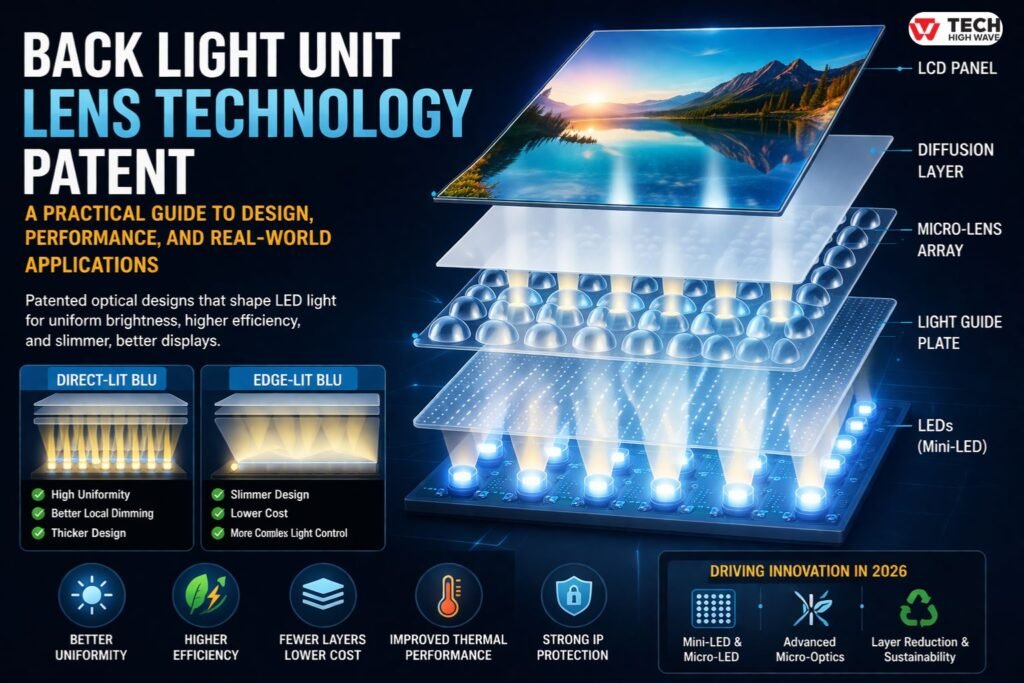
Display quality often comes down to something hidden behind the screen: how light is shaped and controlled. Uneven brightness, visible hotspots, or excessive thickness usually point to limitations in the backlight system. That’s where the back light unit lens technology patent becomes important.
Interest in this topic typically comes from engineers, product designers, and patent researchers trying to understand how modern displays balance brightness, efficiency, and slim form factors. It also plays a role in manufacturing decisions, especially as Mini-LED systems become more common.
What follows is a clear breakdown of how these patented technologies work, where they are used, and what actually matters when evaluating them in real-world scenarios.
What Is Back Light Unit Lens Technology Patent?
A back light unit lens technology patent protects specific methods or designs used to control how light spreads inside a backlight unit (BLU), most commonly in LCD displays.
Quick definition:
It is a patented optical design that reshapes LED light to produce uniform brightness across a display while minimizing energy loss.
At a functional level, it focuses on:
- Directing light from LEDs into controlled patterns
- Improving brightness uniformity across the panel
- Increasing light extraction efficiency
Instead of allowing light to scatter randomly, engineered lenses guide it with precision. These can include micro-lens arrays, freeform optics, or hybrid lens-diffuser structures.
Most patents in this space protect:
- Lens shape and curvature (beam angle control)
- Refractive structures for light redirection
- Integration with diffusion layers or light guide plates
- Methods to reduce optical layers
The result is a system that delivers more consistent brightness with less wasted energy—and often with fewer components.
How Back Light Unit Lens Technology Works
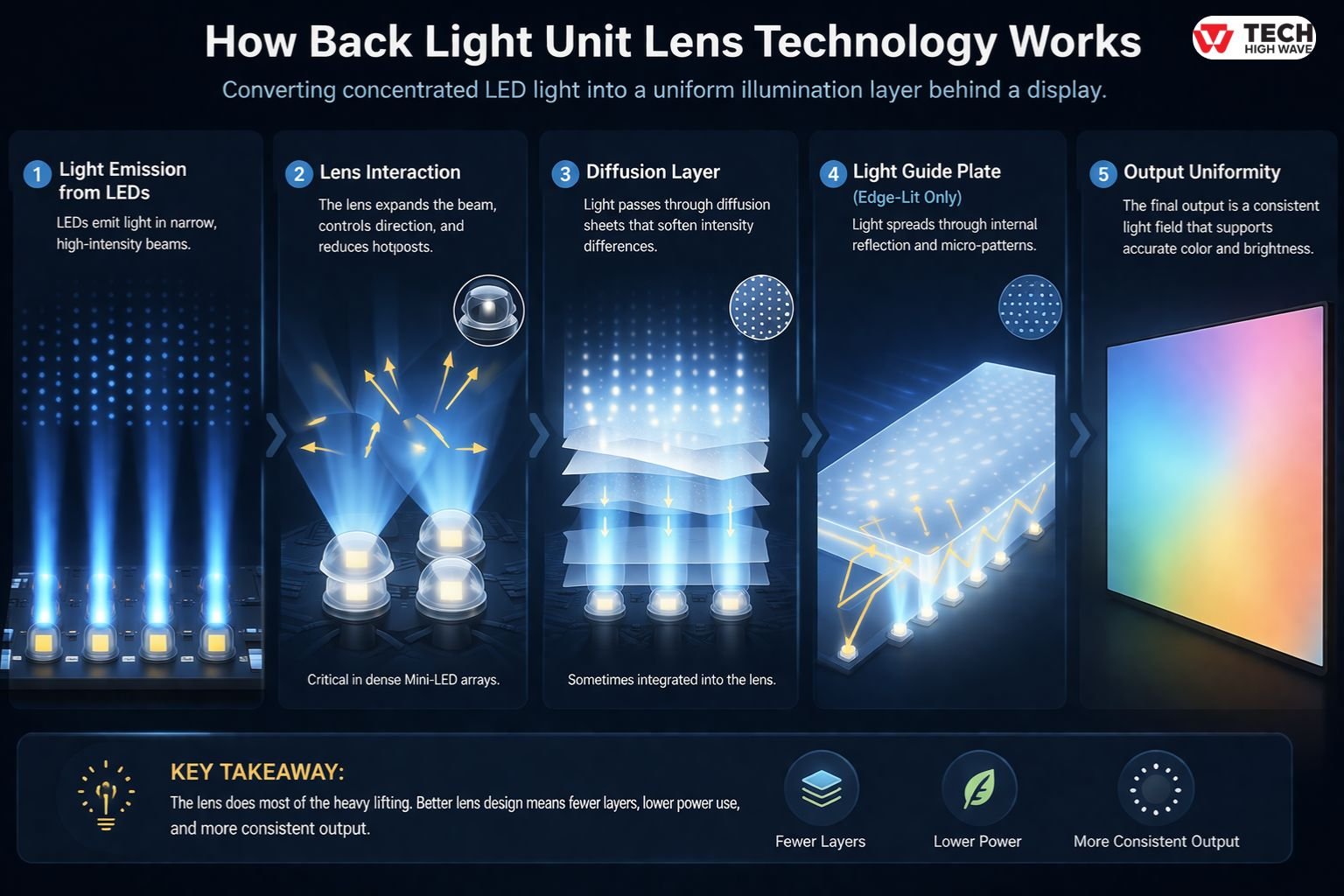
A backlight unit converts concentrated LED light into a uniform illumination layer behind a display.
Step-by-step overview:
- Light Emission from LEDs
LEDs emit light in narrow, high-intensity beams. On their own, they create bright نقاط and dark gaps. - Lens Interaction
A lens sits over each LED, reshaping the beam:
- Expands the beam angle
- Controls direction
- Reduces hotspots
In dense Mini-LED arrays, this step becomes critical. Even small lens inefficiencies can create visible brightness variation across the panel.
- Diffusion Layer
Light passes through diffusion sheets that soften intensity differences. In newer designs, this function is sometimes integrated directly into the lens. - Light Guide Plate (Edge-Lit Only)
In edge-lit systems, light enters a guide plate and spreads through internal reflection and micro-patterns. - Output Uniformity
The final output is a consistent light field that supports accurate color and brightness across the display.
Key takeaway:
The lens does most of the heavy lifting. Better lens design means fewer layers, lower power use, and more consistent output.
Cross-Section of a Direct-Lit vs. Edge-Lit Backlight Unit
| Feature | Direct-Lit BLU | Edge-Lit BLU |
| LED Placement | Behind panel | Along edges |
| Thickness | Thicker | Thinner |
| Uniformity | High | Moderate |
| Lens Role | Individual LED lenses | Works with light guide |
| Complexity | Lower | Higher |
Why this matters:
Direct-lit systems offer better uniformity, especially in Mini-LED displays. Edge-lit systems are thinner but require more complex light control. That trade-off shows up quickly in real-world panels.
Key Performance Metrics in Back Light Unit Lens
Technology
Understanding performance requires more than visual inspection.
Luminance (nits)
Measures brightness output. Higher efficiency lenses achieve the same brightness with less power.
Uniformity Ratio (%)
Indicates how evenly light is distributed across the screen. Poor lens design lowers this value.
Light Extraction Efficiency
The percentage of light that actually reaches the display surface. Better lens geometry reduces internal loss.
Beam Angle Control
Defines how wide or narrow the light spreads. Improper control leads to hotspots or dim zones.
Thermal Behavior
Dense LED arrays generate heat. Poor lens spacing or design can trap heat and reduce lifespan.
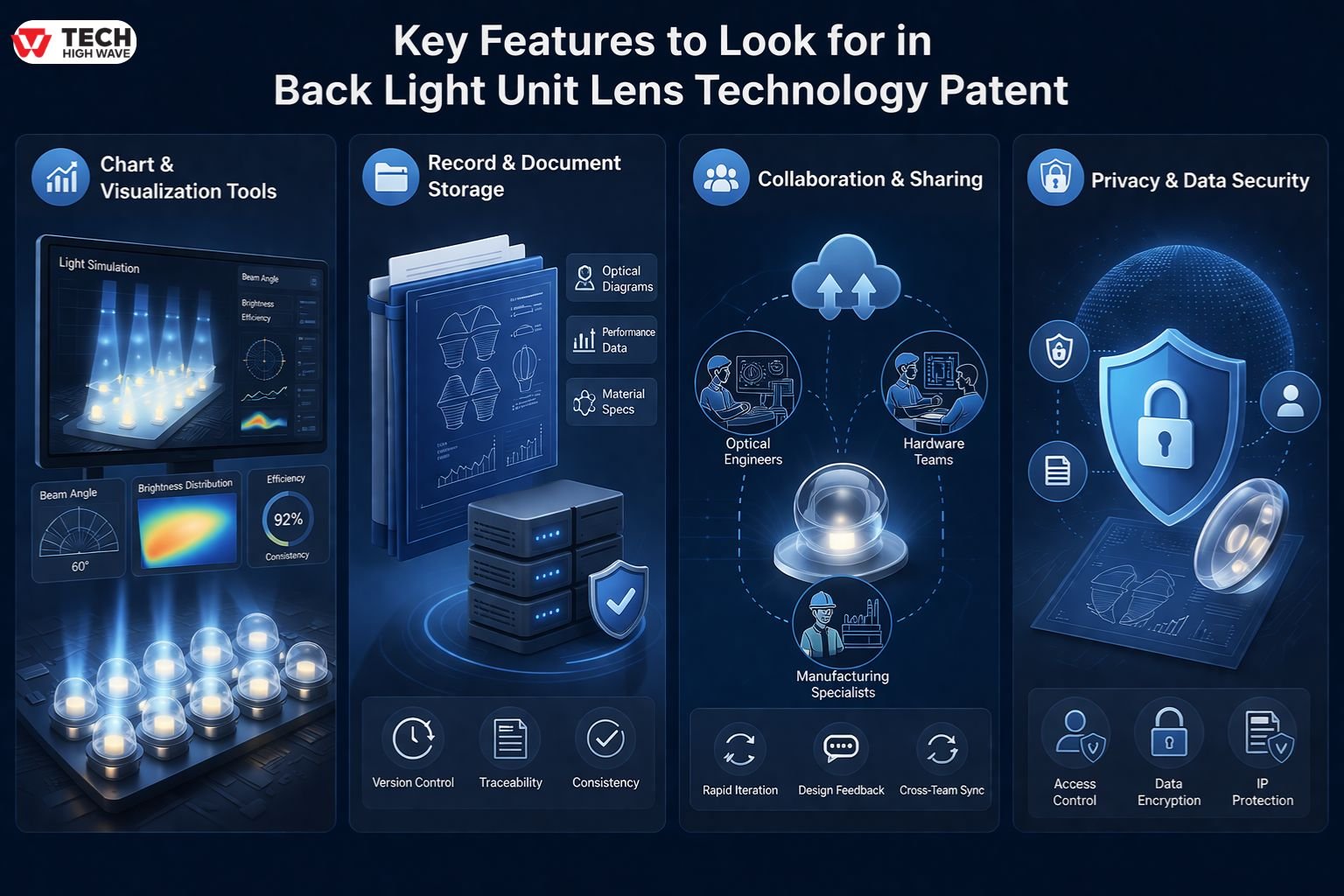
Key Features to Look for in Back Light Unit Lens Technology Patent
Chart & Visualization Tools
Simulation tools model how light behaves before manufacturing begins. They allow engineers to test beam angles, brightness distribution, and efficiency under different conditions.
The reason this matters: small optical errors scale quickly in production.
Record & Document Storage
Detailed documentation supports both engineering and legal protection. Optical diagrams, performance data, and material specifications ensure consistency across production cycles.
Organizations that maintain structured records tend to avoid redesign delays.
Collaboration & Sharing
Backlight design rarely happens in isolation. Optical engineers, hardware teams, and manufacturing specialists all contribute.
Effective collaboration systems allow rapid iteration—especially when adjusting lens geometry for new panel sizes or LED densities.
Privacy & Data Security
Lens designs often represent significant intellectual property value. Unauthorized access can lead to replication or patent disputes.
In high-competition sectors, protecting design data is as critical as developing it.
Best Uses for Back Light Unit Lens Technology Patent
Display Panels
LCD televisions and monitors rely on precise backlight control for brightness consistency and color accuracy.
Automotive Lighting
Instrument clusters and infotainment displays require stable visibility under changing lighting conditions.
Mobile Devices
Thin form factors depend on efficient light distribution with minimal layers.
Industrial Displays
Medical and control systems require predictable brightness with minimal deviation.
Emerging Technologies
AR/VR and wearable displays demand compact and energy-efficient lighting systems.
Recent development cycles show that Mini-LED and Micro-LED displays are driving most new back light unit lens technology patent activity. These systems use thousands of small LEDs, making precise lens control essential for avoiding blooming and uneven brightness. In practice, poorly optimized lenses in these setups quickly expose flaws—especially in high-contrast scenes.
Who Should Use Back Light Unit Lens Technology Patent?
Display Manufacturers
Benefit from improved efficiency and reduced material complexity.
Optical Engineers
Use patented designs to refine beam control and uniformity.
Product Designers
Leverage thinner, more efficient backlight architectures.
IP and Legal Teams
Evaluate patents for licensing and competitive positioning.
Who may not benefit
- Low-cost or simple lighting applications
- Projects without strict uniformity requirements
- Non-technical use cases where advanced optics offer little value
How to Choose the Right Back Light Unit Lens Technology Patent
Choosing the right design involves practical trade-offs.
Application Requirements
High-end displays demand tighter uniformity and higher efficiency.
Light Uniformity Needs
Professional displays require minimal brightness deviation.
Energy Efficiency
Portable devices benefit most from efficient light extraction.
Manufacturing Constraints
Complex lens shapes may increase production difficulty.
Cost vs Performance
Higher precision often increases cost.
Practical checklist
- Does the lens improve uniformity across the panel?
- Can it reduce the number of optical layers?
- Is it manufacturable at scale?
- Does it meet thermal requirements?
- Are there licensing limitations?
Common Mistakes to Avoid
Focusing only on brightness
High brightness with poor distribution leads to visible inconsistencies.
Ignoring Mini-LED density challenges
Dense LED arrays amplify small optical flaws.
Overcomplicating lens design
Complex geometries may not scale well in production.
Neglecting thermal behavior
Poor heat management reduces LED lifespan.
Skipping validation testing
Simulation alone is not enough—real-world testing reveals edge cases.
Examples of Back Light Unit Lens Technology Patents
Patents in this space often focus on subtle but impactful improvements.
Multi-lens array structures
Designed to distribute light evenly across high-density LED grids.
Integrated lens-diffuser systems
Combine multiple optical functions into a single component, reducing layers.
Freeform lens geometries
Custom shapes that optimize light direction for specific panel sizes.
Edge-lit enhancement designs
Improve light guide efficiency and reduce brightness falloff near edges.
These variations highlight how innovation often comes from refining small details rather than redesigning entire systems.
Future Trends in Back Light Unit Lens Technology Patent (2026 Outlook)
Micro-Optics Advancements
Smaller, more precise lens structures improve efficiency and reduce size.
Mini-LED and Micro-LED Integration
Lens design is becoming tightly coupled with dense LED arrays and local dimming systems.
Reduction in Layer Complexity
Designs are moving toward fewer optical layers without sacrificing performance.
Sustainability and Material Reduction
New approaches combine lens and diffusion functions into a single optical element. This reduces plastic usage, lowers manufacturing energy, and simplifies assembly.
Automation in Optical Design
Advanced simulation tools are accelerating development and reducing trial-and-error cycles.
FAQs
Q1: What is a back light unit lens technology patent?
It is a patent covering optical designs that control how LED light spreads in a backlight unit, improving brightness uniformity and efficiency.
Q2: Why are lenses important in backlight units?
They shape and direct light, preventing hotspots and ensuring consistent brightness across the display surface.
Q3: Where is this technology used?
It is used in LCD panels, automotive displays, mobile devices, and industrial systems requiring precise illumination.
Q4: How does it improve efficiency?
By directing light more effectively, it reduces energy loss and achieves desired brightness with lower power input.
Q5: What role does it play in Mini-LED displays?
It controls light from dense LED arrays, helping reduce blooming and maintain uniform brightness.
Q6: Are these patents difficult to implement?
They can be, especially when complex lens geometries require precise manufacturing processes.
Q7: What should be evaluated before adoption?
Uniformity performance, manufacturability, cost, thermal behavior, and licensing constraints are key considerations.
Also Read: Snapdragon X Plus: Performance, Benchmarks, Comparisons, and Real-World Laptop Experience