TL;DR: Team Software Process at a Glance
|
Software projects rarely fail because developers lack skill. More often, they drift. Deadlines stretch. Estimates miss by months. Quality problems surface late, when fixes are expensive and morale is thin.
That frustration is exactly why many organizations ask: what is team software process, and how can it improve predictability, quality, and team accountability?
The Team Software Process (TSP) was designed to address those issues. It introduces structure where informal coordination once dominated, replaces optimistic forecasting with historical data, and shifts quality control earlier in the lifecycle where defects are cheaper to fix.
This guide explores what TSP is, how it works, its phases, metrics, real-world applications, hybrid Agile integration, benefits, limitations, and adoption strategies for modern enterprises.
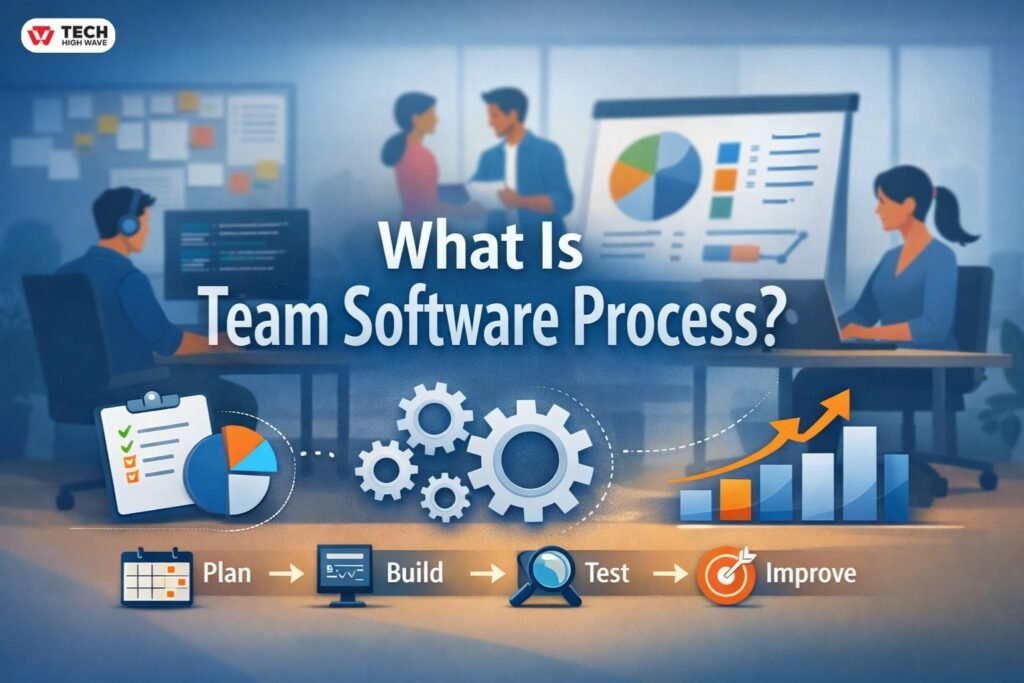
What Is Team Software Process?
Team Software Process (TSP) is a disciplined software engineering framework designed to help development teams deliver reliable, high-quality products on schedule.
Developed by the Software Engineering Institute (SEI) at Carnegie Mellon University, TSP extends the Personal Software Process (PSP) from individual-level discipline to coordinated team execution. Instead of relying on informal collaboration, it introduces clearly defined responsibilities, structured planning sessions, and measurable performance tracking.
Practically, TSP enables teams to:
- Estimate work using historical performance
- Assign formal team roles
- Track time and defect data systematically
- Conduct structured reviews to prevent quality issues
- Improve forecasting accuracy over time
It is not a toolset or programming methodology—it is a process framework for managing engineering work with clarity and accountability.
How Team Software Process Works
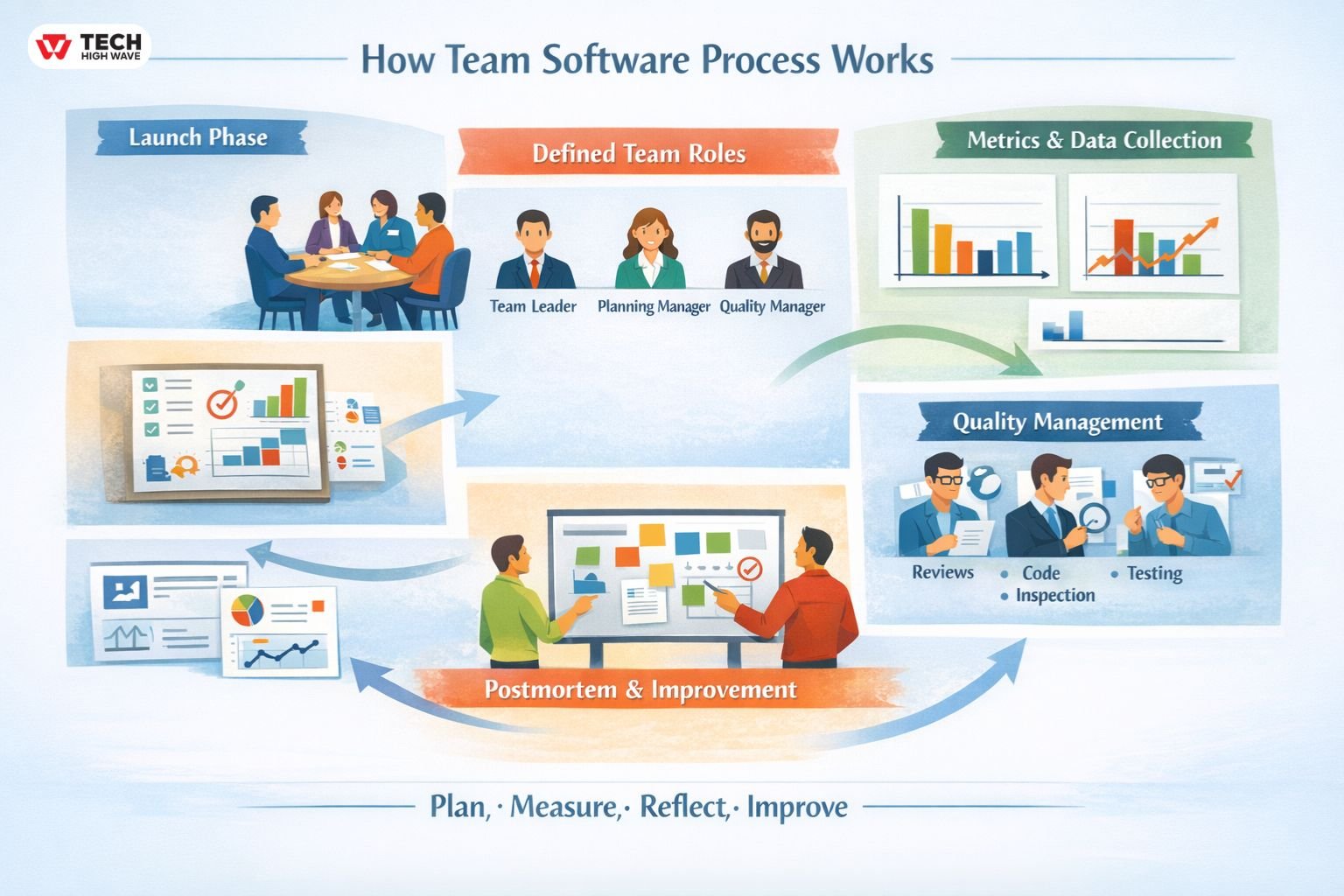
At its core, TSP follows a structured lifecycle built around planning, measurement, and reflection. The structure is deliberate. It slows teams at the start so they can move faster and more predictably later.
-
Launch Phase
Every TSP project begins with a formal launch session, where the team defines:
- Project objectives
- Quality targets
- Development standards
- Size and effort estimates
- Assigned roles
In enterprise projects, initial planning is often rushed or vague. TSP intentionally prevents this, creating early alignment and reducing downstream surprises.
The launch can feel procedural initially. Teams may resist structured meetings, but skipping this phase often results in misalignment and late-stage firefighting.
-
Planning and Estimation
Planning in TSP is data-driven. Teams estimate:
- Software size (lines of code or functional metrics)
- Required effort hours
- Schedule milestones
- Resource allocation
Unlike intuitive estimates, these projections are based on historical productivity data. Over successive projects, estimation accuracy improves measurably.
Some teams initially resist detailed time tracking, seeing it as overhead. Yet consistent data collection is critical. Without it, estimation improvements remain theoretical.
-
Defined Team Roles
TSP formalizes accountability through clearly assigned roles:
- Team Leader – Coordinates execution
- Planning Manager – Oversees estimates and schedules
- Quality/Process Manager – Ensures defect prevention and process adherence
- Development Manager – Supervises technical delivery
- Support Roles – Documentation, configuration management
In loosely structured teams, responsibilities blur, creating bottlenecks. Defined roles reduce ambiguity and enhance accountability. The structure may feel rigid at first, but in complex projects, it prevents confusion.
-
Metrics and Data Collection
Measurement is central to understanding TSP in practice. Teams track:
- Time spent per task
- Defects injected and removed
- Defect density
- Phase yield (defect removal effectiveness)
- Earned value performance
Metrics provide early visibility into project health. They are not meant to punish individuals but to guide improvement.
-
Quality Management
TSP prioritizes early defect detection via:
- Design reviews
- Code inspections
- Peer reviews
- Structured testing checkpoints
Preventing defects early reduces late-stage rework. While methodical, these practices often save significant time and cost in later phases.
-
Postmortem and Continuous Improvement
After each development cycle, teams conduct structured postmortems:
- Were estimates accurate?
- Where did defects cluster?
- Which processes slowed progress?
- What adjustments are necessary?
This reflection transforms TSP into a learning system. It evolves with experience rather than remaining static. Effectiveness depends heavily on leadership discipline and team maturity.
Also Read: Is Tech Tales Pro Reed Worth It in 2026?
Team Software Process Phases Explained
TSP typically progresses through:
- Requirements Definition
- High-Level Design
- Detailed Design
- Implementation
- Integration & Testing
- Postmortem Review
Each phase includes checkpoints and data collection. Structured progression creates traceability and accountability, especially in regulated or safety-critical systems.
Advanced Metrics in Team Software Process
Measurement is mathematical, not symbolic. Two key indicators are:
Defect Density
Defect Density=Total DefectsSize (KLOC)\text{Defect Density} = \frac{\text{Total Defects}}{\text{Size (KLOC)}}Defect Density=Size (KLOC)Total Defects
- Total Defects: Confirmed defects discovered
- Size (KLOC): Thousands of Lines of Code
Lower values indicate higher quality but must be interpreted in context.
Process Yield
Yield=100×(Defects Removed Before TestTotal Defects Injected)\text{Yield} = 100 \times \left( \frac{\text{Defects Removed Before Test}}{\text{Total Defects Injected}} \right)Yield=100×(Total Defects InjectedDefects Removed Before Test)
High yield indicates effective early-phase reviews. Both metrics reinforce the principle: early detection prevents costly downstream fixes.
Agile Integration: TSP-Agile Hybrids in 2026
Pure TSP or pure Waterfall is rare today. Most organizations operate in hybrid environments.
Modern practice:
- TSP Launches often serve as Product Increment (PI) Planning in SAFe.
- Estimation discipline strengthens sprint forecasts.
- Defect tracking integrates with Agile backlogs and DevOps dashboards.
- Postmortems align with Sprint Retrospectives.
Hybridization balances flexibility and predictability. Careful integration is essential; otherwise, administrative overhead can undermine value.
Team Software Process vs Agile vs Scrum
| Feature | TSP | Agile | Scrum |
| Planning | Structured upfront | Iterative | Sprint-based |
| Roles | Formal roles | Flexible | Defined Scrum roles |
| Metrics | Time & defect tracking | Lightweight | Velocity-focused |
| Documentation | Structured | Minimal | Moderate |
| Best Fit | Predictable & quality-critical | Adaptable | Iterative product delivery |
TSP emphasizes stability; Agile emphasizes adaptability. Hybrid frameworks are increasingly common in 2026 enterprise environments.
Benefits and Limitations
Benefits:
- Improved estimation accuracy
- Lower defect density
- Clear accountability
- Strong alignment with process maturity
- Predictable delivery timelines
Limitations:
- Higher process overhead
- Requires disciplined leadership
- Can feel rigid in fluid environments
- Cultural resistance in early adoption
Initial friction is normal, but disciplined adoption often results in long-term predictability.
Real-World Application Example
A large enterprise system faced chronic schedule overruns. After adopting TSP with structured launch sessions, historical estimation models, and early-phase design inspections:
- Estimation errors decreased
- Late-stage defect discovery dropped
- Delivery timelines stabilized
Early cycles felt procedural. As historical data accumulated, predictability improved.
Best Uses
- Enterprise-scale systems
- Safety-critical industries (aerospace, medical devices)
- Government-regulated projects
- Distributed teams
Less suited for short-lived experimental or highly fluid projects.
Who Should Use Team Software Process?
- Medium to large teams
- Organizations pursuing process maturity
- Projects requiring long-term maintenance and documentation
Less effective for solo developers, informal teams, or rapid prototype projects.
Adoption Checklist
- Executive sponsorship confirmed
- Willingness to track metrics objectively
- Training resources available
- Tooling infrastructure prepared
- Pilot team identified
Start with a pilot to discover friction points and refine the approach.
Common Mistakes to Avoid
- Using metrics to rank individuals publicly
- Skipping structured launch planning
- Collecting data without analysis
- Treating documentation as mere bureaucracy
- Applying TSP to highly dynamic projects
Structured measurement only works if interpreted thoughtfully.
Future Trends in Team Software Process (2026 Outlook)
- Automation: Metrics collection increasingly automated in CI/CD pipelines.
- DevOps Integration: TSP aligns with continuous delivery practices.
- Advanced Forecasting: Data analytics improve schedule and defect prediction.
- Improved UX: Dashboards focus on clarity to reduce process fatigue.
Despite evolving tools, the core principles—discipline, measurement, and continuous improvement—remain unchanged.
Frequently Asked Questions
Q1: What is team software process in simple terms?
TSP is a structured methodology that helps teams plan work, track defects, and improve predictability through disciplined measurement.
Q2: How is TSP different from Agile?
TSP emphasizes structured planning, detailed metrics, and defined roles, whereas Agile focuses on adaptability and iterative delivery.
Q3: Is TSP still relevant?
Yes. It is valuable in contexts requiring predictable delivery, formal documentation, and measurable quality control.
Q4: What is the relationship between PSP and TSP?
PSP focuses on individual developer discipline; TSP scales these principles to team-level execution.
Q5: Does TSP reduce defects?
Yes. Early inspections, structured reviews, and systematic tracking minimize late-stage defects.
Q6: Can small teams implement TSP?
Small teams can adopt it, but overhead may outweigh benefits for highly experimental or fast-moving projects.
Conclusion
Understanding what is team software process shows how disciplined planning, rigorous measurement, and continuous improvement transform software delivery from reactive to predictable. Hybrid adoption with Agile enhances flexibility while retaining structured quality control, making TSP highly relevant in 2026 enterprise environments.
Also Check: Konversky in 2026: The Smarter, Trust-Driven Alternative to Traditional CRO