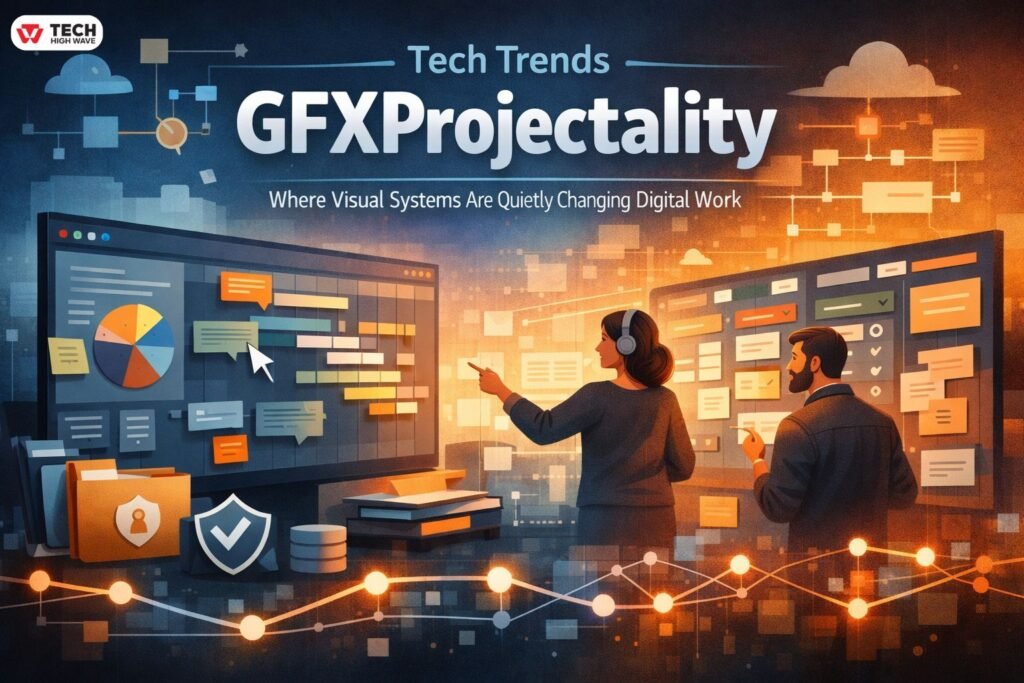
Digital projects rarely fail because of lack of tools. They fail because information drifts. Files move, feedback gets buried, timelines get reinterpreted, and suddenly no one is fully sure what the current state actually is. This slow loss of clarity is why interest in tech trends gfxprojectality keeps growing.
People searching this topic are usually not chasing something flashy. They are trying to make sense of complex work that has become harder to track, harder to explain, and harder to hand over. Tech trends gfx points toward visual-first systems that keep context intact. Not louder workflows, not faster dashboards, but calmer ones, where progress can be seen and understood without stitching pieces together manually.
What Is Tech Trends GFXProjectality?
Its refers to a growing approach to digital project organization built around graphics-driven structure. In this context, GFX relates to visual and graphical systems used to represent work, relationships, progress, and decisions. It does not describe a single platform, brand, or proprietary framework.
Instead, gfxprojectality reflects a mindset. One where visual context is treated as operational infrastructure. Dashboards are not just summaries. Timelines are not just schedules. They become shared reference points that reduce interpretation gaps.
Tech trends gfx, sits between design systems, project management, and data visualization. Its focus is not on controlling work, but on making work visible in a way that holds together over time.
How Tech Trends GFXProjectality Works
It works by tightening the connection between data, visuals, and collaboration. Information enters from multiple sources, often unevenly. Design assets, metrics, planning notes, stakeholder comments, operational logs, all of it.
That information is then structured visually. Not simplified away, but arranged. Dashboards show status. Timelines show dependency. Layered views show how parts of a project interact, where things overlap, where delays ripple outward.
Collaboration happens inside that visual context. Feedback is not floating in chat windows. Comments sit next to the work they describe. Decisions remain attached to the moment they were made.
Over time, everything is archived with structure. Records stay readable months later, even after teams change. That continuity is where gfxprojectality quietly delivers value.
The flow is rarely linear. It loops:
Inputs, visual framing, shared action, preserved history, then back again.
Key Features to Look for in Tech Trends GFXProjectality
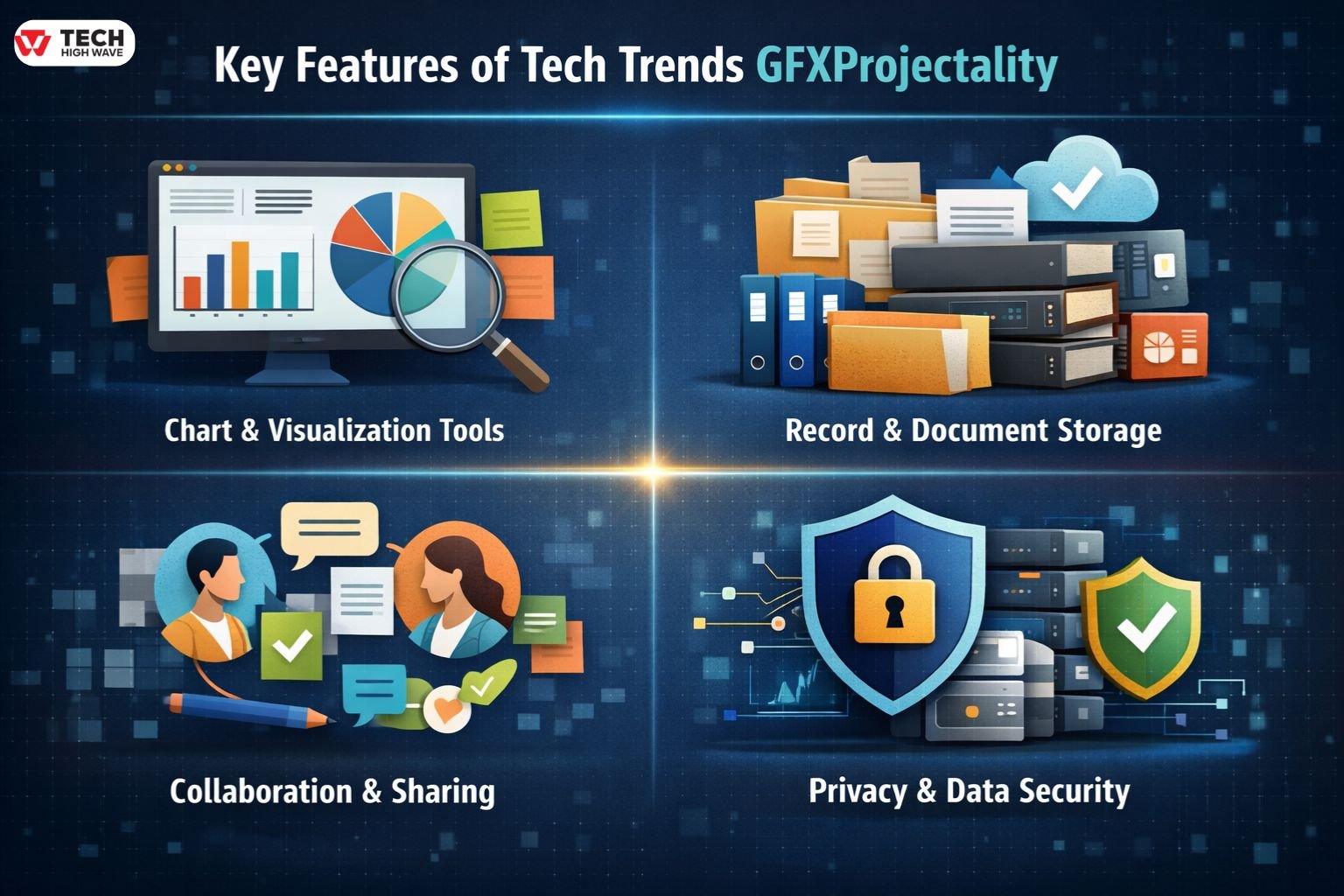
Chart & Visualization Tools
Visualization is the backbone here. Without it, gfxprojectality collapses into another document repository. Strong systems use charts, timelines, and visual layers to surface meaning, not just numbers.
The most useful tools allow views to change depending on role. Leadership sees trends. Practitioners see detail. Everyone sees the same truth, just framed differently. Real-time updates matter, but clarity matters more.
Record & Document Storage
Document storage in gfxprojectality environments is intentional. Files are not dumped. They are placed. Metadata survives. Versions are traceable. Folder logic reflects how work actually happened, not how someone hoped it would.
This matters later. During audits, reviews, handovers, or disputes. A well-kept record reduces rework and avoids memory-based decision making.
Collaboration & Sharing
Collaboration here is quieter. Fewer notifications, more context. Sharing permissions are deliberate. Not everyone edits everything. Feedback stays anchored.
Version control plays a bigger role than many expect. Knowing who changed what, and why, prevents slow erosion of trust inside teams, especially distributed ones.
Privacy & Data Security
Centralization increases risk if security is weak. Tech trends gfx, assumes secure foundations. Encrypted storage, role-based access, and clear ownership boundaries are not optional extras.
Trust grows when teams know sensitive material is protected, without slowing down legitimate collaboration.
Also Check: Data Softout4.v6 Python Explained: What It Is (and Why It Doesn’t Exist)
Best Uses for Tech Trends GFXProjectality
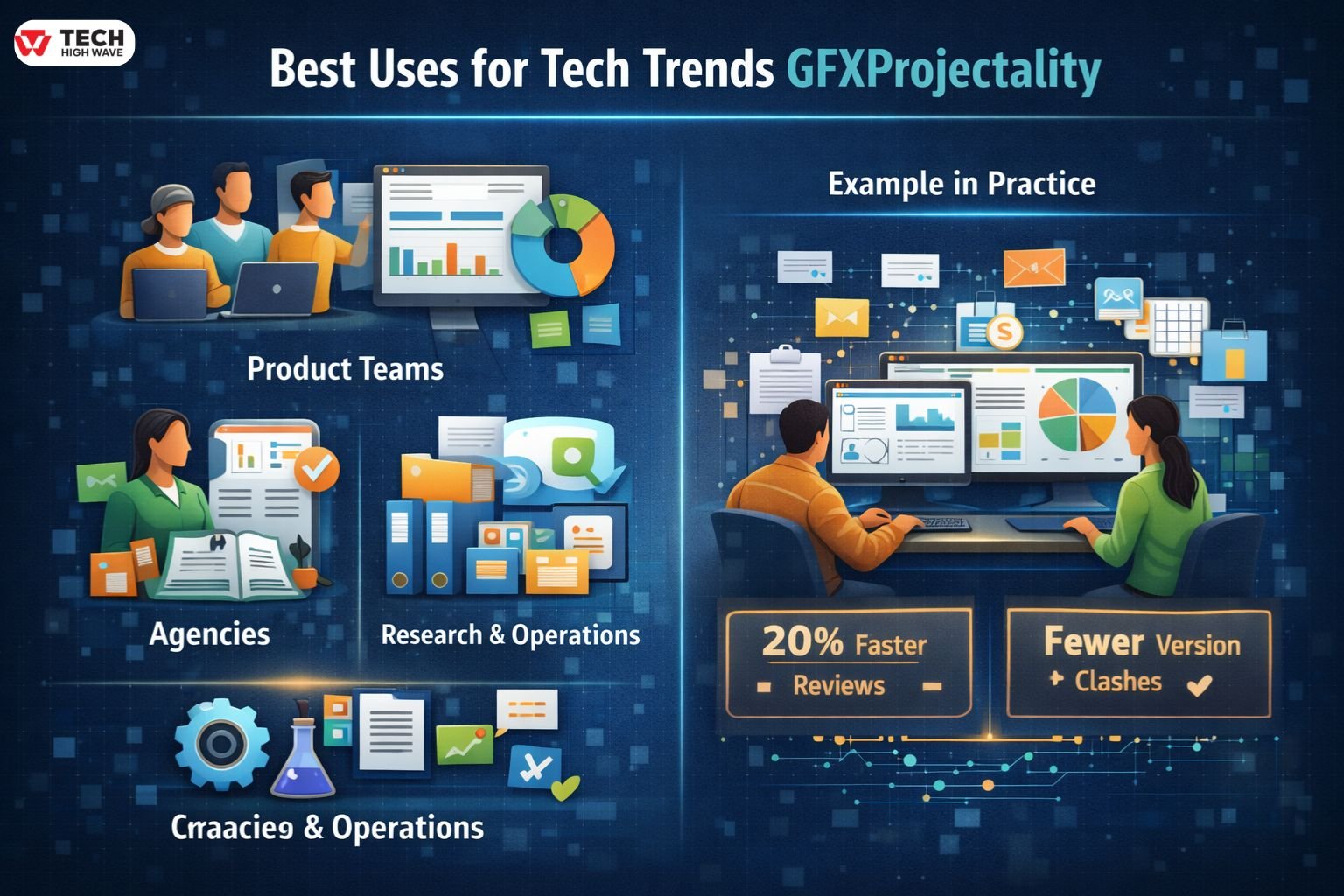
Works best where projects stretch across time and disciplines. Product teams coordinating design, development, and release cycles rely on shared visual truth. Agencies managing client feedback, revisions, and approvals use gfxprojectality to reduce back-and-forth confusion.
Research teams value traceable documentation. Operations teams use it to manage transformation initiatives that evolve mid-stream.
Example in Practice
A mid-sized design firm running multiple client campaigns adopted a gfxprojectality-style workflow centered on shared visual dashboards and centralized records. Review cycles dropped by about 20 percent once feedback moved from scattered emails into annotated timelines. Version clashes declined. New team members reached context faster, with fewer clarifying meetings.
No dramatic overhaul, just fewer loose ends.
Who Should Use Tech Trends GFXProjectality?
Tech trends gfx, fits teams managing layered digital work. Project managers, designers, developers, analysts, strategy leads, all benefit when context stays visible.
Remote and hybrid teams see added value, since shared visuals reduce reliance on synchronous explanation. However, very small teams with simple task flows may find gfxprojectality unnecessary. In those cases, lighter tools remain more efficient.
Not every workflow needs structure at this level.
How to Choose the Right Tech Trends GFXProjectality
Choosing a gfxprojectality solution starts with honesty about how work actually flows. How many stakeholders touch each stage. How often requirements change and how long records need to live.
Some systems favor flexibility. Others favor guardrails. Visual depth, document integrity, collaboration control, and security posture usually matter more than feature count.
A grounded evaluation focuses on:
•Visibility that matches reality
• Traceability without friction
• Scalability without lock-in
• Governance that feels natural
When systems fight habits, adoption fails. When systems reflect habits, they stick.
Common Mistakes to Avoid
Overbuilding is common. Teams adopt complex systems before they are ready, then bypass them. Simpler setups often perform better.
Permission sprawl is another issue. Too much access blurs accountability. Too little access creates shadow workflows.
Visuals can mislead if data discipline slips. Dashboards only help when inputs stay accurate.
Finally, storage growth is often underestimated. Planning early avoids disruptive migrations later.
Future Trends in Tech Trends GFXProjectality (2026 Outlook)
By 2026, (TTGP)is becoming less performative. Smarter systems surface context quietly. Summaries appear when needed, not constantly.
Privacy expectations are tightening. Compliance and access control are shaping design decisions more directly. Interfaces continue moving toward restraint, fewer controls, clearer focus.
Integration remains a priority, allowing visual systems to pull from analytics, communication, and development environments without duplication.
Progress here looks subtle, but meaningful.
Frequently Asked Questions
Q.1 What does tech trends gfxprojectality mean?
It describes graphics-driven project systems that organize work through visual structure, shared context, and preserved documentation.
Q.2 Is tech trends gfxprojectality one specific tool?
No. Tech trends gfxprojectality represents a category of approaches and technologies, not a single platform or product.
Q.3 Who benefits most from tech trends gfxprojectality?
Teams managing complex, collaborative, or long-running digital projects benefit most, especially where clarity and traceability matter.
Q.4 Does tech trends gfxprojectality replace project management?
It complements project management by improving visibility and record continuity rather than replacing planning fundamentals.
Q.5 What problems can arise with tech trends gfxprojectality?
Overcomplex setups, weak permission controls, and inconsistent data input are common challenges.
Q.6 How is tech trends gfxprojectality evolving in 2026?
The focus is shifting toward calmer interfaces, adaptive summaries, and stronger privacy-driven design.
Also Read: Android Backup Software 2026: A Definitive, Practical Guide