
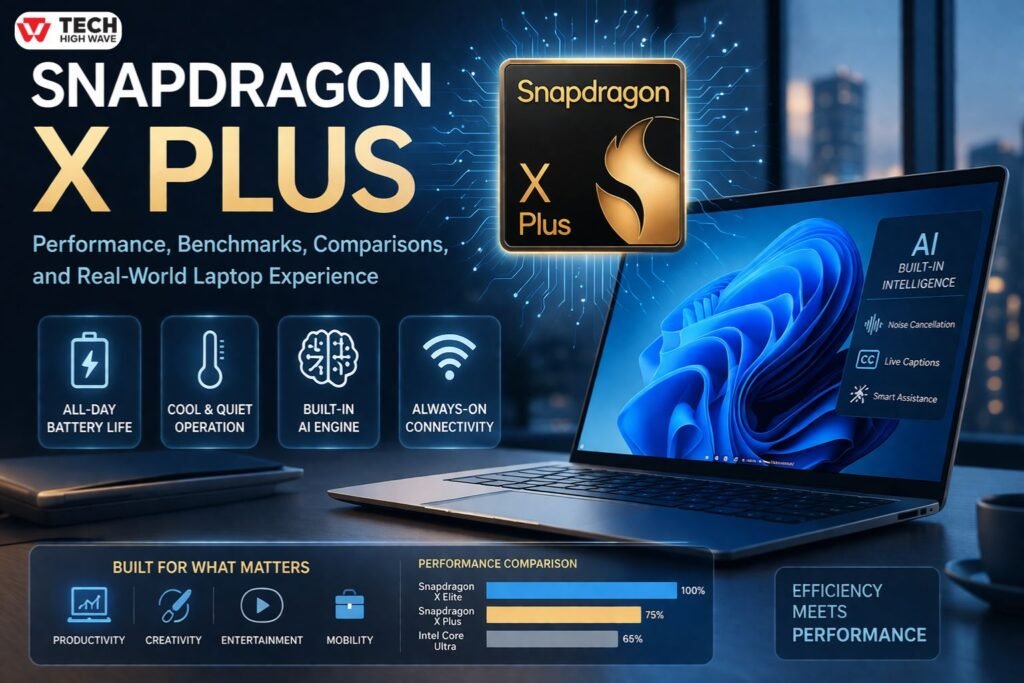
Quick Verdict (At a Glance)
Alternative: Snapdragon X Elite for more demanding workloads |
Modern laptops are no longer judged just by speed. Battery life, heat, and noise have become just as important—sometimes even more. That shift is exactly why processors like the Snapdragon X Plus are getting so much attention.
The Snapdragon X Plus isn’t trying to win a raw performance race. Instead, it focuses on delivering a smoother, more efficient everyday experience. That difference becomes noticeable in ways benchmarks don’t always capture—longer unplugged sessions, quieter operation, and fewer slowdowns over time.
This guide breaks down how it actually performs, where it fits, and where expectations need to stay realistic.
What Is Snapdragon X Plus?
The Snapdragon X Plus is a laptop processor developed by Qualcomm for modern Windows systems. It sits just below the higher-end Snapdragon X Elite in the same lineup.
Unlike traditional processors, it uses ARM architecture. That shift changes how laptops behave day to day—less heat, longer battery life, and often no need for loud cooling systems.
Everything is built into a single system-on-chip, where CPU, graphics, and AI processing work together instead of depending on separate components. This design reflects the broader Snapdragon vs Intel shift, where efficiency and integration take priority over traditional performance scaling—resulting in a smoother, more streamlined everyday experience.
How Snapdragon X Plus Works
Snapdragon X is built around efficiency first, not peak bursts of speed.
The CPU handles multitasking, browsing, and productivity work without aggressive spikes. It stays consistent over time. That matters more than it sounds—especially during long sessions where many laptops start to slow down.
The GPU takes care of visuals. Video playback, UI animations, and light creative work run smoothly. Push it into heavier workloads, though, and the limits start to show.
The NPU (AI engine) works quietly in the background. Features like noise cancellation or live transcription happen instantly, without relying on cloud processing.
Software runs in two ways. Native apps feel fast and responsive. Emulated apps usually work fine—but not always perfectly. Some older tools can feel slightly slower or inconsistent. That’s where the difference shows.
Snapdragon X Plus Benchmarks and Real-World Performance
Benchmarks place Snapdragon X in the mid-to-high performance range. But numbers only tell part of the story.
In daily use, the experience feels smooth. Apps open quickly. Switching between tasks doesn’t feel sluggish. Even with multiple browser tabs and background apps running, performance stays stable.
Where things shift is under sustained pressure. Heavy rendering, large exports, or demanding workloads take longer compared to higher-end chips. Not dramatically—but enough to notice.
For most users, though, that situation is rare. Day-to-day performance is where this processor feels strongest—and that’s exactly where it’s designed to shine.
Snapdragon X Plus vs Snapdragon X Elite (Quick Comparison)
| Feature | Snapdragon X Plus (10-core) | Snapdragon X Elite (12-core) |
| CPU Cores | 10 cores | 12 cores |
| Performance Level | Mid-to-high range | High-end / flagship |
| Target Users | Everyday users, professionals | Power users, creators |
| AI Processing (NPU) | Strong | More advanced |
| Battery Efficiency | Excellent | Excellent (slightly lower under heavy load) |
| Graphics Performance | Good for light tasks | Better for demanding workloads |
| Thermal Design | Cooler, more efficient | Slightly higher thermal output |
| Ideal Use Cases | Office work, browsing, streaming | Video editing, heavy multitasking |
| Device Pricing Tier | More affordable | Premium |
What This Comparison Shows
Snapdragon X Plus focuses on balance. It’s designed to handle everyday work without pushing hardware too hard.
Snapdragon X Elite, on the other hand, is built for heavier workloads. When tasks get demanding, the gap becomes clearer. Not immediately—but over time.
Snapdragon X Plus vs Intel and Apple Silicon
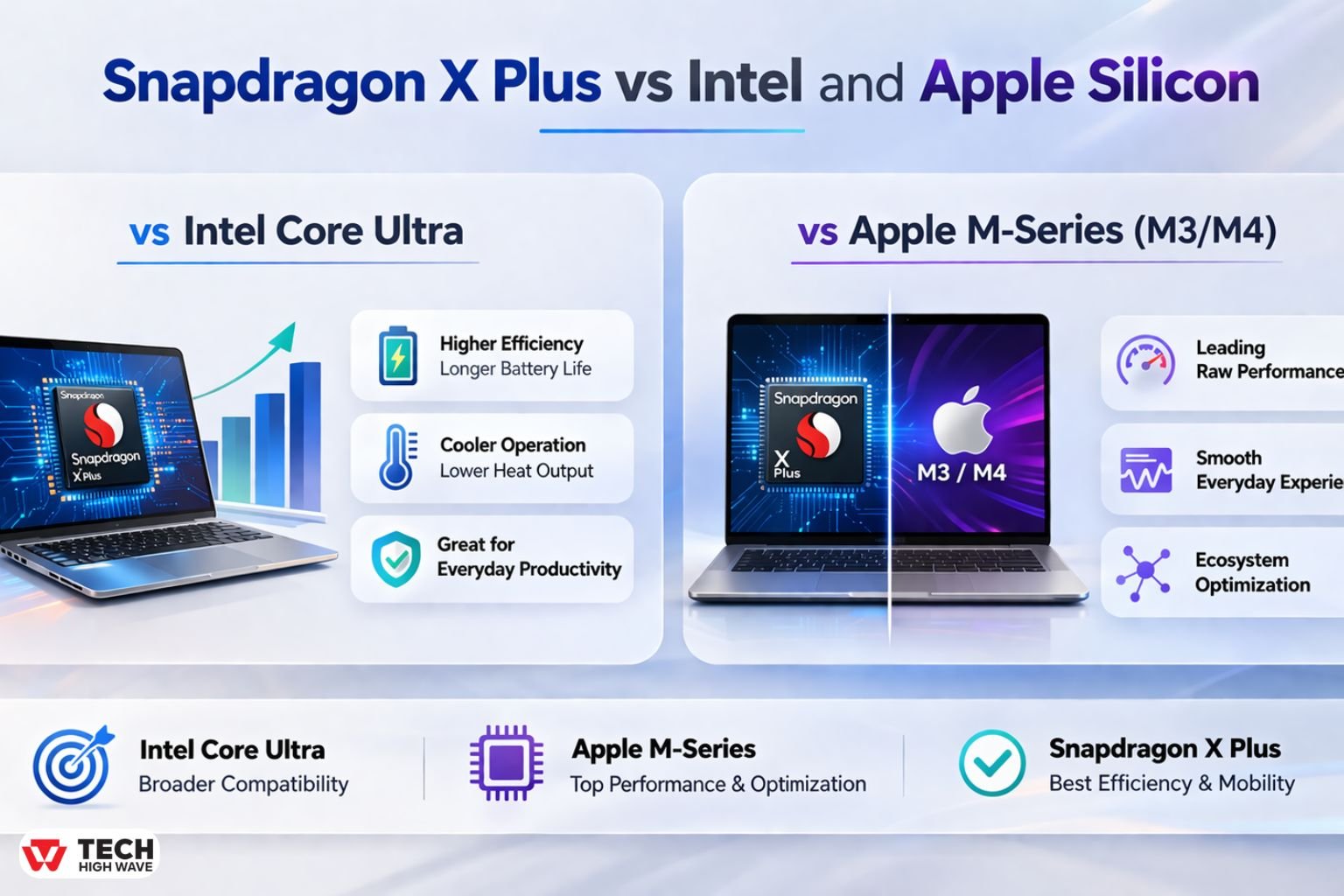
vs Intel Core Ultra
Compared to Intel Core Ultra processors, Snapdragon X Plus often feels more efficient. Systems stay cooler, and battery life tends to stretch further.
Intel still holds an advantage in compatibility and certain performance-heavy tasks. That matters for specific workflows, especially in professional environments.
Takeaway: Better efficiency vs broader compatibility. The choice depends on what matters more.
vs Apple M-Series (M3/M4)
Apple silicon still leads in raw performance and optimization. That’s difficult to match.
Snapdragon X Plus competes differently. It delivers a similar level of smoothness for everyday tasks, even if it doesn’t match peak performance.
The real difference comes down to the ecosystem. Apple is tightly optimized. Windows on ARM is still evolving.
Takeaway: Apple leads in performance consistency. Snapdragon holds its ground in efficiency and general use.
Snapdragon X Plus Gaming Performance
Gaming is where expectations need to be realistic.
Lightweight and older games run well, especially when optimized. Casual gaming feels fine. Nothing unusual there.
Modern AAA titles are a different story. Performance drops, compatibility becomes inconsistent, and settings often need to be lowered significantly. Not everything scales well.
For occasional gaming, it works. For serious gaming, it’s not the right tool.
Snapdragon X Plus Laptops (Real-World Devices)
Devices using Snapdragon X are designed around mobility.
Most are thin, lightweight, and built for all-day use. Many include always-on connectivity and instant wake features, which feel noticeably different from traditional laptops.
In real-world use, one thing stands out quickly—silence. Even during long sessions, fans rarely become noticeable. Sometimes, they don’t run at all.
Pricing typically sits in the mid-to-premium range, depending on build quality and features.
Also Check: Kellogg Innovation Network 2026: Leaders’ Guide to AI & Innovation
Key Features to Look for in Snapdragon X Plus
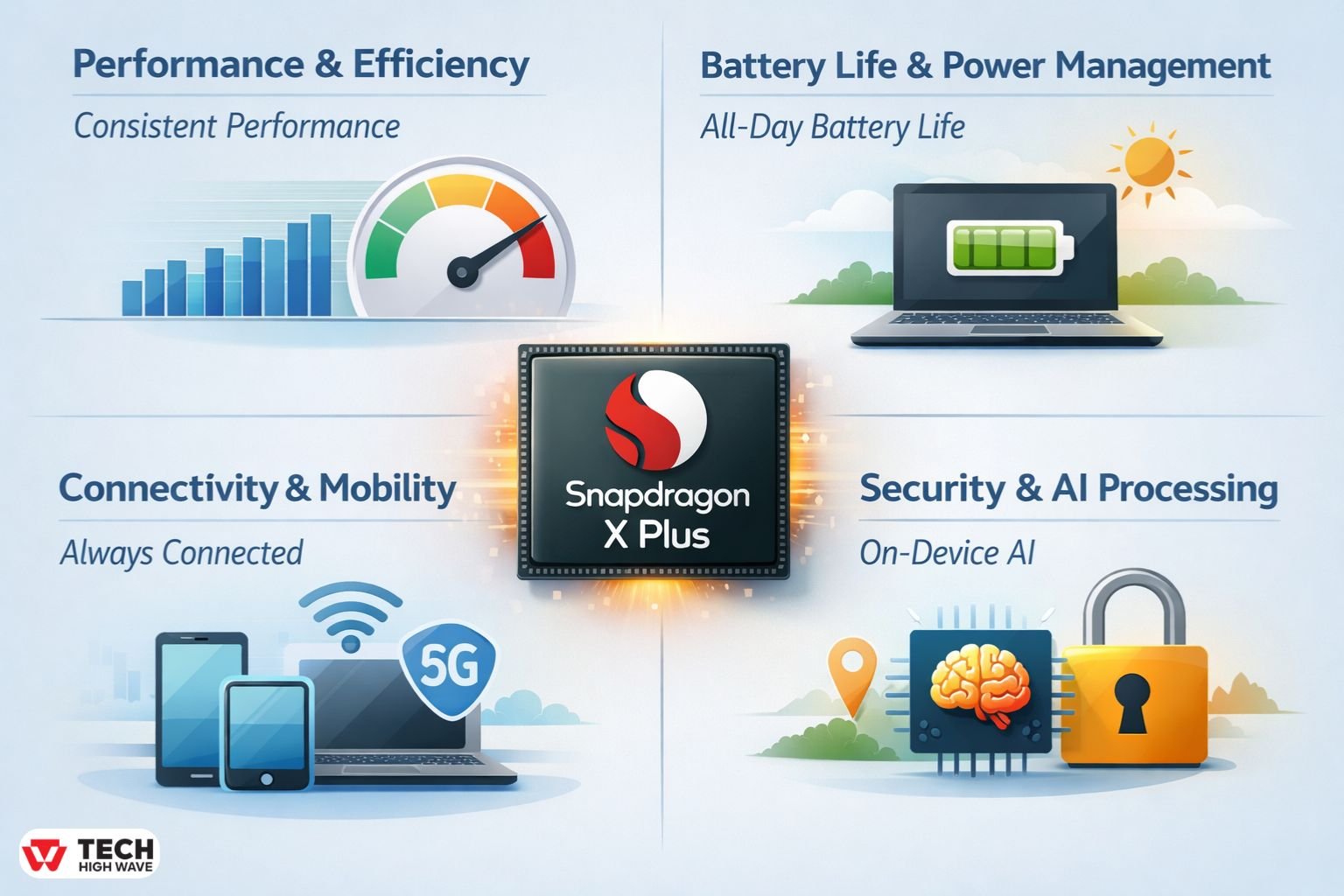
Performance & Efficiency
Performance stays consistent over time rather than peaking and dropping. That consistency becomes noticeable during long work sessions.
Battery Life & Power Management
Battery life is one of the biggest strengths. Many systems last through a full day without needing a charge. That’s not always the case with traditional laptops.
Connectivity & Mobility
Always-connected features improve usability in subtle ways. Faster wake times, stable connections, and fewer interruptions make a difference over time.
Security & AI Processing
On-device AI reduces reliance on cloud processing. It also keeps certain tasks private. Not everything needs to leave the device anymore.
Best Uses for Snapdragon X Plus
Snapdragon X Plus performs best in everyday scenarios.
Office work, browsing, and communication tools all run smoothly. Even with multiple tabs open and background apps running, the system holds steady.
During long video calls or back-to-back meetings, it tends to stay cool and quiet—something many thin laptops struggle with.
Media consumption feels effortless. Streaming, multitasking, and background activity rarely slow things down.
Light creative work is manageable, but heavier workloads begin to expose limits. Not immediately—but gradually.
Who Should Use Snapdragon X Plus?
This processor fits users who prioritize efficiency over raw power.
Students benefit from long battery life and portability. Carrying a charger becomes less of a concern.
Professionals working remotely gain from stability and quiet operation. That matters more than expected during long workdays.
For general use, it feels fast and responsive. No friction in everyday tasks.
But it’s not for everyone. Developers using specialized tools, gamers, or professionals working with demanding software may run into limitations.
How to Choose the Right Snapdragon X Plus
Choosing the right system comes down to practical needs:
- Workload: Everyday tasks vs heavy creative work
- Compatibility: Native apps vs reliance on emulation
- Battery expectations: Occasional vs all-day use
- Mobility: Desk use vs constant movement
If the focus is productivity and portability, Snapdragon X fits naturally. If workloads are heavier, alternatives may make more sense.
Where Snapdragon X Plus Still Falls Short
No processor is perfect—and this one has clear limits.
Some applications still rely on emulation. Most work fine, but certain tools can feel slower or behave unpredictably. Older enterprise software is a common example.
Gaming performance remains limited. It’s not just about power—it’s also about compatibility.
Certain development environments, virtualization tools, and niche workflows may not run as efficiently as expected.
These issues are improving, but they haven’t disappeared.
Common Mistakes to Avoid
Assuming all apps perform the same is a common mistake. Native apps feel fast. Emulated ones vary.
Another issue is expecting gaming-level performance. That’s not what this processor is built for.
Focusing only on battery life can also be misleading. Compatibility matters just as much.
Ignoring long-term needs—especially for specialized software—can lead to frustration later.
Future Trends in Snapdragon X Plus (2026 Outlook)
ARM-based computing is expanding, and Snapdragon X is part of that shift.
More applications are being optimized for ARM, which will improve performance consistency over time.
On-device AI will continue to grow. More tasks will run locally, faster and more privately.
Battery efficiency will keep improving. That trend isn’t slowing down.
At the same time, competition is increasing. That pressure will push performance and compatibility even further.
FAQs
Q1: What is Snapdragon X Plus?
Snapdragon X Plus is an ARM-based laptop processor by Qualcomm designed for efficient performance, long battery life, and integrated AI capabilities.
Q2: Is Snapdragon X Plus good for everyday use?
Yes, it performs smoothly for browsing, office work, and multitasking while maintaining strong battery efficiency.
Q3: Can Snapdragon X Plus run games?
It supports casual and lightweight games, but struggles with high-end titles due to GPU and compatibility limitations.
Q4: How does Snapdragon X Plus compare to Intel processors?
It offers better efficiency and battery life, while Intel provides stronger compatibility and performance for demanding tasks.
Q5: How does Snapdragon X Plus compare to Apple silicon?
Apple silicon leads in raw performance, but Snapdragon X remains competitive for everyday productivity on Windows devices.
Q6: Does Snapdragon X Plus support all Windows apps?
Most apps work, but some rely on emulation, which can affect performance depending on the software.
Q7: Are Snapdragon X Plus laptops worth buying?
They are a strong choice for users focused on battery life, portability, and consistent everyday performance.
For More Tech Info Visit: TechHighWave