Most teams don’t have a productivity problem. They have a memory problem.
That idea alone is powerful enough to sell software.
It’s also powerful enough to sell something that isn’t real.
This article began life as a confident, polished review of a digital workspace called Nimedes—a tool supposedly built for teams that care about context, continuity, and traceability. It had all the signs of a legitimate 2026 SaaS platform: enterprise language, modern security concepts, clean comparisons to Notion and Jira, and a future‑facing roadmap.
There was only one issue.
Nimedes doesn’t exist.
What follows is not a product review, but a case study in modern misinformation—how AI‑assisted content, SEO incentives, and reader trust combine to create tools that feel real long before anyone checks whether they are.
How the Nimedes Narrative Works
The original Nimedes article didn’t rely on wild claims or obvious hype. It used something far more effective: plausibility.
The hook was subtle and accurate:
- Distributed teams really do lose context over time
- Decisions really do disappear into chat threads
- Compliance and continuity really are growing problems in 2026
From there, the article followed a familiar SaaS storytelling structure:
- Identify a real pain point (the “memory problem”)
- Introduce a calm, rational solution
- Describe features that feel inevitable rather than exciting
- Compare it to tools everyone already trusts
Nothing about Nimedes sounded futuristic or unbelievable. That’s exactly why it worked.
The Association Trap: Notion, Jira, and Borrowed Legitimacy
One of the most effective techniques used was context borrowing.
By placing Nimedes alongside real platforms like Notion and Jira, the article created subconscious validation:
“If it belongs in this category, it must exist.”
This is sometimes called guilt by association, but in content ecosystems, it’s closer to credibility inheritance. Readers don’t verify every name in a comparison table. They assume the unfamiliar one earned its place.
That assumption is expensive.
The Verification That Breaks the Illusion
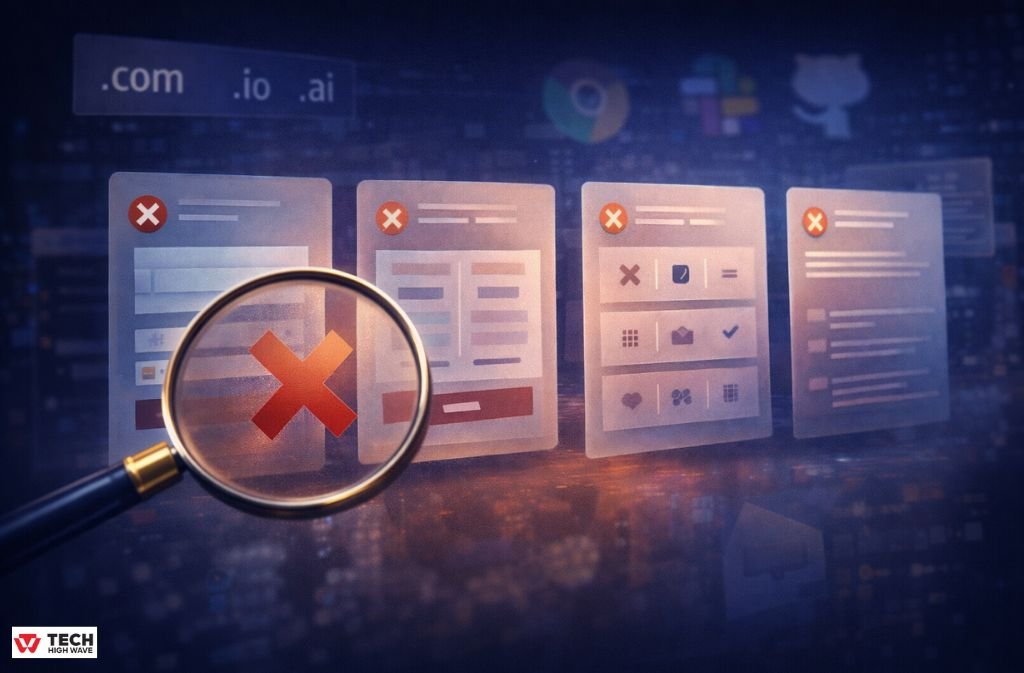
Once you step outside the article and try to verify Nimedes as a real product, the story collapses quickly.
What was checked:
- Official domains (.com, .io, .ai)
- Product sign‑up pages
- Chrome Web Store listings
- Slack App Directory
- GitHub repositories or APIs
- Independent documentation or changelogs
What turned up:
- ❌ No official website owned by a software vendor
- ❌ No login pages, pricing pages, or onboarding flows
- ❌ No integrations, plugins, or APIs
- ❌ No corporate footprint
The name only appears on a small number of SEO‑driven review sites—often repeating the same feature language in slightly different wording.
That’s the fingerprint of a hallucination that escaped containment.
The Feature Hallucination Layer
Many of Nimedes’ described features are real concepts—just not real implementations.
Examples:
- Identity‑aware access control
- Attribute‑based permissions
- Audit‑friendly record linking
- Predictive risk dashboards
These are all legitimate 2026 trends. The problem isn’t the ideas—it’s the attribution.
The article didn’t say “tools like Nimedes aim to…”. It said “Nimedes does…”.
That single grammatical choice turns trend analysis into misinformation.
Also read: Top Free Personal Finance Software to Unlock Your Financial Potential
Why Search Engines Are Especially Vulnerable
This is where the risk escalates.
Because the original article was:
- Long‑form
- Well‑structured
- Neutral in tone
- Non‑promotional
- Rich in comparisons and FAQs
…it is perfectly shaped for Search Generative Experience (SGE) systems.
An AI answering “What is Nimedes?” doesn’t know Nimedes is fictional. It only knows that:
- Multiple pages describe it consistently
- The language matches real enterprise software
- There are no obvious red flags
At that point, repetition becomes reality.
The Echo Chamber Effect
Once a hallucinated product appears credible:
- One article publishes it
- Another AI summarizes it
- A third site cites the summary
- A fourth AI treats the citations as verification
No humans are lying. No one is intentionally deceiving.
And yet misinformation spreads at industrial scale.
The Humanization Trap
Ironically, the more human the writing feels, the more dangerous it becomes.
The original Nimedes article:
- Avoided hype
- Used calm professional language
- Included balanced pros and cons
- Ended with thoughtful caveats
These are signals readers associate with honesty.
They are no longer reliable signals of truth.
Red Flags Readers Should Learn to Spot
Use Nimedes as a checklist for future skepticism:
- A product with no official domain
- Features described perfectly but vaguely
- Comparisons to well‑known tools without links
- No screenshots, onboarding flows, or pricing pages
- Multiple “reviews” that sound suspiciously similar
None of these alone prove deception. Together, they should trigger verification.
Why This Matters More Than One Fake Tool
Nimedes isn’t dangerous because it doesn’t exist.
It’s dangerous because it could.
The article describes exactly the kind of software enterprises want in 2026. That makes it easy for readers—and AI systems—to assume it already exists.
This is the new misinformation:
- Calm
- Professional
- Well‑intentioned
- Structurally correct
And still wrong.
FAQs
Q1. What is Nimedes?
Nimedes is a fictional AI-powered productivity tool that appeared in 2026 content reviews. Despite detailed features and comparisons to Notion and Jira, it does not actually exist. This case highlights how AI-generated content can create believable tools that are entirely imaginary.
Q2. Why do people think Nimedes is real?
Many AI-written reviews presented Nimedes with professional language, realistic features, and comparisons to trusted platforms. Its plausible “context-focused” design and 2026 trends made it feel legitimate, leading search engines and readers to treat it as a real product.
Q3. How can I verify if an AI tool like Nimedes actually exists?
To confirm a tool’s authenticity, check for: an official domain, product sign-up pages, integrations, Chrome or Slack plugins, and independent documentation. If these are missing or lead to dead links, the product may be AI-generated or fictional.
Q4. Is Nimedes safe to try or download?
Since Nimedes does not exist, there is no safe download or trial. Attempting to find it online may lead to misleading sites or phishing risks. This highlights the importance of verifying AI-generated software before use.
Q5. What lessons does the Nimedes case teach about AI-generated content?
The Nimedes example shows that polished, professional AI content can create “realistic” products that never existed. Readers and businesses should always verify sources, cross-check features, and treat AI content with critical scrutiny to avoid misinformation.
Final Thought
The problem isn’t that AI can write convincing content.
The problem is that convincing content now looks identical to verified truth.
Until verification becomes as visible as storytelling, tools like “Nimedes” will keep appearing—fully formed, highly ranked, and entirely imaginary.
And most people will never notice.
Also check: Lufanest Explained: What It Is, How It Works, and How to Choose the Right Option in 2026