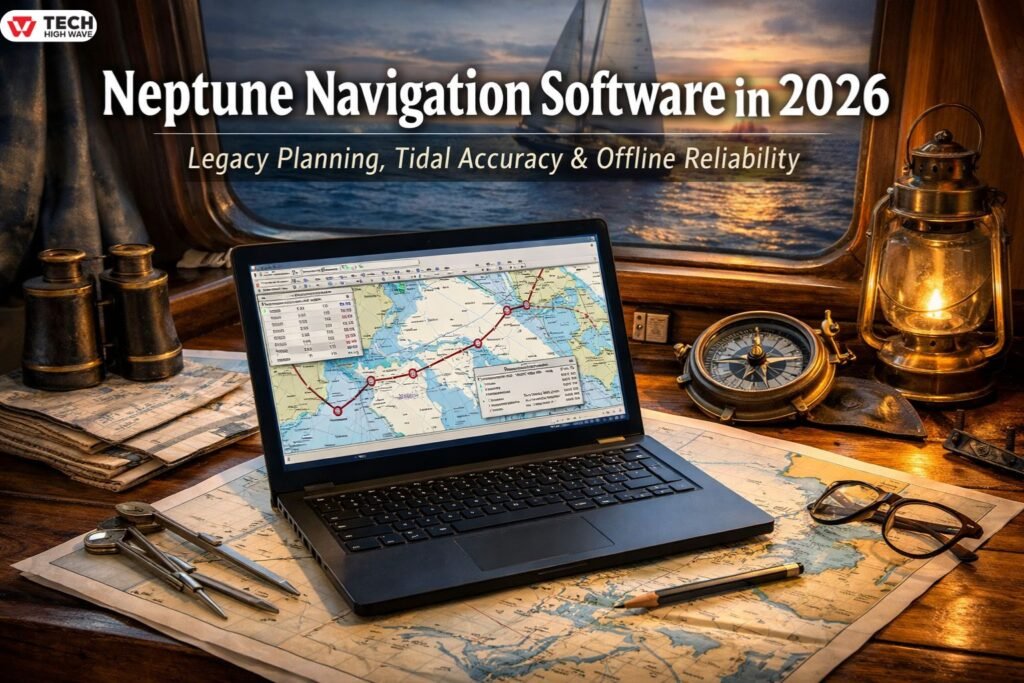
If you’re searching for Neptune navigation software in 2026, you’re likely not hunting for the newest marine app or an AI-driven routing engine. You’re probably looking for something quieter, more predictable, and deliberately offline.
Neptune has never tried to be everything. It was built for sailors who plan carefully, understand tides, and prefer ownership over subscriptions. While the marine navigation market has moved aggressively toward cloud platforms and recurring payments, Neptune has remained rooted in a very different philosophy.
This guide explains what Neptune navigation software is today, why it’s now considered legacy software, and why — despite that — it still hasn’t disappeared from serious navigation discussions.
What Is Neptune Navigation Software?
Neptune navigation software is a PC-based marine passage planning application originally developed by Les and Sandra Emptage. Its primary purpose has always been pre-voyage planning, not live navigation.
It specializes in:
- Manual route and waypoint planning
- High-precision tidal stream calculations
- Course-to-steer computation
- Clear, printable passage plans
Important 2026 Context
Neptune must now be described accurately:
Neptune navigation software is legacy software.
The original developers retired in mid-2024, and active commercial development stopped at that time. The official website remains online primarily to:
- Support existing users
- Provide unlocking and reactivation services
- Host documentation and downloads
Neptune is no longer evolving to compete with modern navigation ecosystems — and that’s a feature for some users, not a flaw.
How Neptune Navigation Software Works
Neptune runs locally on a Windows PC and performs all calculations offline. There is no account system, no cloud sync, and no background data exchange.
The workflow is intentionally traditional:
- Load charts and tidal datasets
- Manually plot waypoints and routes
- Apply tidal streams and timing
- Calculate distances, ETAs, and courses to steer
- Print or export the plan for onboard use
There are no automated routing suggestions, no weather-driven path changes, and no live feeds. The skipper remains fully responsible for every decision.
Key Features That Still Matter in 2026
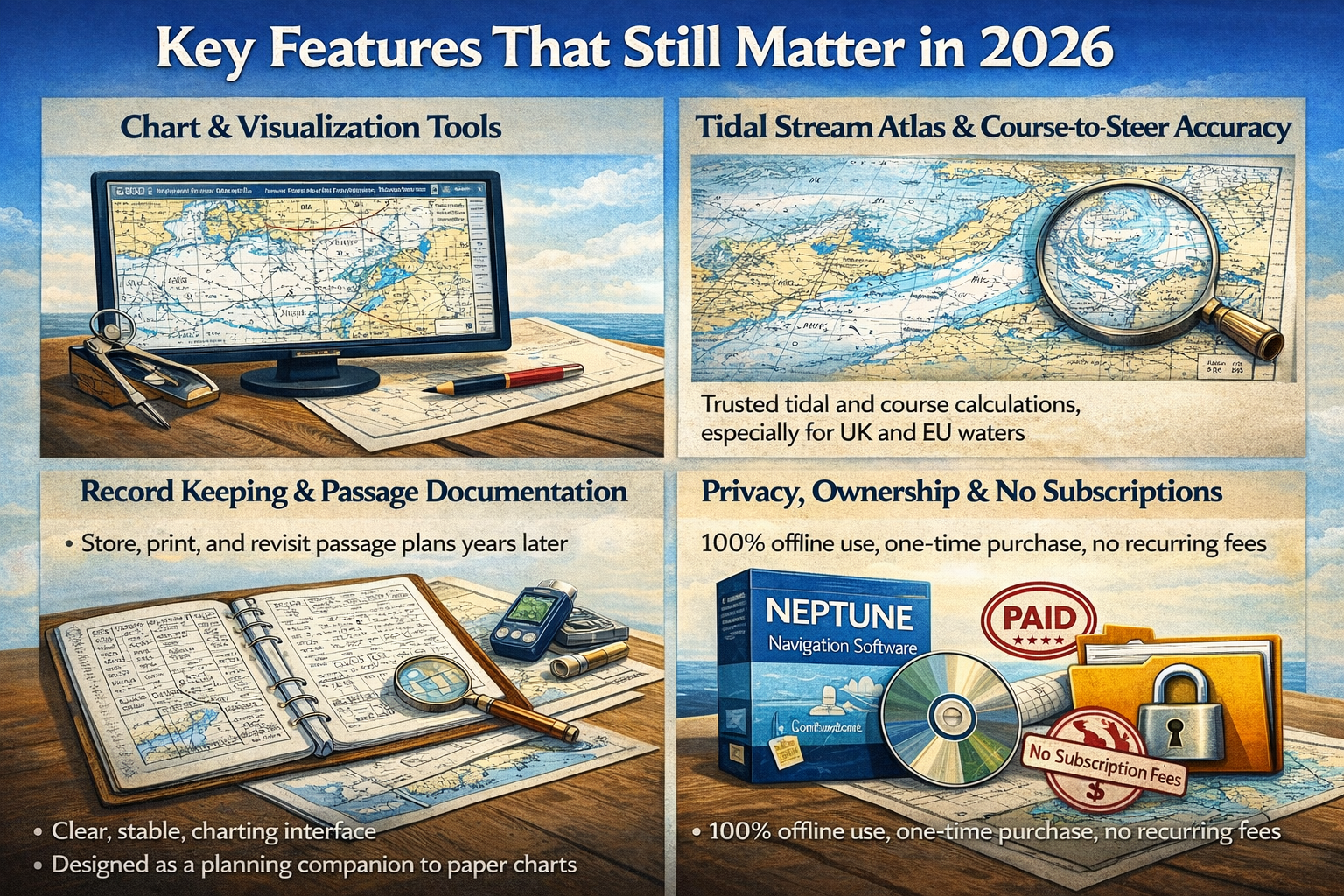
Chart & Visualization Tools
Neptune’s charting interface is utilitarian by modern standards, but it is stable, uncluttered, and predictable. It supports careful planning rather than real-time situational awareness.
For sailors who still use paper charts, Neptune works well as a desk-based companion, not a replacement.
Tidal Stream Atlas & Course-to-Steer Accuracy
This remains Neptune’s most respected capability.
For UK and European waters, Neptune’s tidal stream atlas and course-to-steer calculations are still regarded as exceptionally accurate. Many instructors and delivery skippers trust its math even if they’ve moved on to other tools for execution.
This precision is the primary reason Neptune remains relevant.
Record Keeping & Passage Documentation
Neptune excels at producing clean, structured passage plans suitable for:
- Training environments
- Delivery planning
- Compliance or audit records
Routes and calculations can be saved and revisited years later without format changes or subscription lockouts.
Privacy, Ownership & No Subscriptions
Neptune requires:
- No login
- No internet connection
- No recurring payments
Once unlocked, the software remains usable indefinitely. In an era of subscription fatigue, this ownership model has become one of Neptune’s strongest remaining advantages.
Related: Is Coomersu Legit? What You Should Know Before Visiting
Best Uses for Neptune Navigation Software
Neptune is no longer a general-purpose navigation solution. It performs best in specific, intentional roles.
Best use cases in 2026:
- Offline passage planning before departure
- Redundancy planning alongside modern systems
- RYA instruction and training
- Paper–digital hybrid navigation workflows
- Off-grid cruising preparation
It is not suitable for:
- Live navigation
- Tablet-only sailing setups
- Fleet collaboration
- Dynamic weather routing
Who Should Still Use Neptune Navigation Software?
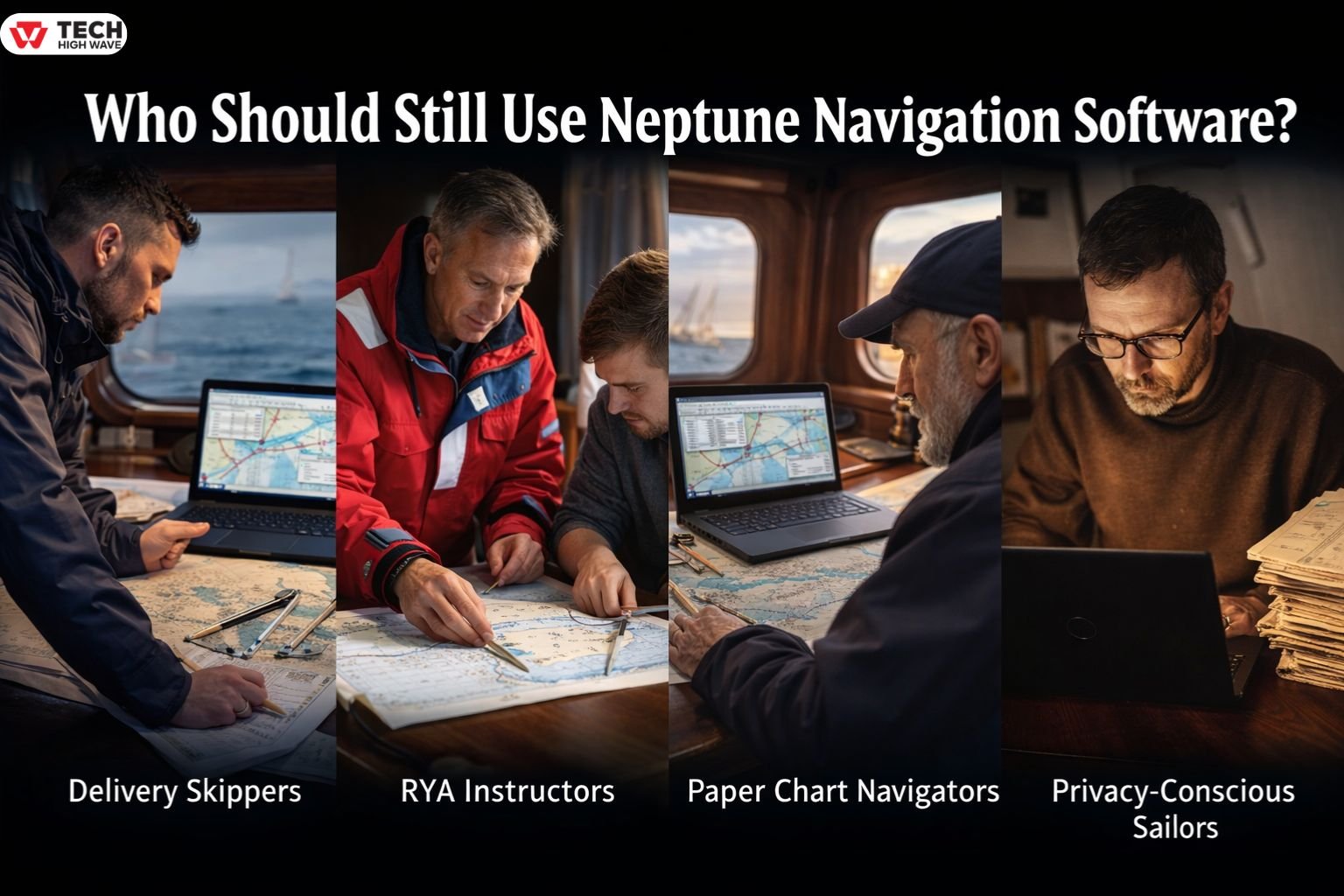
Neptune remains relevant for a narrow but serious audience.
It still makes sense for:
- Delivery skippers who want a distraction-free planning tool
- RYA instructors teaching tidal theory and manual planning
- Sailors who primarily navigate using paper charts
- Privacy-conscious users avoiding cloud ecosystems
It is not well-suited for:
- New sailors expecting modern UX
- Mobile-first navigators
- Users wanting a single “do everything” app
Neptune Navigation vs Subscription-Based Apps (2026 Comparison)
| Feature | Neptune Navigation (Legacy) | Modern Navigation Apps (Navionics, Savvy Navvy, etc.) |
| Pricing Model | One-time purchase (ownership) | Annual subscription (access-only) |
| Internet Requirement | 100% offline, no login required | Periodic check-ins and syncing |
| Tidal Calculations | High-fidelity manual calculations | Automated, AI-interpolated models |
| Routing Philosophy | Manual waypoint planning | Auto-routing & weather routing |
| Hardware Focus | Windows PC (legacy/Intel-based) | Tablets, phones, web sync |
| Live Data | None (static planning) | AIS, weather, crowd-sourced data |
| Data Privacy | Fully local, no data sharing | Cloud-stored, anonymized sharing |
| Failure Mode | Works indefinitely once installed | Degrades if subscription or login fails |
This comparison highlights a critical truth: Neptune isn’t trying to “win” on features. It exists for sailors who see subscriptions, automation, and cloud dependency as liabilities, not benefits.
Compatibility & Platform Considerations
Neptune navigation software is fundamentally a Windows legacy application.
Important notes:
- Works on Windows 10 and most Windows 11 systems
- ARM-based devices may require emulation
- macOS users need virtualization or dual-boot solutions
- The Android Planner app exists but is functionally limited
Neptune should be treated as desktop-only software.
Common Mistakes to Avoid
Most dissatisfaction comes from mismatched expectations.
Avoid:
- Expecting active development or updates
- Assuming mobile or tablet parity
- Using Neptune as a live navigation tool
- Ignoring OS compatibility constraints
Neptune works best when treated as a calculation engine and planning reference, not a modern navigation platform.
Future Outlook: Neptune’s Role Beyond 2026
Unless a successor resumes full development, Neptune’s role is unlikely to expand.
Its long-term relevance lies in:
- Redundancy and backup planning
- Training and education
- Tidal accuracy for specific regions
- Ownership without subscriptions
In a cloud-dominated market, Neptune represents a different philosophy: buy it once, keep it local, and rely on your own judgment.
Frequently Asked Questions
Q.1 Is Neptune navigation software still available in 2026?
Neptune is no longer actively sold as a mainstream product. Availability is mostly limited to existing licenses or legacy channels.
Q.2 Is Neptune navigation software still supported?
Support is limited to unlocking services and basic assistance. There is no active development roadmap.
Q.3 Why do sailors still use Neptune?
Its tidal calculations and course-to-steer accuracy remain highly trusted, especially for UK and European waters.
Q.4 Does Neptune require a subscription?
No. Neptune uses a one-time purchase ownership model with no recurring fees.
Q.5 Can Neptune replace modern navigation apps?
No. It should be used for planning and redundancy, not live navigation.
Q.6 Is Neptune suitable for training and instruction?
Yes. Many instructors still value it for teaching manual navigation and tidal theory.
Final Verdict: Is Neptune Navigation Software Worth Using in 2026?
Neptune navigation software is legacy, static, and unapologetically traditional.
But for sailors who value:
- Offline reliability
- Mathematical tidal accuracy
- Data privacy
- Ownership without subscriptions
…it still has a legitimate place.
In 2026, Neptune isn’t competing with modern navigation apps. It’s doing something else entirely: providing a clean, dependable planning environment for sailors who don’t want their navigation tied to the cloud.
Also Check: Top Free Personal Finance Software to Unlock Your Financial Potential