You’re in the final circle of a Warzone match.
Your heart is racing. One squad left. You line up the shot.
And suddenly your reticle drifts upward.
Not because of recoil. Not because of nerves. Because your controller decided it was time to stare at the sky.
Stick drift hasn’t just become a meme in 2026. For many PlayStation players, it’s one of the most frustrating hardware problems the console ecosystem still struggles with. If you’ve run into the issue before, it helps to understand what actually causes PS5 controller drift and the ways players try to fix it before deciding whether a Hall effect upgrade is worth considering.
While Sony’s standard PS5 controller still relies on traditional potentiometer joysticks—a design that hasn’t changed much in decades—the hardware world is experimenting with something different.
Magnetic sensors.
The rise of the hall effect PS5 controller is part of a broader shift in gaming hardware. Instead of fragile contact-based sensors, these controllers detect joystick movement through magnetic fields. Less friction. Less wear. Far lower drift risk.
But the story is more complicated than the marketing.
Some hall effect controllers sacrifice advanced PS5 haptic features. Others require firmware calibration to eliminate jitter. And new sensor technologies—like TMR sensors—are already pushing magnetic joystick tech even further.
Before investing in a premium controller, it’s worth understanding what actually changes when you switch.
What Is a Hall Effect PS5 Controller?
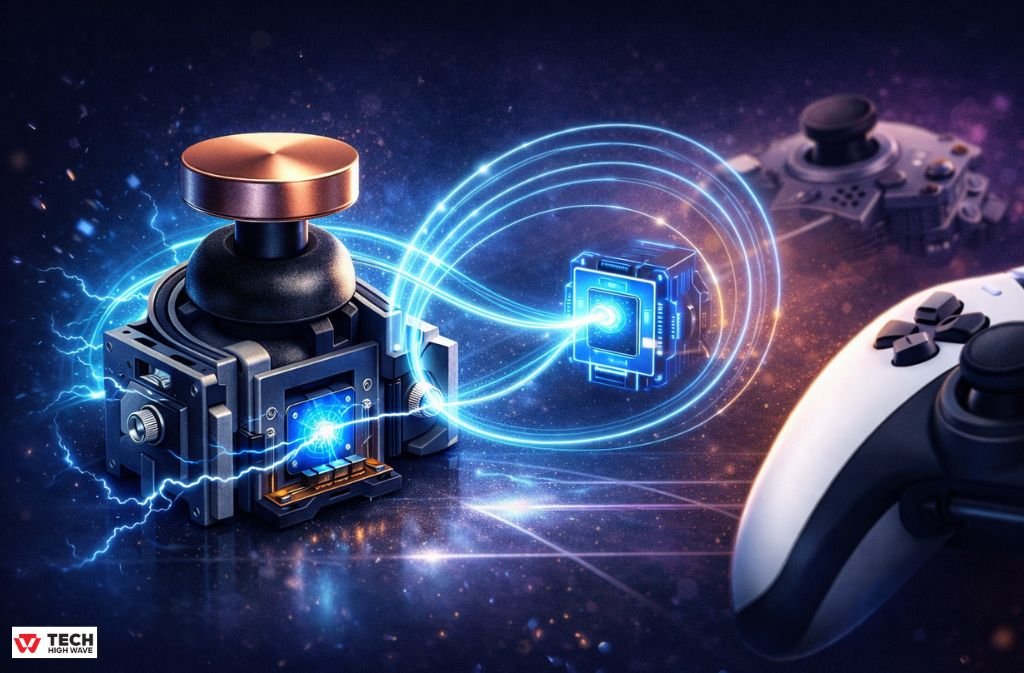
A hall effect PS5 controller uses magnetic sensors to detect joystick movement instead of physical contact sensors.
Traditional controllers rely on potentiometers. Inside the joystick are carbon tracks and metal contacts that measure resistance when the stick moves. Over time, those components wear down.
That’s when stick drift starts.
Hall effect joysticks take a different approach:
-
A magnet is attached to the joystick shaft
-
A magnetic sensor detects its position
-
Movement is translated into input signals
Because the system relies on magnetic fields instead of friction, the sensor itself experiences almost no mechanical wear.
That design dramatically increases the potential lifespan of the joystick.
Why Hall Effect Controllers Matter in 2026
Stick drift isn’t just an occasional annoyance anymore. It’s one of the most commonly reported hardware complaints among console players.
Many gamers only begin researching magnetic joysticks after their controller starts behaving unpredictably. In some cases, however, controller responsiveness problems can also be linked to broader system issues. When that happens, it may help to look at common PS5 performance problems and the ways players troubleshoot them before assuming the controller hardware is permanently damaged.
Still, joystick wear remains the most frequent cause.
Typical joystick lifespan estimates look like this:
| Controller Type | Average Stick Lifespan | Drift Risk |
|---|---|---|
| Standard PS5 controller | 400–500 hours | High |
| Premium pro controllers | 500–800 hours | Medium |
| Hall effect joystick | 5,000+ hours | Very low |
That difference explains why interest in hall effect PS5 controllers has steadily grown over the past few years.
The Science Behind Hall Effect Joysticks
The technology comes from a physical principle discovered in the 19th century called the Hall Effect.
When electricity flows through a conductor and a magnetic field passes across it, the interaction produces a small voltage difference. Sensors can measure that voltage and determine the strength and position of the magnetic field.
In a controller joystick, this allows the system to track movement without requiring physical electrical contact.
Traditional joysticks depend on parts that wear out:
-
Carbon tracks
-
Metal brushes
-
Contact friction
Hall effect sensors remove those failure points.
The result is:
-
More consistent readings
-
Lower mechanical wear
-
Longer hardware lifespan
Do PS5 Controllers Have Hall Effect Joysticks?
The standard PS5 DualSense controller does not use Hall effect joysticks.
Sony still relies on traditional potentiometer sticks in its default hardware.
This means drift can still occur over time. It also explains why some players start exploring third-party controller options after repeated replacements.
Hardware compatibility in the PlayStation ecosystem can be restrictive in general. It’s similar to how using PS4 controllers on PS5 only works under certain conditions, depending on the game and connection method.
For hall effect technology, the current options usually include:
-
Third-party controllers with magnetic sticks
-
Custom controller modifications
-
DIY joystick replacement kits
Hall Effect vs Standard PS5 Controller
Comparing the two technologies highlights the real advantage of magnetic sensors.
| Feature | Standard PS5 Controller | Hall Effect PS5 Controller |
|---|---|---|
| Sensor type | Potentiometer | Magnetic |
| Physical contact | Yes | No |
| Drift risk | Higher over time | Much lower |
| Lifespan | Hundreds of hours | Thousands of hours |
| Maintenance | Occasional replacement | Rare |
The biggest difference isn’t immediate gameplay performance.
It’s long-term reliability.
Notable Hall Effect PS5 Controllers in 2026
Sony hasn’t adopted magnetic sticks yet, but several premium controllers have introduced them.
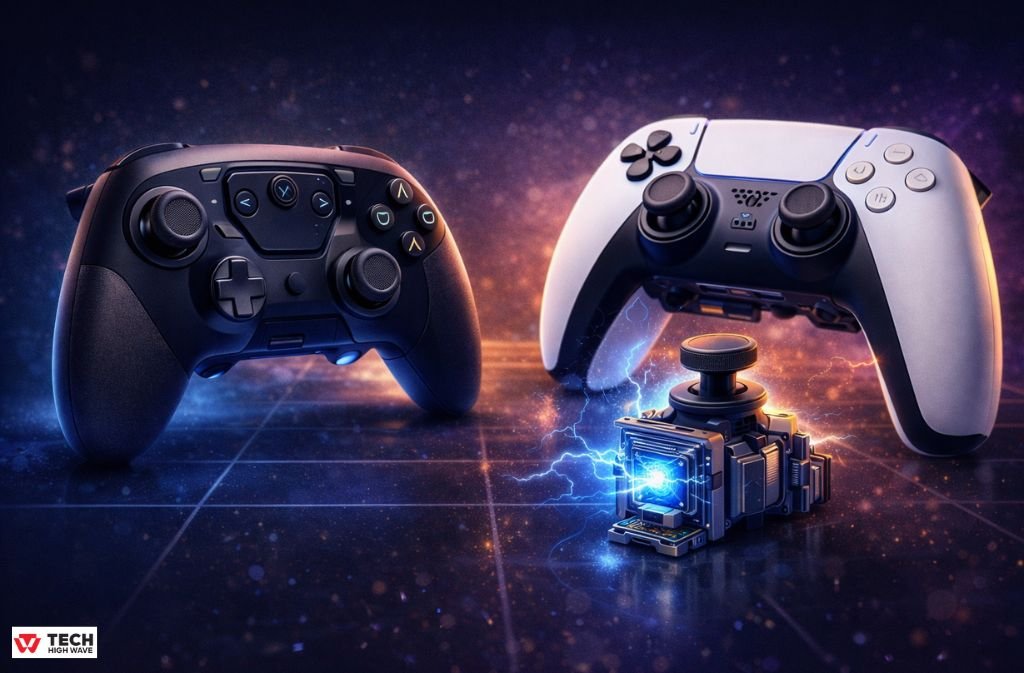
Nacon Revolution 5 Pro
A widely discussed Hall effect controller designed for competitive players.
Strengths include customizable stick tension and extensive software controls. However, like many third-party controllers, advanced PS5 haptic feedback support can be limited in certain games.
Victrix Pro BFG
This controller uses a modular design, allowing players to swap joystick modules.
Instead of replacing an entire controller when a stick wears out, users can simply replace the module.
Custom Hall Effect DualSense Mods
Some services upgrade standard DualSense controllers with hall effect joysticks.
The advantage is simple: you keep the familiar Sony controller design while improving durability.
Some players also experiment with other controller accessories instead of replacing the sticks entirely. For example, certain competitive setups use paddle attachments or remapping tools similar to the Strike Pack accessory, which many PS5 players still experiment with for additional controls.
Firmware Calibration: The Step Most People Skip
Magnetic sensors introduce a small challenge that most players don’t expect.
They can detect extremely tiny movements, which sometimes appear as micro-inputs or “jitter.”
To fix this, many controllers include calibration tools.
Typical calibration steps:
-
Connect the controller to a PC
-
Open calibration software
-
Center both sticks
-
Rotate through the full range of motion
-
Save a deadzone profile
Once calibrated, the sticks usually feel extremely stable.
Skipping this step can make the controller feel overly sensitive.
Building a Reliable PS5 Gaming Setup
Controllers are only one piece of the gaming experience.
Console placement, airflow, and accessory choices can also influence long-term performance and comfort. For example, players who reorganize their gaming space sometimes explore whether mounting the console vertically or installing a PS5 wall mount improves airflow and setup stability.
Audio is another area where the PlayStation ecosystem has unusual limitations. Many players are surprised to discover that Bluetooth headphones like AirPods don’t connect directly to the PS5 without additional hardware workarounds.
Understanding these ecosystem quirks helps explain why third-party hardware solutions continue to grow around the console.
Limitations of Hall Effect Controllers
Magnetic joysticks solve an important problem, but they are not perfect.
Several limitations still exist.
Higher upfront cost
Many hall effect controllers are significantly more expensive than standard DualSense controllers.
Limited PS5 feature support
Some models lose advanced haptic feedback and adaptive trigger functionality.
Modding complexity
DIY upgrades require opening the controller and sometimes soldering components.
For casual players, that level of modification may not be worth the effort.
FAQs
Q. Do PS5 controllers have Hall effect joysticks?
No. Standard PS5 controllers still use traditional potentiometer sensors. Hall effect sticks currently appear mainly in third-party controllers and hardware upgrades.
Q. Is a Hall effect PS5 controller worth it?
For players who frequently experience stick drift, magnetic joysticks can significantly extend the controller’s lifespan.
Q. Can you upgrade a PS5 controller with hall effect sticks?
Yes. Aftermarket joystick modules allow upgrades, although installation may require controller disassembly and soldering.
Q. Do Hall effect controllers eliminate drift completely?
They greatly reduce drift risk, but mechanical wear in other parts of the joystick assembly can still occur.
Conclusion: The Quiet Shift in Controller Technology
Most gamers never think about the sensor technology inside their controllers.
They only notice it when something goes wrong.
Stick drift has become one of the most persistent frustrations in modern gaming hardware. Magnetic joystick sensors offer a compelling alternative to the traditional designs that have dominated controllers for decades.
The hall effect PS5 controller isn’t yet the default option for PlayStation players. But it represents a clear direction for the future of gaming hardware—one where controllers last longer, fail less often, and feel consistent after thousands of hours of gameplay.
If that shift continues, the era of replacing controllers every year may finally start to fade.
Related: Minecraft PlugBoxLinux: The Hidden Linux Setup Powering Faster Minecraft Servers