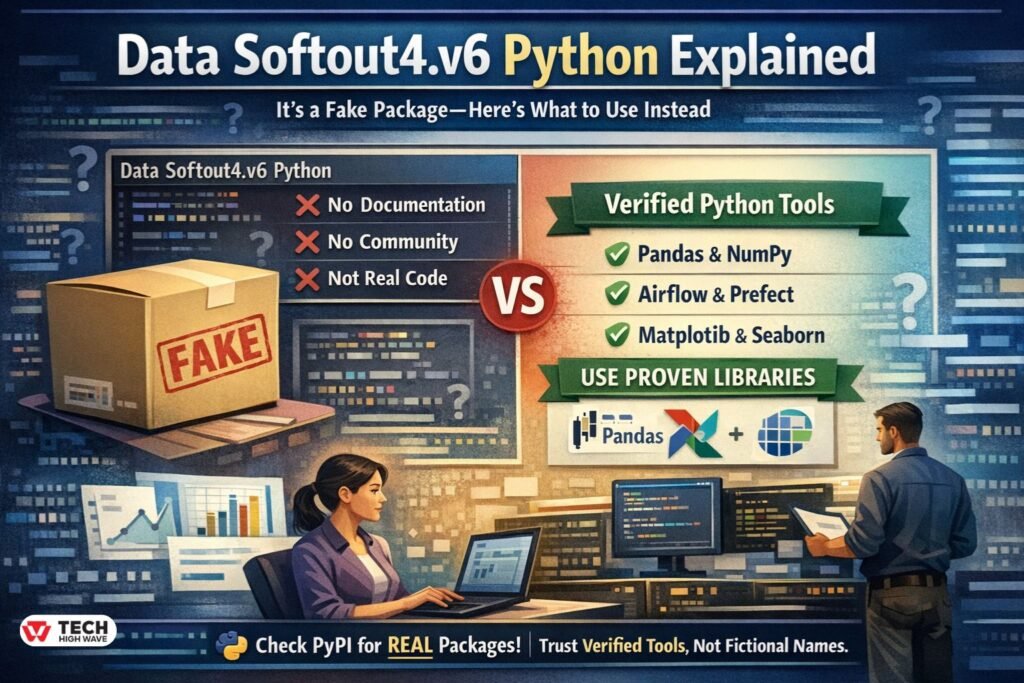
Data Softout4.v6 Python is not a real Python package or framework. Despite appearing in blog posts, guides, and comparison pages, there is no installable library, no PyPI entry, no official documentation, and no maintained repository under this name. It’s a placeholder term—often produced by low-verification or auto-generated content—that loosely describes common Python data workflows without referencing any actual tool.
This article explains why the term keeps appearing, what people are usually trying to accomplish when they search for it, and which verified Python libraries can reliably handle those tasks.
What Is Data Softout4.v6 Python?
Simply put, it doesn’t exist. There’s no package on PyPI, no GitHub repo, no official release notes, nothing. The name is basically used as a placeholder to describe general Python data workflows, like:
- Importing, cleaning datasets (and yes, even small CSVs count)
- Running transformations, aggregations, or merges
- Producing summaries, or simple visualizations
- Keeping workflows reproducible (so someone else could pick it up later)
All of these are standard Python practices, but they rely on verified, actual libraries—not some phantom called Data Softout4.v6 Python.
Why the Term Appears
The name is designed to sound credible, and honestly, in some cases, it works. It’s constructed like this:
- “Data” → suggests it’s technical, serious
- “Softout4.v6” → implies a mature product, like it’s been around a while
- “Python” → ties it to the most popular data language
Content using the term often talks about real data workflow concepts, but the framework itself doesn’t exist. Its presence is mostly due to automated content generation and SEO-driven publishing patterns—rather than anything real, or actually usable.
What Users Are Really Looking For
Most people, when they stumble on Data Softout4.v6 Python, are trying to do practical stuff, like:
- Loading and inspecting datasets
- Performing structured data transformations
- Generating summary statistics, charts, or quick visuals
- Maintaining reproducible workflows (so it doesn’t have to be done from scratch each time)
And all of this is completely achievable using existing Python tools, which are reliable, and documented.
A Real, Minimal Example
To show what people usually want, here’s a working snippet using Pandas—real, tested, and straightforward:
import pandas as pd
df = pd.read_csv(“data.csv”)
summary = df.describe()
print(summary)
In just three lines, it loads a dataset, calculates basic statistics, and prints the results. This is basically what people expect when reading about a fictional “framework,” and it actually works, unlike the non-existent alternative.
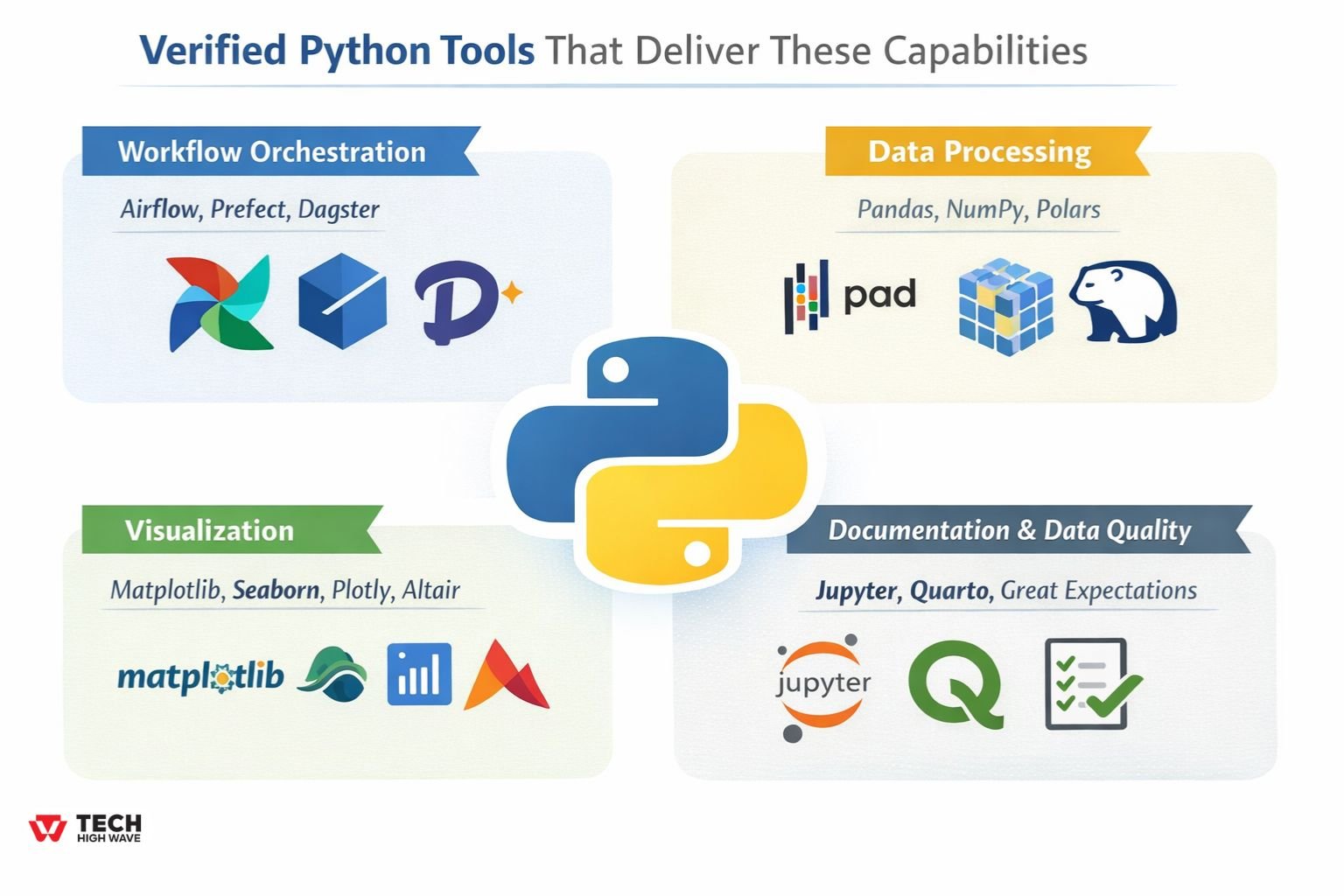
Verified Python Tools That Deliver These Capabilities
Workflow Orchestration
Airflow, Prefect, Dagster—these manage tasks, scheduling, logging, and dependencies. They’re widely used for production pipelines, so if you need reliability, these are the go-to options.
Data Processing
Pandas, Polars, and NumPy handle structured data efficiently—cleaning, aggregating, and transforming. They’re mature, well-documented, and widely adopted.
Visualization
Matplotlib, Seaborn, Plotly, Altair create reproducible charts, for analysis, dashboards, reports—whatever you need.
Documentation & Data Quality
Jupyter Notebooks, Quarto, and Great Expectations support transparency, reproducibility, workflow validation—basically all the things vaguely attributed to fictional frameworks, but actually real.
Related: The Nimedes Mystery: How a “World-Class” AI Tool That Doesn’t Exist Fooled the Internet
Quick Comparison: Data Softout4.v6 Python vs Real Python Tools
| Feature / Task | Data Softout4.v6 Python | Real Python Alternatives |
| Existence | ❌ Fictional placeholder | ✅ Verified libraries and frameworks |
| Data Loading | ❌ Not supported | ✅ pandas.read_csv, polars.read_csv |
| Data Transformation | ❌ Not applicable | ✅ Pandas, NumPy, Polars |
| Automation / Orchestration | ❌ Not available | ✅ Airflow, Prefect, Dagster |
| Visualization | ❌ N/A | ✅ Matplotlib, Seaborn, Plotly, Altair |
| Documentation / Reproducibility | ❌ N/A | ✅ Jupyter Notebooks, Quarto, Great Expectations |
| Community Support | ❌ None | ✅ Active, well-documented communities |
| Verification | ❌ Cannot verify | ✅ Check PyPI listings and official repos |
This table gives readers instant clarity, reinforces the verdict, and points to actionable alternatives. (It’s also a nice visual stop for someone skimming.)
Best Uses for Verified Tools
These tools are great for:
- Analytics reporting, automated pipelines
- Research workflows requiring reproducibility
- Team projects where results need proper documentation
- Scalable, maintainable production pipelines
They are reliable, well-documented, supported by active communities, and actually work—unlike a phantom framework.
Who Benefits Most
Data engineers, analysts, and technical teams gain the most from using verified Python tools. Beginners can also benefit, though a little patience is required—the long-term clarity, reliability, and maintainability make the learning curve worthwhile.
How to Verify Python Tools
A simple rule: always check PyPI before relying on any package. Make sure the library has:
- Installation instructions
- Release notes, version history
- Documentation with examples
- Evidence of ongoing maintenance
If these are missing, it’s probably not legit. Seriously, don’t waste time on it.
Common Mistakes to Avoid
- Assuming polished writing equals legitimacy
- Focusing on names instead of capabilities
- Using unverified frameworks, which often leads to headaches and wasted effort
Frequently Asked Questions
Q.1 Is Data Softout4.v6 Python real?
No, there’s no official library, repository, or package under this name. (It’s literally made up.)
Q.2 Why does it appear online?
It’s used in auto-generated content, or low-verification blogs, to describe generic Python workflows.
Q.3 What are real alternatives?
Pandas, Polars, NumPy, Airflow, Prefect, Dagster, Matplotlib, Seaborn, Plotly.
Q.4 How can tools be verified?
Check PyPI listings, documentation, release history—basically, look for proof it exists.
Q.5 Is relying on fictional tools harmful?
Yes—it wastes time, and undermines trust.
Q.6 What’s the safest approach to unfamiliar tool names?
Identify the capabilities you need, then map them to well-documented, actively maintained libraries. Simple as that.
Future Outlook
Python’s data ecosystem is evolving, but improvements are happening in existing, proven frameworks, rather than unknown, unverified tools. Expect better usability, validation, integration with cloud and enterprise systems—but not some random, fake “framework” popping up.
Also check: QuikConsole Com Explained: What It Is & How It Works (2026)