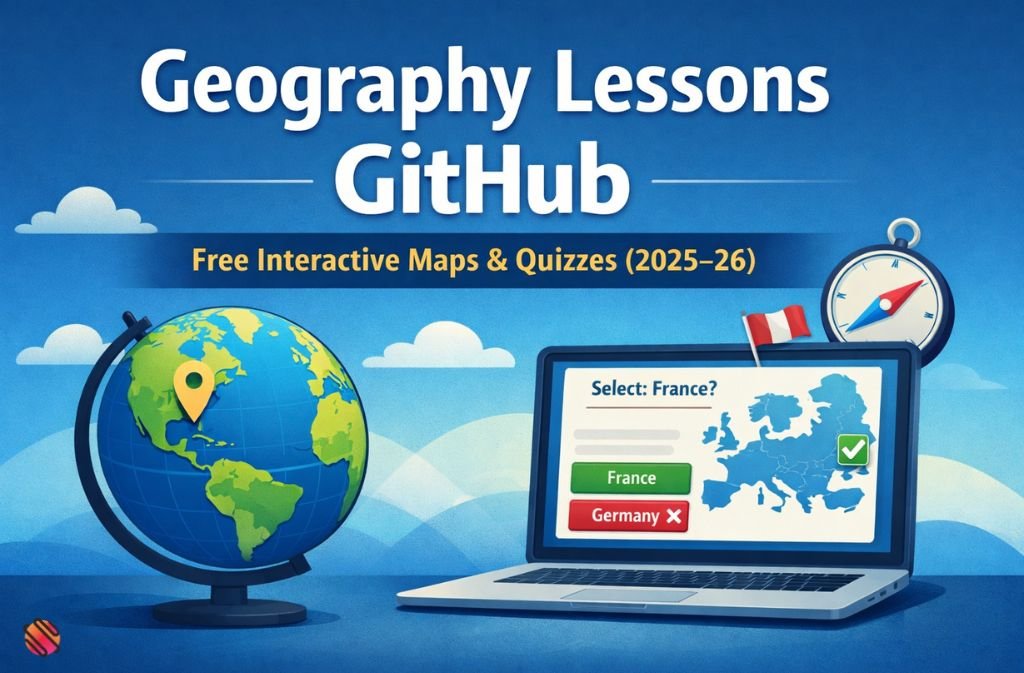
If you searched for geography lessons on GitHub, chances are you weren’t looking to learn programming.
You were probably looking for something much simpler: free geography lessons, interactive maps, or practice quizzes that don’t require subscriptions, logins, or school licenses. GitHub just happened to appear in the results—and that raised a few questions.
That reaction is understandable. GitHub is usually associated with developers, not students or teachers. But over the last few years, it has quietly become a hosting platform for open, browser-based learning tools, including geography lessons used in schools, homeschooling, and self-study.
This article explains what people really mean when they talk about geography lessons on GitHub, how these lessons work, and how to use them safely in 2025 and beyond. No hype, no technical jargon, and no assumptions that you’re a developer.
What People Actually Mean by “Geography Lessons on GitHub”
When most users search this phrase, they are not looking for GitHub repositories full of code.
They are usually looking for live lesson websites that happen to be hosted on GitHub.
These lessons are commonly published using GitHub Pages, a feature that turns project files into normal websites. The result looks and behaves like any other educational site—you open it in your browser and start using it. No GitHub account is required.
In practical terms, geography lessons on GitHub usually appear as:
-
Interactive country and capital quizzes
-
Map-based learning games
-
Simple lesson pages used for revision or homework
-
Open resources shared by teachers or universities
The platform matters less than the outcome: free access to usable learning material.
Why So Many Geography Lessons Are Hosted on GitHub
There’s a reason these projects keep showing up in search results.
First, GitHub hosting is free and reliable. That makes it attractive to educators who want to share lessons without running ads or charging fees.
Second, GitHub Pages sites load quickly and work well on school networks, which often block commercial gaming or quiz platforms.
Third, the content is transparent. Anyone can see when a lesson was last updated, what data it uses, and whether it’s still being maintained. That’s a big trust signal for teachers.
Over time, these factors have made GitHub a quiet hub for open educational resources, especially for subjects like geography that benefit from maps and interaction.
Common Types of Geography Lessons You’ll Find on GitHub
Not all GitHub geography lessons are the same. Most fall into a few broad categories.
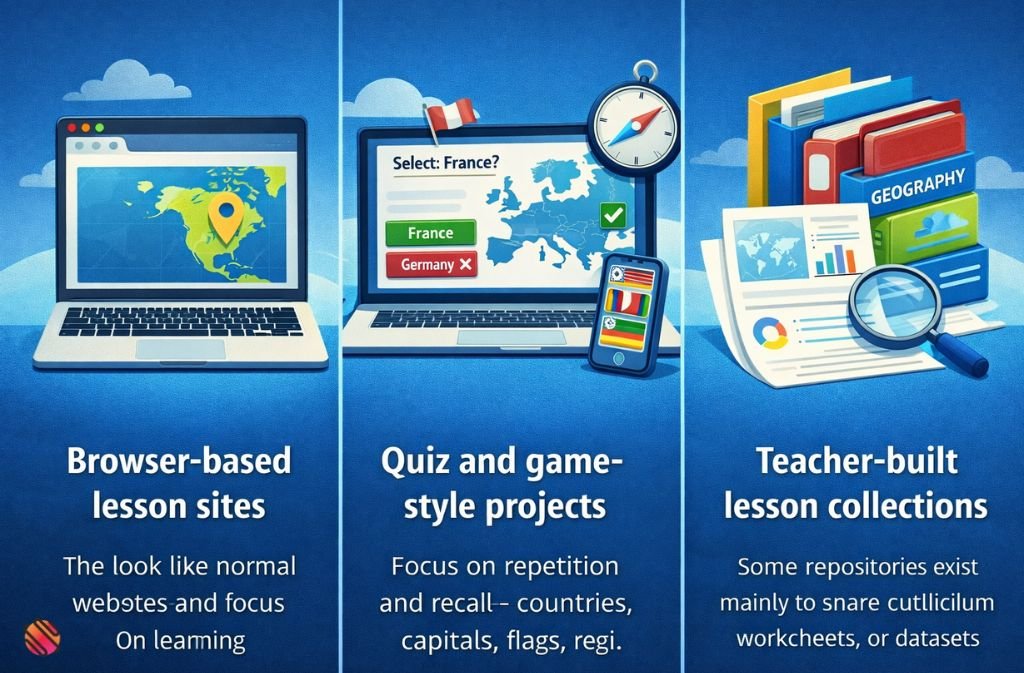
Browser-based lesson sites
These are the easiest to use. They look like normal websites and focus on learning, not technical detail. This is where most students and parents should start.
Quiz and game-style projects
These focus on repetition and recall—countries, capitals, flags, regions. They’re popular for revision and casual practice.
Teacher-built lesson collections
Some repositories exist mainly to share lesson structures, worksheets, or datasets. These are more useful for educators than students.
Understanding the type of project helps avoid frustration and wasted time.
Are Geography Lessons on GitHub Safe to Use?
For the most part, yes—if you use them the right way.
Most geography lessons are hosted as static GitHub Pages sites, which means they don’t install software, run background scripts, or collect personal data. This makes them safer than many third-party quiz platforms.
The simplest rule is this:
If it runs in your browser and doesn’t ask you to download anything, it’s usually fine.
Downloading files is rarely necessary for learning and should only be done if you understand what the project is for.
How Teachers and Students Actually Use These Lessons
In real classrooms, GitHub-hosted geography lessons are rarely used as full courses.
Instead, they’re used for:
-
Revision before tests
-
Homework practice
-
Quick in-class activities
-
Extra support for struggling students
Teachers often appreciate that these tools work without logins and don’t lock features behind paywalls. Some even make copies of the lessons and adapt them for their own classes, something that’s not possible with closed platforms.
GitHub Geography Lessons vs Paid Learning Platforms
Paid geography platforms usually offer polished dashboards, progress tracking, and certificates. GitHub lessons don’t try to compete on those terms.
What they offer instead is flexibility and freedom.
They are:
-
Free to access
-
Ad-free
-
Easy to share
-
Easy to review for accuracy
For many teachers and parents, that trade-off is worth it. GitHub lessons often sit alongside textbooks and formal platforms rather than replacing them.
A Small Technical Note (Without the Jargon)
Many interactive geography lessons use standard open map formats like GeoJSON behind the scenes. You don’t need to understand these formats to use the lessons, but they help explain why the maps load quickly and work well in browsers.
This is one reason GitHub-hosted lessons tend to feel lightweight and responsive compared to older, software-based tools.
Mistakes People Commonly Make
The biggest mistake is assuming that every GitHub project is designed for learners. Some are experiments or teaching demos rather than finished lessons.
Another mistake is expecting certificates or official curriculum alignment. Most GitHub geography lessons are best treated as practice tools, not formal coursework.
A quick look at update dates and page structure usually tells you whether a lesson is worth using.
Why These Lessons Rank So Well on Google
GitHub-hosted geography lessons benefit from a combination of factors Google tends to reward:
-
Fast loading speeds
-
Original, non-duplicated content
-
High user engagement
-
A trusted hosting domain
They also solve a real problem: people want geography practice without subscriptions. That practical usefulness matters more than polish.
What Are Geography Lessons on GitHub? (Quick Answer)
Geography lessons on GitHub are free educational tools, often hosted as normal websites using GitHub Pages. They include interactive maps, quizzes, and lesson content that can be used directly in a browser without accounts, downloads, or payment.
FAQs
Q. Do I need technical skills to use geography lessons on GitHub?
No. Most GitHub geography lessons run on GitHub Pages like regular websites. You can open and use interactive maps, quizzes, and lesson content directly in a browser without coding knowledge. Accounts or programming skills are only needed if you want to modify or fork the lessons.
Q. Are GitHub geography lessons suitable for younger students?
Many GitHub geography lessons are suitable for younger learners, but quality and difficulty vary. Teachers and parents should review lessons first. Browser-based quizzes, interactive maps, and simple revision tools make these lessons safe and engaging for middle-school and high-school students.
Q. Can teachers adapt or customize GitHub geography lessons?
Yes. Most lessons are open-source, allowing educators to fork, copy, or modify content legally. Teachers can adjust quizzes, maps, and exercises to match curriculum goals, classroom needs, or student skill levels. This flexibility makes GitHub lessons ideal for custom classroom activities.
Q. Do GitHub geography lessons replace textbooks or formal courses?
No. GitHub lessons are best used as supplementary learning tools. They provide interactive practice, revision exercises, and fun quizzes but do not offer full curricula, grading, or certification. Pair them with textbooks or formal courses for a complete geography education experience.
Q. Why do schools allow GitHub Pages geography lessons?
GitHub Pages lessons are lightweight, ad-free, and safe for school networks. Unlike many commercial educational platforms, these browser-based lessons do not require software downloads and are sandboxed, reducing security and privacy risks. This makes them suitable for classroom and remote learning environments.
Conclusion
Geography lessons on GitHub exist because educators and developers wanted a simple way to share learning tools without ads, subscriptions, or restrictions.
For students, parents, and teachers, they offer something increasingly rare online: useful content with no strings attached. As long as expectations are realistic and lessons are chosen carefully, these resources can be a valuable part of geography learning in 2025 and beyond.
Related: CNLawBlog Explained: Which One Is Real and Which One Isn’t