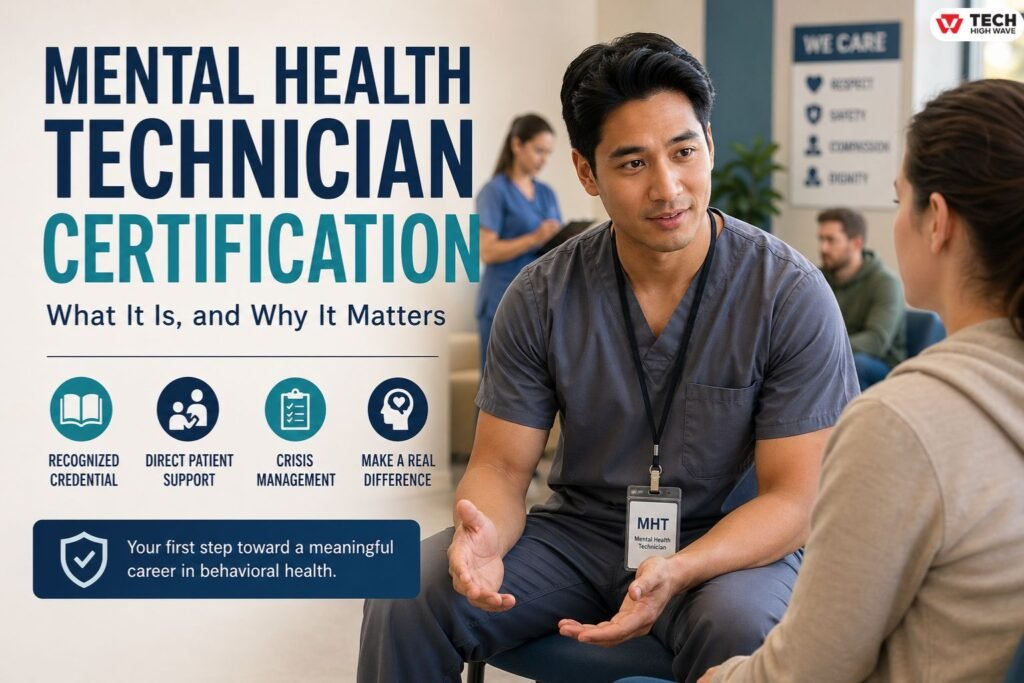
Somewhere between a nursing assistant and a licensed counselor, there’s a role most people outside healthcare have never heard of — but one that psychiatric facilities genuinely can’t function without.
Mental health technicians work directly with patients in behavioral health units, residential programs, and crisis stabilization centers. They’re present during calm moments and during the hard ones. For anyone serious about entering this field, a mental health technician certification isn’t just a resume addition — it’s the credential that tells employers you understand what you’re walking into.
This guide covers what the certification actually means, how the process works, what programs are worth your time, and — critically — what a real shift in this role looks like before you commit.
What Is a Mental Health Technician Certification?
A mental health technician certification is a formal credential issued by a national or state-approved organization confirming that a professional has the foundational knowledge to provide direct psychiatric support under clinical supervision.
The role has several names depending on employer and location — psych tech, behavioral health technician, psychiatric aide, mental health aide. Titles vary. The actual work doesn’t shift that dramatically across them. What changes is the patient population, the setting, and how much independence the facility extends to non-licensed staff.
One thing worth being clear about upfront: this certification is not a clinical license. A certified mental health technician (CMHT) works under licensed clinicians — nurses, social workers, psychiatrists — and handles direct patient interaction, behavioral observation, and crisis support. It’s not a passive role by any stretch, but it operates within a supervised structure.
What a solid certification program typically covers:
- Recognizing symptoms of common psychiatric conditions — mood disorders, psychosis, personality disorders, substance use disorders
- De-escalation techniques and non-physical crisis intervention
- Patient rights, HIPAA compliance, and accurate documentation
- Therapeutic communication — knowing when to talk, and when silence is the better tool
- Observation protocols, safety monitoring, and shift handoff procedures
These aren’t soft-skills workshops. The exams from recognized certifying bodies test applied, scenario-based knowledge. You should expect to study.
How Mental Health Technician Certification Works
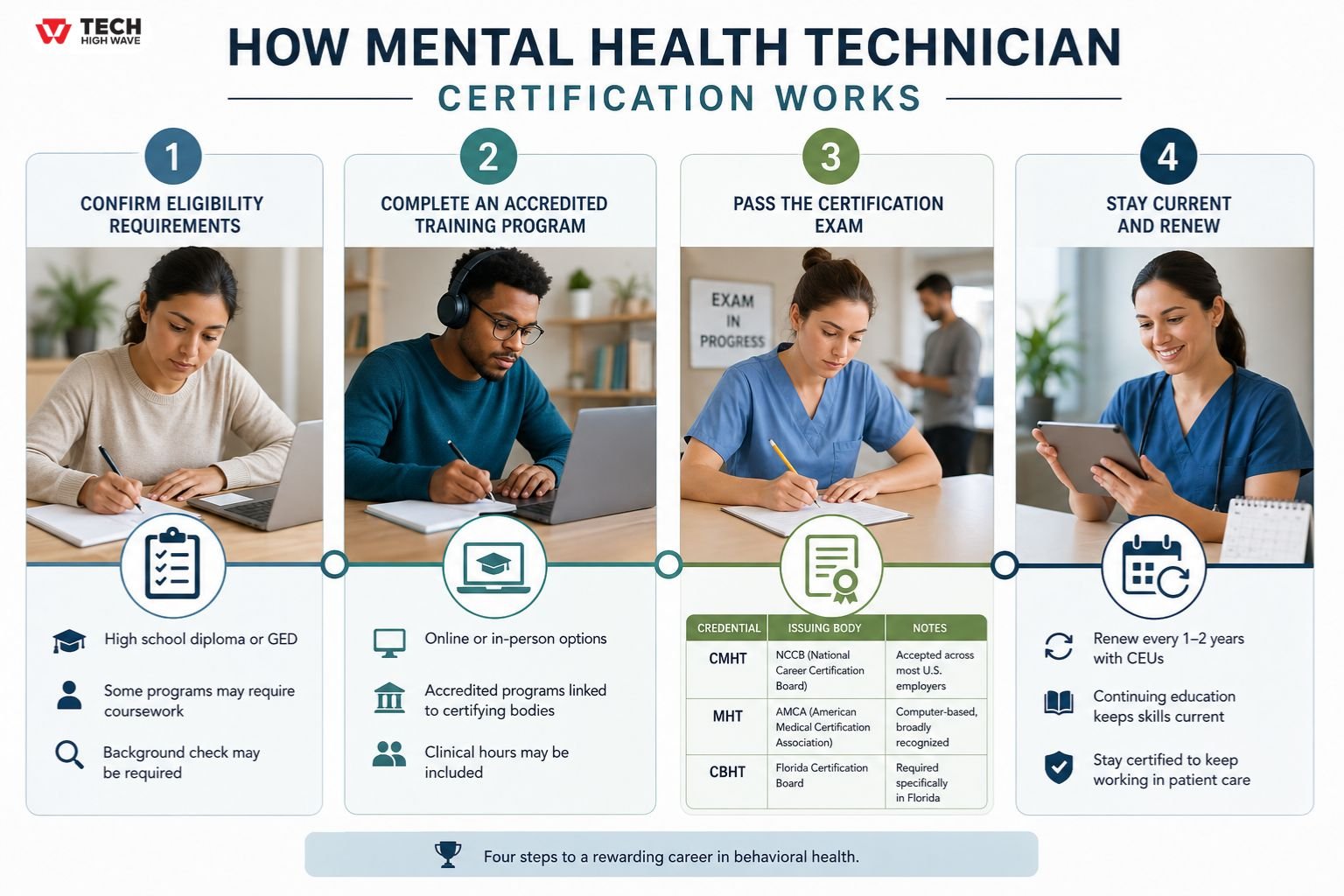
The process has four stages. It’s more accessible than most people assume, but it rewards people who do their research first.
Step 1: Confirm the Eligibility Requirements
Most programs require a high school diploma or GED. Some community college offerings ask for basic psychology or human services coursework. Prior healthcare experience — CNA, medical assistant, home health aide — is an advantage but rarely a hard requirement.
Many programs also require a background check as part of enrollment, especially those with clinical components. Standard practice in healthcare. Not worth being caught off guard by.
Step 2: Complete an Accredited Training Program
This is where people most often make mistakes. Not every course that surfaces in a search result leads to a legitimate credential. The training program must connect to a recognized certifying body — otherwise completing it doesn’t make you eligible for a recognized exam, and some employers won’t accept it at all.
Programs range from a few weeks online to a full semester at a community college. Online options work well for working adults. Classroom programs tend to include supervised clinical hours, which carries real weight with some employers.
Step 3: Pass the Certification Exam
After training, candidates sit for a proctored exam. Two nationally recognized credentials dominate this space:
| Credential | Issuing Body | Notes |
| CMHT | NCCB (National Career Certification Board) | Accepted across most U.S. employers |
| MHT | AMCA (American Medical Certification Association) | Computer-based, broadly recognized |
| CBHT | Florida Certification Board | Required specifically in Florida |
The exams aren’t multiple-choice trivia. They’re built around realistic patient scenarios — how you’d respond to a behavioral escalation, how to document an incident correctly, what your obligations are around patient rights. Know the material, not just the vocabulary.
Step 4: Stay Current and Renew
Most credentials require renewal every one to two years through continuing education units (CEUs). Behavioral health practice evolves and the renewal requirement keeps certified technicians from operating on outdated knowledge.
Let the credential lapse and some employers will pull you from patient-facing roles until it’s reinstated. Treat the renewal deadline like a non-negotiable. Build it into your calendar six months out.
Types of Programs to Know About
Online Certificate Programs
Online mental health technician programs have improved considerably. The reputable ones go well beyond slide decks — video case studies, scenario-based assessments, structured modules that mirror what you’d see on the certification exam.
Completion ranges from four to twelve weeks for most programs. The flexibility is real and useful. The honest limitation is that online-only programs don’t include hands-on clinical hours. If your target employer expects supervised experience, you may need to fill that gap separately.
When evaluating a program, confirm it explicitly prepares students for the NCCB or AMCA exam. If that connection isn’t clearly stated in the program materials, keep looking.
Community College Programs
These run longer — one to two semesters typically — but they come with distinct advantages. Structured coursework, instructor access, supervised clinical placements, and academic credit that can transfer toward a degree in psychology or social work.
If you want a thorough foundation before stepping into a psychiatric unit for the first time, and you’re not in a rush, a community college program is often the smarter long-term choice.
Employer-Sponsored Training
Some hospital systems and residential facilities hire entry-level candidates and train them in-house before assigning direct patient care. The arrangement works well for facilities in high-demand markets: you get paid training and a role on the other side; they get a trained staff member without waiting for external pipelines.
Slots are limited and competitive. You need an offer first. But if you land one, it’s one of the more efficient routes into the field.
A Day in the Life of a Certified Mental Health Technician
Program brochures tend to skip this part. They shouldn’t.
The shift doesn’t start with patients. It starts with the handoff — reviewing charts, absorbing notes from the previous shift, getting briefed on anything flagged overnight. A patient became dysregulated during evening medication rounds. Another refused meals twice in a row. That context shapes every interaction you’ll have for the next eight hours.
Safety checks happen every 15 minutes on most inpatient units. Not approximately 15 minutes. Every 15 minutes. You’re logging each patient’s location, behavior, and affect — and you’re doing it consistently, even when the floor is quiet. Especially when the floor is quiet, because flat affect and sudden calm can signal something is wrong.
Mid-morning often involves a group session. You’re not running it — that’s the social worker or therapist — but you’re present and observing. You notice a patient near the back start to disengage, eyes glazing, posture withdrawing. You catch the clinician’s eye. The session adjusts. That’s exactly what your role is for.
Lunch looks simple from the outside. It isn’t. Eating disorders, medication side effects, and social anxiety all surface in communal meal settings. You’re not just making sure trays get picked up — you’re watching affect, pacing, avoidance, and interaction between patients.
Afternoons can bring a patient in distress. Not always loud. Sometimes it’s someone sitting alone, not speaking, not responding to check-ins the way they usually do. You pull a chair nearby. Don’t push. You wait. Your training tells you the difference between a moment that calls for patience and one that calls for backup — and acting on that judgment correctly matters.
Then there’s documentation. Everything logged. Every behavioral deviation from baseline recorded. The standard is simple and non-negotiable: if it isn’t charted, it didn’t happen. Accurate records protect patients, protect staff, and protect the facility legally.
By the end of the shift, you’ve done more sustained observation and behavioral management work than most people would imagine a non-licensed role involves. It’s demanding — physically and emotionally. It’s also, for the right person, one of the more impactful entry-level roles in healthcare.
State-Specific Requirements: Do the Research First
The NCCB’s CMHT and AMCA’s MHT are nationally recognized, but that doesn’t mean they automatically satisfy every state’s requirements.
Florida is a clear example. It has its own Certified Behavioral Health Technician (CBHT) designation managed by the Florida Certification Board — a separate credential with its own pathway that doesn’t simply overlap with national programs. Mental health technician certification in Florida requires checking with the FCB directly, not just enrolling in a general national program.
Other states layer employer-specific requirements on top of any national credential — CPR and first aid, specific de-escalation training such as CPI (Crisis Prevention Intervention), or minimum documented clinical hours before placement in direct patient care.
The fastest and most reliable way to avoid a gap is to call HR at a facility you’d want to work at. Ask what credentials they accept and whether they require anything beyond the exam. One phone call can save months of unnecessary retraining.
Also Check: Healthcare Software Development Services The Strategic Role in Modern Medicine
Mistakes That Cost People Time and Money
Signing up for a program that isn’t connected to a recognized exam. Plenty of online courses use “certified” in their name without leading to any nationally accepted credential. Verify the program’s connection to the NCCB, AMCA, or an equivalent body before you pay anything.
Skipping state-level research. A credential fully accepted in Texas might not satisfy employer or regulatory expectations in Florida or California. Check your specific market before committing to a program.
Missing the renewal window. The credential lapses if renewal is ignored. In many facilities, an expired certification removes you from patient-facing duties until it’s reinstated. Put the renewal deadline in your calendar now, not later.
Career Path and Honest Salary Expectations
Certified MHTs work in inpatient psychiatric units, residential treatment programs, crisis stabilization centers, adolescent behavioral health programs, correctional mental health settings, and community mental health organizations.
Salaries generally land between $35,000 and $55,000 annually. Geographic location matters more than most entry-level healthcare roles — urban markets with higher costs of living often pay more, though the real-world difference doesn’t always keep pace with cost-of-living gaps. Hospital and government-run facilities tend to offer stronger compensation than outpatient settings.
The career progression piece is worth taking seriously. A significant number of licensed social workers, behavioral health coaches, and clinical supervisors started as mental health technicians. The direct patient experience builds a foundation that classroom education alone can’t replicate. With continuing education and formal degree pathways, moving into clinical roles is realistic and fairly common.
Conclusion
Mental health technician certification is a practical, recognized credential for anyone serious about entering psychiatric and behavioral health care. The process is clear: complete an accredited program, pass a recognized exam, stay current with renewals. But the certification is really preparation for the actual work — the 15-minute safety checks, the group session observations, the moments that require judgment over protocol.
If you’re drawn to mental health care but aren’t pursuing full licensure yet, this is one of the most direct routes into meaningful, clinical-adjacent work. Research programs tied to the NCCB or AMCA, check your state’s specific requirements, and if possible, talk to someone already working the role. What they tell you will matter more than any program brochure.
Frequently Asked Questions
Q1: What is a mental health technician certification?
A mental health technician certification validates competency in psychiatric support and behavioral health care. It’s awarded by organizations like the NCCB or AMCA after completing a training program and passing a standardized exam.
Q2: How long does it take to complete a mental health technician certificate program?
Online programs typically run 4 to 12 weeks. Community college programs take one to two semesters and usually include supervised clinical hours. Exact timelines vary by format and pace of study.
Q3: Is mental health technician certification available online?
Yes. Several accredited providers offer fully online programs leading to the NCCB or AMCA exam. Hands-on clinical hours aren’t included online — some employers may require those separately depending on the role.
Q4: Is a mental health technician the same as an RBT?
No. A Registered Behavior Technician (RBT) works specifically in applied behavior analysis (ABA) for individuals with autism and developmental disabilities. Mental health technicians work across broader psychiatric and behavioral health settings.
Visit For More: TechHighWave