Most developers think about program correctness one execution at a time. You run a program with a given input and check whether the output is correct. That mindset works for many bugs, but it breaks down when verifying modern security guarantees.
Some of the most critical properties in today’s software cannot be evaluated by examining a single execution. Instead, they require reasoning about multiple program runs simultaneously. This is the core challenge behind hyperliveness, a class of properties that compares relationships between different execution traces rather than analyzing just one.
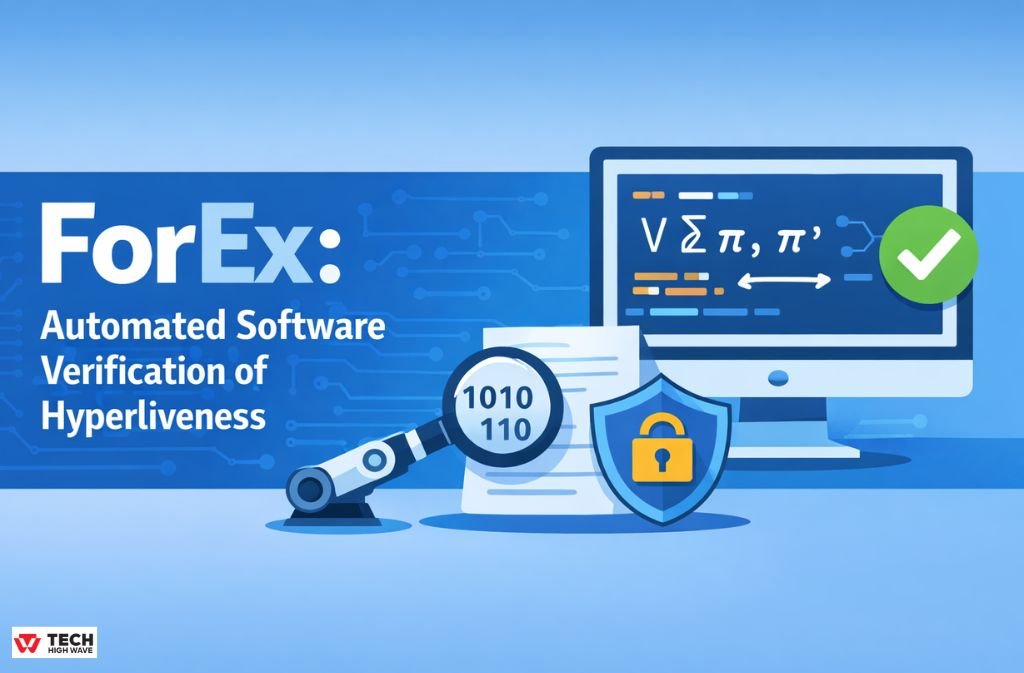
This is where forex automated software verification of hyperliveness becomes important. ForEx is a research tool designed to automatically verify these complex properties using formal program logic and constraint-based reasoning. Instead of checking one run of a program, it analyzes relationships between many possible runs and determines whether a required condition eventually holds.
The ForEx approach represents a significant step forward in formal verification. Traditional verification tools handle safety properties reasonably well, but they struggle when specifications involve both universal and existential reasoning across traces. By extending the classical strongest postcondition method and combining it with constraint solving, ForEx provides a practical framework for verifying hyperliveness properties automatically.
In this guide, you will learn:
-
What hyperliveness properties are and why they matter
-
Why is verifying them computationally difficult
-
How the ForEx constraint-based algorithm works
-
How it compares with earlier verification approaches
-
Real-world applications in security, privacy, and distributed systems
The goal is to translate the core ideas from the original research—such as the paper “Automated Software Verification of Hyperliveness” by Beutner et al.—into a clear, practical explanation that engineers and researchers can understand.
Understanding Hyperliveness in Formal Verification
To understand hyperliveness, it helps to start with the basic categories used in program verification.
Most verification problems fall into two classical groups.
| Property Type | Meaning | Example |
|---|---|---|
| Safety | Something bad never happens | No memory corruption |
| Liveness | Something good eventually happens | Every request gets a response |
| Hyperproperties | Relationships across multiple runs | Data confidentiality guarantees |
| Hyperliveness | Eventual guarantees across multiple traces | Privacy-preserving outputs |
Traditional liveness properties analyze only a single execution trace. For example, a liveness guarantee might say that a request sent to a server eventually receives a reply.
Hyperliveness extends this concept to multiple traces. Instead of reasoning about one execution, it examines relationships between several possible executions.
A typical hyperliveness statement looks like this:
-
For every program execution, there exists another execution that satisfies a related condition.
In logic form, this often appears as:
∀ π ∃ π’ such that property φ holds
Here:
-
π represents one execution trace
-
π’ represents another trace
-
φ expresses a relationship between them
This structure is essential for verifying properties such as information flow security and privacy guarantees.
The theoretical framework used to express these properties is called HyperLTL, a temporal logic that extends Linear Temporal Logic (LTL) to support quantification over multiple traces.
Why Hyperliveness Requires Multiple Execution Traces
Some software guarantees only make sense when comparing different runs of a program.
Consider a privacy-preserving system. If a user changes a secret input value, the public outputs should remain indistinguishable. That means for every execution containing secret input A, there must exist another execution with secret input B that produces the same observable behavior.
This type of guarantee cannot be verified by observing one execution alone. The verification algorithm must reason about relationships between pairs or sets of executions.
This requirement introduces several challenges.
First, the verification process must handle quantifier alternation. Universal quantifiers ask whether a property holds for all traces, while existential quantifiers require the algorithm to find a trace that acts as a witness.
Second, the algorithm must reason about infinite execution spaces. Real programs often contain loops, recursion, and nondeterministic behavior.
Third, the verification tool must construct symbolic representations of execution traces rather than enumerating them explicitly.
These challenges explain why hyperliveness verification remained largely theoretical for many years. Automated tools capable of solving such problems were limited until approaches like the one implemented in the ForEx verification tool emerged.
Also Read: Symbolism of Ticks: The Hidden Energy Drains You’re Ignoring (2026 Guide)
How ForEx Performs Automated Software Verification of Hyperliveness
The key innovation behind forex automated software verification of hyperliveness is a combination of formal program logic and constraint solving. The system converts hyperliveness verification into a logical problem that automated solvers can handle.
The architecture of the ForEx tool operates in three main stages.
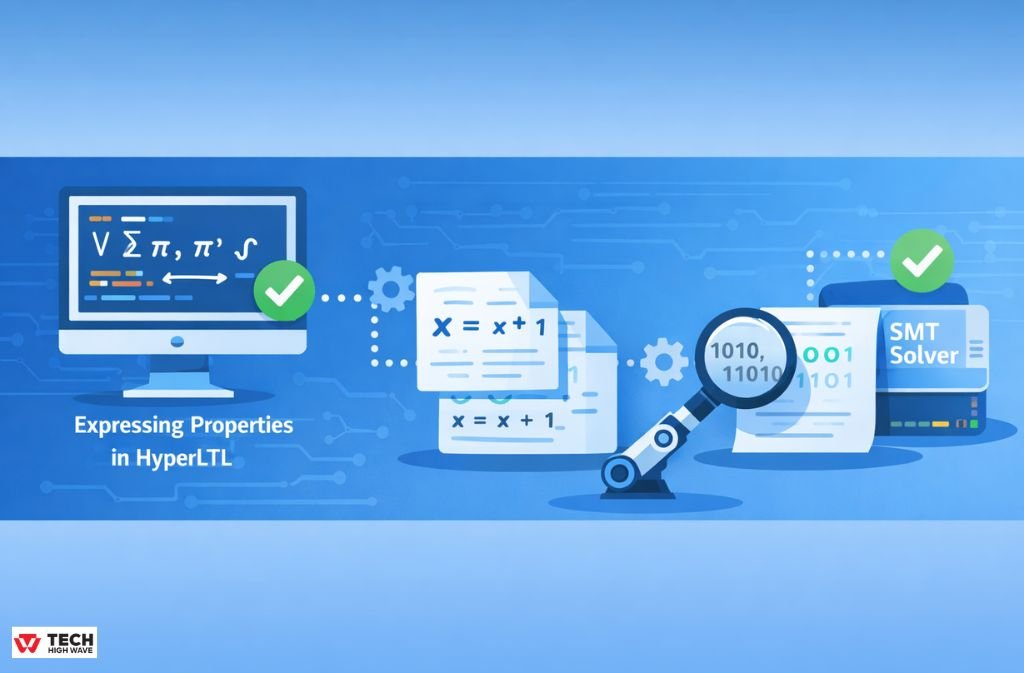
Step 1: Expressing Properties in HyperLTL
ForEx begins by representing the target property in HyperLTL, which allows quantification over multiple execution traces.
A simple hyperliveness specification might take the form:
This means that for every trace π produced by the program, there must exist another trace π′ satisfying the condition φ.
These formulas allow developers to describe complex relationships between program executions, such as confidentiality guarantees or fairness conditions.
Step 2: Computing the Strongest Postcondition
The next step uses a classical concept from program logic called the strongest postcondition.
The strongest postcondition describes the most precise condition that must hold after executing a statement, given a particular starting state.
For example:
If the precondition is:
Then the strongest postcondition becomes:
ForEx generalizes this reasoning to multiple simultaneous execution traces. Instead of tracking one state transformation, it tracks relationships between states across different traces.
This extended strongest postcondition mechanism allows the verification engine to propagate logical conditions throughout the program while preserving trace relationships.
Step 3: Constraint-Based Verification
Once the strongest postconditions are generated, ForEx transforms the verification problem into a set of logical constraints.
These constraints describe:
-
program states
-
relationships between execution traces
-
existential witness requirements
The resulting constraint system is passed to an SMT solver such as Z3. The solver determines whether the constraints can be satisfied.
If they can, the property is verified.
If they cannot, the solver produces a counterexample trace that demonstrates why the property fails.
This constraint-based design allows the algorithm to remain sound and complete within its supported logical fragment, which is a significant improvement over earlier approaches.
ForEx vs Traditional Verification Approaches
To understand the importance of ForEx, it helps to compare it with earlier verification techniques.
| Feature | Manual Proofs | Model Checkers | ForEx |
|---|---|---|---|
| Hyperliveness verification | Possible but complex | Limited support | Full support |
| Automation level | Low | Moderate | High |
| Infinite-state programs | Difficult | Limited | Supported |
| Logical foundation | Ad hoc reasoning | Automata theory | Strongest postcondition |
| Constraint solving | No | Partial | Core mechanism |
Traditional model checkers perform well when verifying safety properties. However, they struggle with existential quantifiers that appear in hyperliveness specifications.
ForEx addresses this gap by generating symbolic constraints that allow existential witnesses to be constructed automatically.
Real-World Applications of Hyperliveness Verification
Although the research around hyperliveness is academic in origin, its applications extend into several real-world domains.
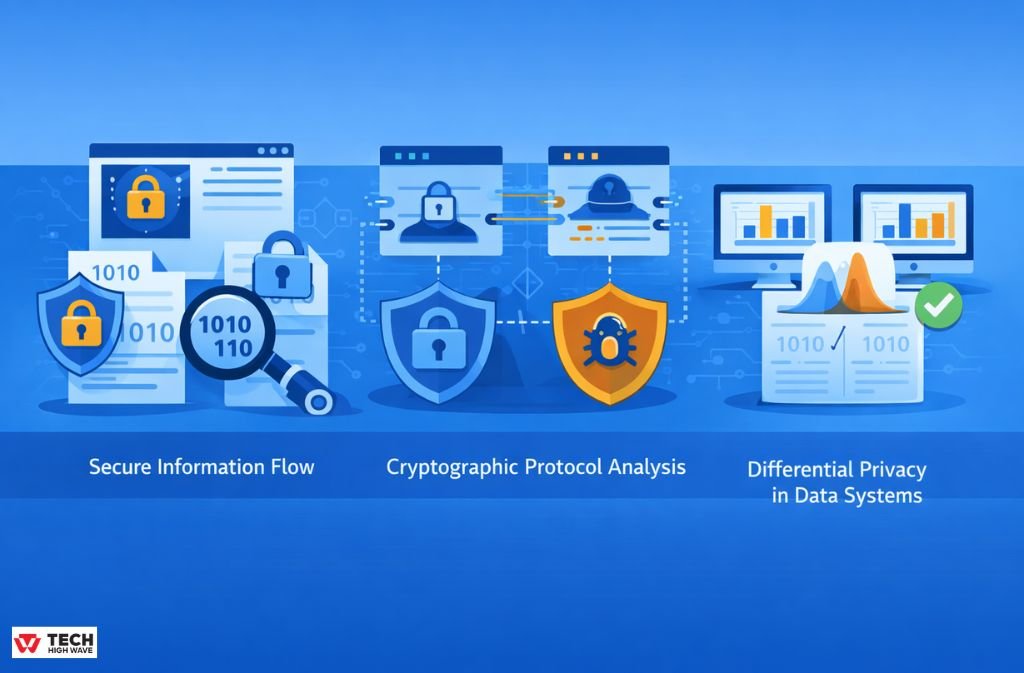
Secure Information Flow
Operating systems and secure applications must guarantee that secret data does not leak through observable outputs. Many confidentiality guarantees can be expressed as hyperproperties comparing multiple program executions.
Hyperliveness verification helps ensure that public outputs remain independent of secret inputs.
Cryptographic Protocol Analysis
Modern cryptographic protocols rely on security guarantees that compare multiple executions of an algorithm under different inputs.
For example, some security definitions require that for every adversarial interaction, there exists a simulated execution that produces indistinguishable outputs.
These guarantees are naturally expressed as hyperliveness properties.
Differential Privacy in Data Systems
Differential privacy is widely used in data analysis and machine learning pipelines.
A system satisfies differential privacy when two executions using neighboring datasets produce statistically similar outputs.
Because this definition compares multiple executions, it can be expressed as a hyperproperty and verified using approaches similar to those used by the ForEx algorithm.
Also Check: What Is Team Software Process? Complete Guide to TSP, Roles, Metrics, and Modern Hybrid Implementation
Common Misconceptions About Hyperliveness Verification
Despite growing interest in this field, several misconceptions persist.
One common misunderstanding is that hyperliveness properties can be verified using the same techniques as safety properties. In reality, the existential quantifiers involved in hyperliveness introduce additional complexity.
Another misconception is that verification tools like ForEx can analyze any real-world program. Current implementations focus on simplified imperative languages to establish sound logical foundations before expanding to more complex languages.
A third misconception is that completeness guarantees unlimited verification capability. Completeness only applies within a specific logical fragment, meaning some properties remain outside the current scope.
Recognizing these limitations is important when applying hyperliveness verification techniques in practice.
Future Directions for Hyperliveness Verification
Research into automated hyperproperty verification continues to evolve rapidly.
One promising direction involves extending the ForEx framework to support richer programming constructs such as procedures, concurrency, and dynamic memory allocation.
Another area of active research focuses on improving integration with SMT solvers. Advances in solver technology directly improve the scalability of constraint-based verification systems.
A third emerging direction is the intersection between program synthesis and hyperproperty verification. In the future, it may be possible to automatically generate programs that are guaranteed to satisfy hyperliveness properties by construction.
These developments suggest that automated hyperliveness verification will become increasingly important as software systems grow more complex and security requirements become stricter.
Frequently Asked Questions
Q. What is hyperliveness in software verification?
Hyperliveness is a class of program properties that involve reasoning about relationships between multiple execution traces. These properties typically require that for every program execution, another related execution exists that satisfies a specific condition.
Q. What is ForEx in formal verification?
ForEx is a verification tool designed to automatically analyze hyperliveness properties in programs. It uses a constraint-based algorithm combined with strongest postcondition reasoning to verify relationships between execution traces.
Q. How does automated hyperliveness verification work?
Automated hyperliveness verification converts the verification problem into logical constraints. These constraints describe relationships between program executions and are solved using automated theorem provers or SMT solvers.
Q. Is ForEx sound and complete?
ForEx is sound and complete within the logical fragment it supports. Soundness means the tool will not incorrectly verify a false property, while completeness means it will find a proof if one exists within the supported logic.
Q. What programming languages does ForEx support?
Current implementations operate on simplified imperative programming languages commonly used in formal verification research. Support for richer languages is an ongoing research area.
Q. Why are hyperproperties important for security?
Hyperproperties allow verification of security guarantees that compare multiple program executions. These include information flow security, differential privacy, and cryptographic indistinguishability properties.
Conclusion
Automated verification of hyperliveness represents one of the most ambitious advances in modern formal methods research. By extending the classical strongest postcondition framework and combining it with constraint solving, the ForEx tool demonstrates that complex hyperproperties can be verified automatically.
The approach behind forex automated software verification of hyperliveness enables reasoning about relationships between execution traces, something traditional verification tools struggle to handle.
For developers building secure systems, this capability is becoming increasingly relevant. Privacy guarantees, cryptographic security definitions, and confidentiality policies often depend on hyperproperties that cannot be checked using traditional techniques.
As research progresses and verification tools mature, automated hyperliveness verification may become a standard component of secure software development workflows.
Related: What Is Hyperfixation? Understanding Hyperfiksaatio in ADHD and Autism