
| Labarty at a Glance
• A digital system designed to organize laboratory experiments and research data |
New terminology often appears in scientific and technology discussions, sometimes without clear explanation. One example is labarty. Researchers, students, and technology professionals frequently encounter the term while exploring laboratory management tools or digital research systems.
The confusion is understandable. The word itself does not immediately reveal whether it refers to software, a research framework, or a broader concept related to scientific workflows.
Modern laboratories generate far more information than they did even a decade ago. Experiments produce datasets, microscope images, calibration logs, analysis reports, and detailed research notes. Over time, those records spread across folders, notebooks, spreadsheets, and instrument outputs.
The data exists.
Finding it later is often the real challenge.
Many research teams only realize the scale of the problem when attempting to review or reproduce an experiment months after it was completed.
This is the environment in which labarty-style systems have begun to appear. They aim to organize experiments, documentation, and datasets within a single structured research environment.
Understanding what labarty represents requires looking at how laboratories manage information, collaboration, and experimental workflows.
What Is Labarty?
Labarty generally refers to a digital research environment designed to organize laboratory experiments, documentation, and scientific data within a centralized system.
At its core, the concept focuses on improving how research teams manage information.
Laboratories rarely work with a single type of data. Experiments generate measurements, images, analytical results, and procedural notes. Each piece of information must remain connected to the original experiment.
Without structure, those records become fragmented.
Consider a typical research situation.
A scientist performs a test using multiple instruments, stores raw data on a workstation, and writes observations in a notebook. Weeks later, a colleague asks to review the experiment.
The data still exists—but locating every file can take time.
Labarty-style systems attempt to prevent that fragmentation by providing a structured digital environment for research activities.
In practical terms, such systems may support:
- Experiment documentation and record keeping
• Centralized storage of datasets and research files
• Tracking of experiment procedures and outcomes
• Collaboration between research teams
• Visualization and analysis of scientific data
Rather than representing one specific product, the term often describes a broader approach to digital laboratory organization.
The goal is simple: keep research information connected, traceable, and accessible.
Why Labarty Is Becoming Popular
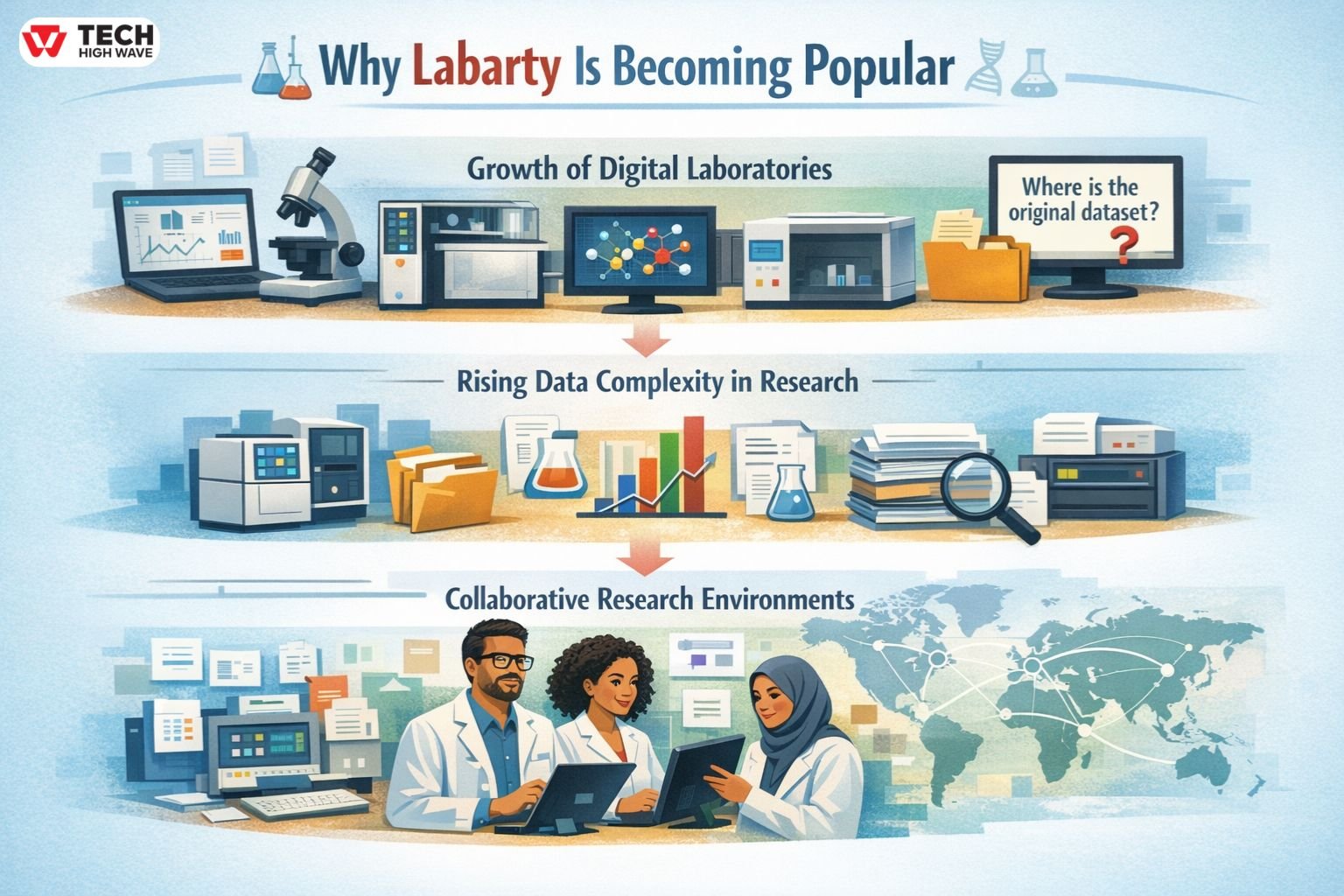
Across many research environments, the same challenge appears repeatedly—information grows faster than traditional documentation methods can manage.
Paper notebooks and scattered digital files were once sufficient. Modern research rarely works that way anymore.
Growth of Digital Laboratories
Scientific experiments now generate detailed digital outputs. Instruments record measurements automatically, imaging systems produce high-resolution datasets, and analytical software creates additional layers of data.
Keeping track of all these files manually becomes difficult.
Even well-organized teams eventually encounter the same question:
Where was the original dataset stored?
Digital laboratory systems attempt to solve that problem by centralizing documentation and experiment records.
Rising Data Complexity in Research
A single experiment may now involve dozens of files, including:
- instrument measurements
• analysis reports
• experimental observations
• calibration logs
• imaging results
Over time, the volume increases.
Many research teams underestimate how quickly documentation grows. What begins as a small project can evolve into hundreds of files within a few months.
Structured platforms help maintain order as datasets expand.
Collaborative Research Environments
Few modern experiments are conducted by a single researcher.
Scientific projects often involve teams working across departments, institutions, or even countries. Sharing experiment records through email or file transfers can become inefficient.
Visibility becomes more important than communication.
When researchers can access the same structured documentation, collaboration becomes much easier.
How Labarty Works
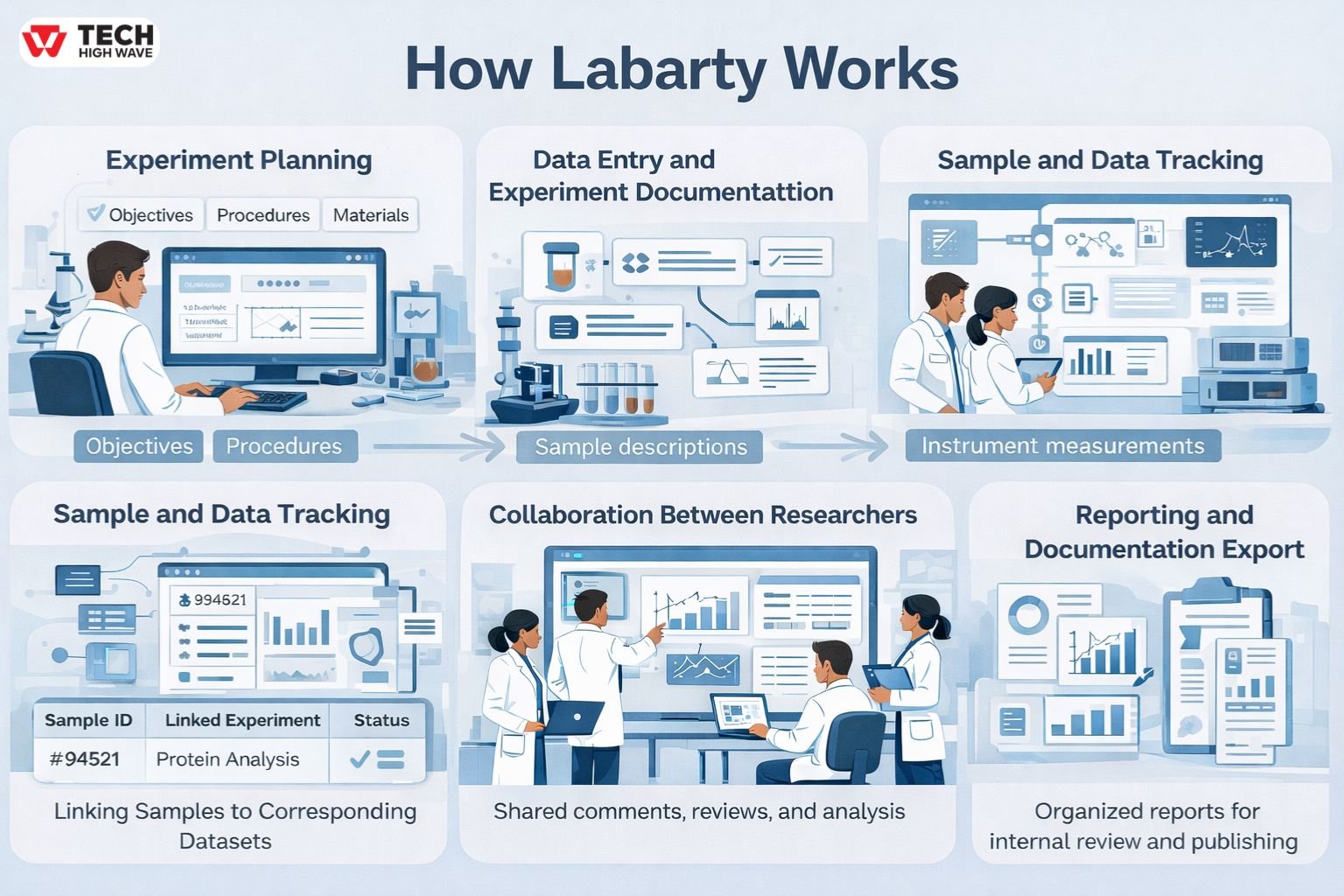
Although different systems vary in design, most labarty-style environments follow a similar research workflow.
-
Experiment Planning
Research projects typically begin with defining objectives, procedures, and materials.
Recording these details within a structured platform ensures that experiment protocols remain available to the entire research team.
Clear documentation also helps maintain consistency across repeated experiments.
-
Data Entry and Experiment Documentation
During experiments, researchers record observations, measurements, and procedural notes.
These entries may include:
- experiment protocols
• sample descriptions
• instrument measurements
• research notes
• environmental conditions
Digital documentation replaces traditional handwritten lab notebooks.
The advantage is not just storage.
It is traceability.
-
Sample and Data Tracking
Experiments often involve multiple samples, variables, and datasets. Without a clear tracking system, connecting results to specific experimental conditions can become difficult.
Structured platforms link each dataset to its corresponding experiment and sample.
Researchers no longer need to search across multiple files to reconstruct results.
-
Collaboration Between Researchers
Scientific research benefits from review and discussion.
Labarty-style environments allow researchers to comment on experiment records, review results, and contribute additional analysis.
In practice, collaboration problems rarely come from a lack of communication.
The issue is usually visibility.
Shared research environments allow teams to see the same data at the same time.
-
Data Visualization and Analysis
Large datasets can be difficult to interpret without visual representation.
Many platforms include tools that convert raw measurements into charts, graphs, or statistical summaries. These visualizations help researchers identify patterns and compare experimental outcomes.
Insights often appear faster when results are presented visually.
-
Reporting and Documentation Export
Research projects eventually produce reports, presentations, or publications.
Structured documentation allows experiment records and datasets to be exported into organized reports. This simplifies internal reviews and supports scientific publishing.
Well-documented research is easier to evaluate, replicate, and share.
Core Features of a Labarty System
Digital research platforms typically include several key capabilities.
Chart & Visualization Tools
Data visualization plays an important role in scientific analysis. Graphs, trend charts, and statistical plots help researchers interpret complex datasets more easily.
Visual summaries often reveal patterns that remain hidden in raw data.

Record & Document Storage
Laboratories generate numerous documents—protocols, experiment logs, images, datasets, and analysis reports.
Structured storage keeps these materials organized and searchable.
Typical capabilities include:
- version tracking for experiment notes
• searchable research archives
• timestamped experiment records
• categorized document management
Research data rarely disappears.
It simply becomes difficult to find.
Collaboration & Sharing
Research teams often involve scientists, technicians, and analysts working together.
Shared digital environments allow team members to contribute data, review results, and coordinate experiments within the same workspace.
Centralized records also make it easier for new team members to understand previous experiments.
Privacy & Data Security
Scientific research frequently involves sensitive information, intellectual property, or regulated datasets.
Reliable research platforms include security features such as encrypted storage, access permissions, and activity logs.
These protections ensure that research information remains accessible only to authorized users.
Also Check: What Is Hyperfixation? Understanding Hyperfiksaatio in ADHD and Autism
Labarty vs Traditional Laboratory Management
Laboratories historically relied on manual documentation methods. Digital research systems introduce several improvements.
| Feature | Traditional Lab Methods | Labarty Systems |
| Experiment tracking | Paper notebooks | Digital experiment logs |
| Data storage | Multiple local files | Centralized repository |
| Collaboration | Manual file sharing | Shared research workspaces |
| Data search | Manual lookup | Instant searchable records |
Centralization solves a surprisingly common problem: locating research data months after an experiment.
Labarty vs Electronic Lab Notebooks
Electronic Lab Notebooks (ELNs) are widely used in scientific environments. They share similarities with labarty-style systems but often focus primarily on documentation.
| Feature | Electronic Lab Notebook | Labarty Systems |
| Main purpose | Record experiments | Manage full research workflow |
| Data tracking | Limited | Comprehensive |
| Collaboration | Basic sharing | Integrated collaboration |
| Workflow tools | Minimal | Broader workflow features |
In many cases, electronic notebooks function as one component within a larger research management environment.
Best Uses for Labarty
Labarty-style systems appear in a wide range of research environments.
Academic Research Laboratories
Universities conduct experiments across multiple disciplines. Structured platforms help maintain consistent documentation across research groups.
Biotechnology and Pharmaceutical Research
Drug development requires detailed experiment records and regulatory documentation. Digital platforms simplify the organization of these materials.
University Research Departments
Large institutions often coordinate research between departments. Shared systems help teams access the same data and maintain consistent documentation standards.
Environmental and Field Research
Field researchers collecting environmental samples must record observations quickly and accurately.
Digital platforms allow those records to be stored alongside laboratory analysis results.
Engineering and Prototype Development
Engineering teams testing prototypes often generate technical measurements, design iterations, and performance results.
Structured documentation systems help maintain a clear record of development progress.
Who Should Use Labarty?
Labarty systems provide the greatest value in environments where experiments produce complex or large datasets.
Ideal Users
- scientific research teams
• biotechnology organizations
• university laboratories
• engineering research groups
• environmental research programs
These environments depend on accurate experiment records.
Occasional Users
Smaller research teams may also adopt simplified documentation systems when managing multiple experiments.
When It May Not Be Necessary
Not every research activity requires a full digital laboratory platform.
Small projects with limited documentation needs may function effectively with simpler tools.
How to Choose the Right Labarty Platform
Selecting an appropriate system requires careful evaluation.
Data Storage Capacity
Research teams handling large datasets require platforms capable of storing and retrieving information efficiently.
Collaboration Features
Shared workspaces, commenting tools, and user access controls allow multiple researchers to contribute to the same project.
Integration with Research Tools
Many laboratories rely on specialized instruments and analytical software.
Platforms that integrate with existing tools reduce workflow disruption.
Security Standards
Sensitive research environments should prioritize encryption, access monitoring, and secure data storage.
Scalability
Research programs often grow over time.
Scalable platforms can support larger datasets and expanding research teams without requiring major system changes.
Common Mistakes When Implementing Labarty
Adopting digital laboratory systems can improve organization, but certain mistakes appear frequently.
Ignoring Training Requirements
New platforms require onboarding. Without proper guidance, researchers may revert to older documentation habits.
Poor Data Structure
If experiment records are entered inconsistently, analyzing results later becomes difficult.
Clear documentation standards help prevent confusion.
Weak Access Controls
Allowing unrestricted editing or data access may create security risks or accidental data changes.
Incomplete Data Migration
Transferring historical experiment records into new systems can be complex.
A common problem appears when older datasets exist in inconsistent formats.
Challenges of Labarty Systems
Digital research platforms offer clear advantages, but laboratories may encounter challenges during adoption.
Researchers must adapt to new documentation workflows. Existing data may need restructuring before migration. Integration with older laboratory instruments can also require additional configuration.
These challenges are manageable, but they require planning.
Successful adoption often depends on training, clear documentation standards, and gradual implementation.
Future Trends in Labarty (2026 Outlook)
Laboratory technology continues evolving as research becomes increasingly digital.
Automated Data Capture
Modern instruments increasingly connect directly with research management systems. Measurements can be recorded automatically, reducing manual data entry.
Advanced Data Analysis
Integrated analysis tools allow researchers to explore large datasets more efficiently. Visualization and statistical modeling are becoming standard features.
Remote Research Collaboration
Many research teams operate across multiple institutions.
Secure digital platforms allow scientists to review experiment records and collaborate from different locations.
Integrated Compliance Tools
Regulatory requirements continue to shape research documentation practices.
Platforms increasingly include built-in compliance features that support structured reporting and audit preparation.
Frequently Asked Questions
Q1: What does labarty mean?
Labarty refers to a digital environment used to organize laboratory experiments, research data, and collaboration within a structured system.
Q2: Is labarty a specific software platform?
The term often describes a category of laboratory workflow systems rather than a single product.
Q3: How is labarty different from LIMS?
Laboratory Information Management Systems focus mainly on sample tracking, while labarty-style platforms often manage broader research workflows and experiment documentation.
Q4: Can small laboratories use labarty systems?
Yes. Smaller laboratories can benefit from structured experiment documentation, although simpler tools may sometimes be sufficient.
Q5: Is labarty used outside scientific laboratories?
Similar systems may also support engineering testing, prototype development, and technical documentation workflows.
Q6: How secure are labarty platforms?
Most platforms include encrypted storage, user access controls, and activity logs to protect research data.
Q7: What is the main benefit of labarty?
The primary benefit is improved organization of research data, allowing experiments, datasets, and documentation to remain connected and accessible.
Also Read: What Is Android System Intelligence? Features, Privacy, Battery Use & Safety