TL;DR: When FT-QPSI Matters
|
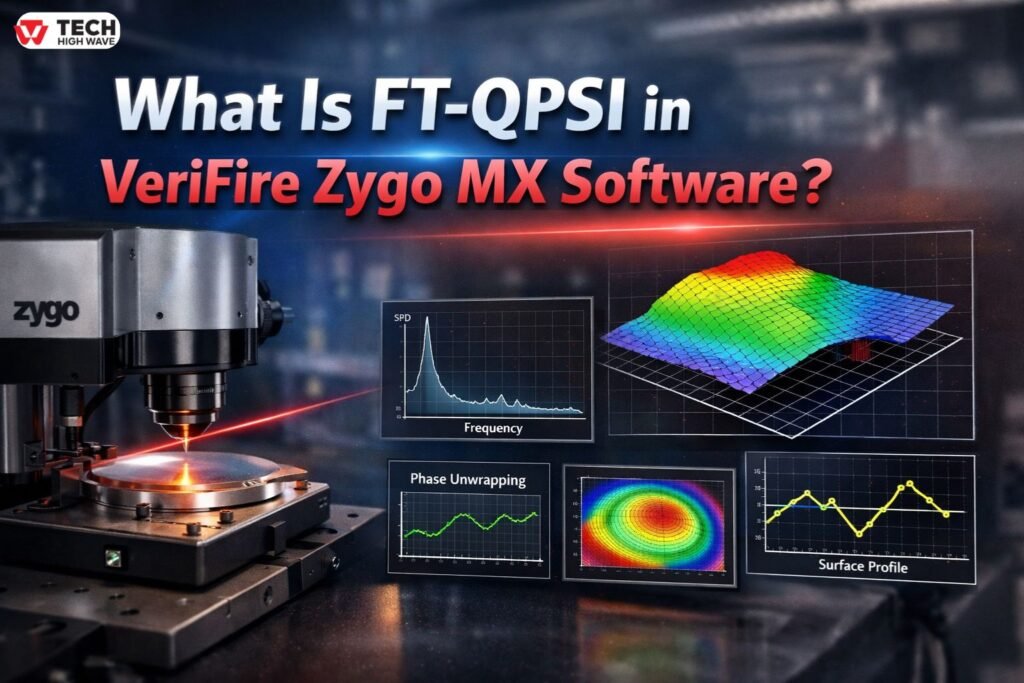
Modern optical manufacturing operates at nanometer-scale tolerances. When repeatability drifts by even a few nanometers, product yield, compliance audits, and customer acceptance can all be affected. That is why engineers frequently ask what is FT-QPSI in VeriFire Zygo MX software and whether it materially improves measurement stability.
FT-QPSI is not a cosmetic software feature. It is an advanced phase extraction method within the VeriFire platform developed by Zygo Corporation. It combines quadrature phase sampling with Fourier transform processing to improve robustness against vibration and phase-step errors.
This guide explains how FT-QPSI works, how it compares to traditional phase-shifting interferometry, when it should be used, where it fits within Zygo MX measurement modes, and what limitations must be considered in real production environments.
What Is FT-QPSI in VeriFire Zygo MX Software?
FT-QPSI stands for Fourier Transform – Quadrature Phase Shift Interferometry. It is a hybrid phase extraction method used in interferometric surface metrology.
In practical terms, FT-QPSI combines:
- Traditional phase-shifting interferometry (PSI)
- Quadrature phase sampling
- Fourier-based signal reconstruction
Its goal is to extract accurate surface phase data from interference fringes while reducing sensitivity to:
- Mechanical vibration
- Air turbulence
- Phase-step calibration errors
- Minor actuator nonlinearities
Unlike classical PSI, which depends heavily on precise mechanical phase increments, FT-QPSI uses quadrature information and frequency-domain processing to compensate for small phase-step deviations.
In short, FT-QPSI improves measurement robustness in less-than-perfect environmental conditions.
Where FT-QPSI Fits Within Zygo MX Measurement Modes
Within the Zygo MX software environment, FT-QPSI functions as a selectable phase-shifting mode available on compatible interferometer systems. It operates at the algorithmic level, meaning:
- The interferometer still captures multiple phase-shifted fringe images.
- The reconstruction method differs from classical PSI.
- Processing parameters are applied during phase extraction, not fringe acquisition.
In many setups, FT-QPSI can be enabled within measurement configuration settings alongside other phase-shifting or dynamic measurement options.
It does not replace hardware vibration isolation, nor does it convert a static interferometer into a fully dynamic system. Instead, it enhances computational stability within existing hardware constraints.
How FT-QPSI Works
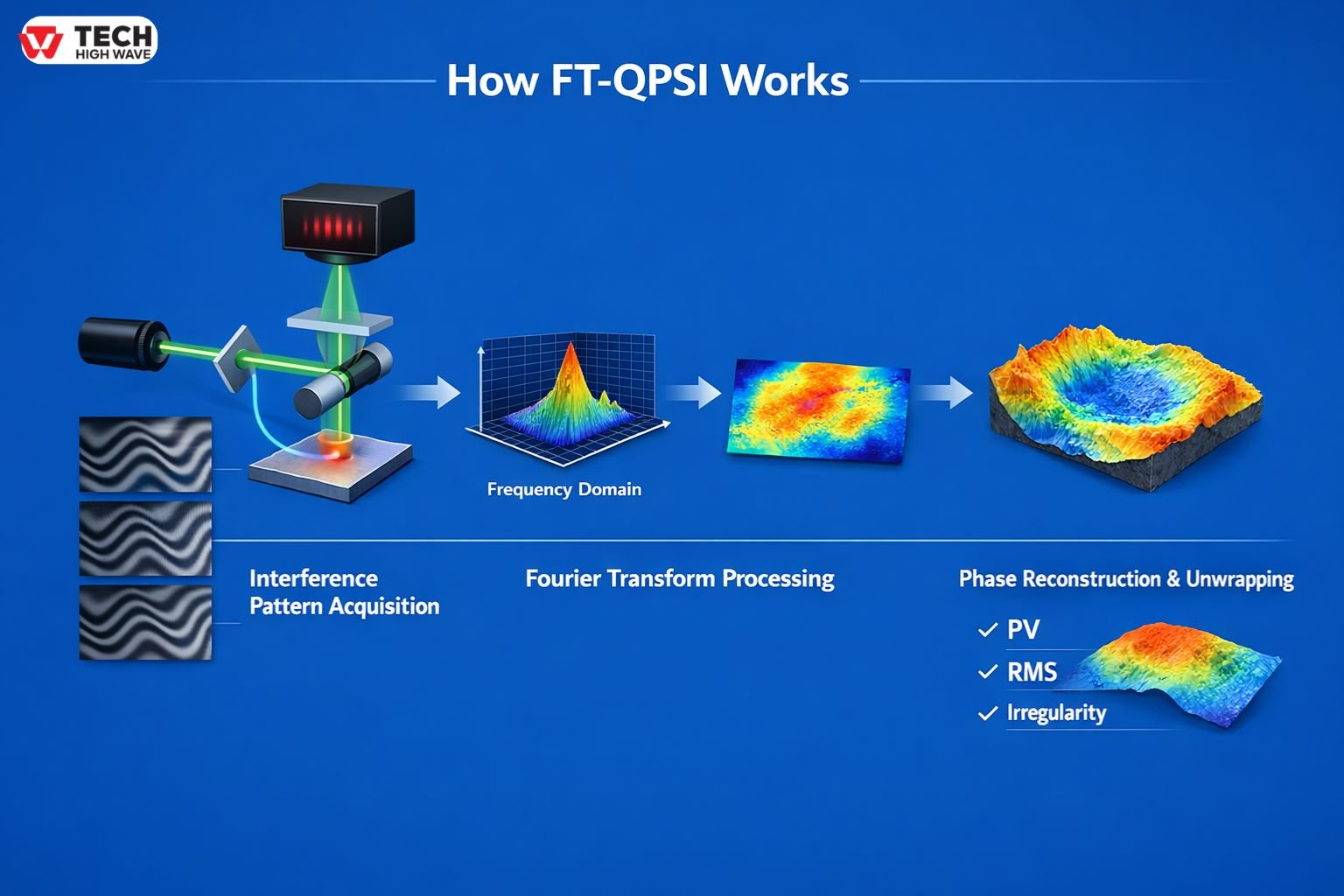
FT-QPSI operates through a structured sequence of acquisition and reconstruction steps.
-
Interference Pattern Acquisition
The interferometer captures multiple phase-shifted fringe images created by combining:
- A reference beam
- A test surface reflection
-
Quadrature Phase Sampling
The system captures phase data at offsets that approximate sine and cosine components of the fringe signal.
This quadrature structure allows:
- Compensation for small phase-step deviations
- Reduced sensitivity to actuator nonlinearity
- More stable extraction when fringe contrast varies
If phase steps deviate slightly from their ideal values, the algorithm compensates mathematically.
-
Fourier Transform Processing
The captured fringe data is transformed into the frequency domain. This enables:
- Separation of dominant spatial frequency components
- Improved isolation of surface deviations
- Reduction of tilt and background modulation artifacts
Fourier-based processing helps distinguish meaningful surface information from environmental noise.
-
Phase Reconstruction & Unwrapping
The processed data is converted into a continuous phase map through:
- Phase reconstruction
- Phase unwrapping
- Spatial filtering
The result is a high-resolution surface map, typically expressed in:
- Peak-to-valley (PV)
- Root mean square (RMS)
- Power
- Irregularity
FT-QPSI does not change interferometric physics. It improves the stability of computational phase extraction.
FT-QPSI vs Traditional Phase-Shifting Interferometry
Understanding the differences clarifies decision-making.
| Feature | Traditional PSI | FT-QPSI |
| Sensitivity to vibration | High | Reduced |
| Sensitivity to phase-step error | High | Reduced |
| Computational complexity | Lower | Moderate |
| Environmental robustness | Limited | Improved |
| Processing time | Faster | Slightly increased |
Stability Differences
Traditional PSI assumes highly accurate phase steps. If actuators drift or environmental conditions fluctuate, measurement repeatability can degrade.
FT-QPSI compensates for small deviations using quadrature and Fourier analysis.
Accuracy & Repeatability
In stable labs, both methods can achieve nanometer-level repeatability. In mixed environments, FT-QPSI often improves repeatability consistency rather than absolute accuracy.
Environmental Sensitivity
FT-QPSI is not dynamic interferometry. Severe vibration still disrupts measurement. However, moderate instability is handled more effectively.
Key Features to Look for in FT-QPSI
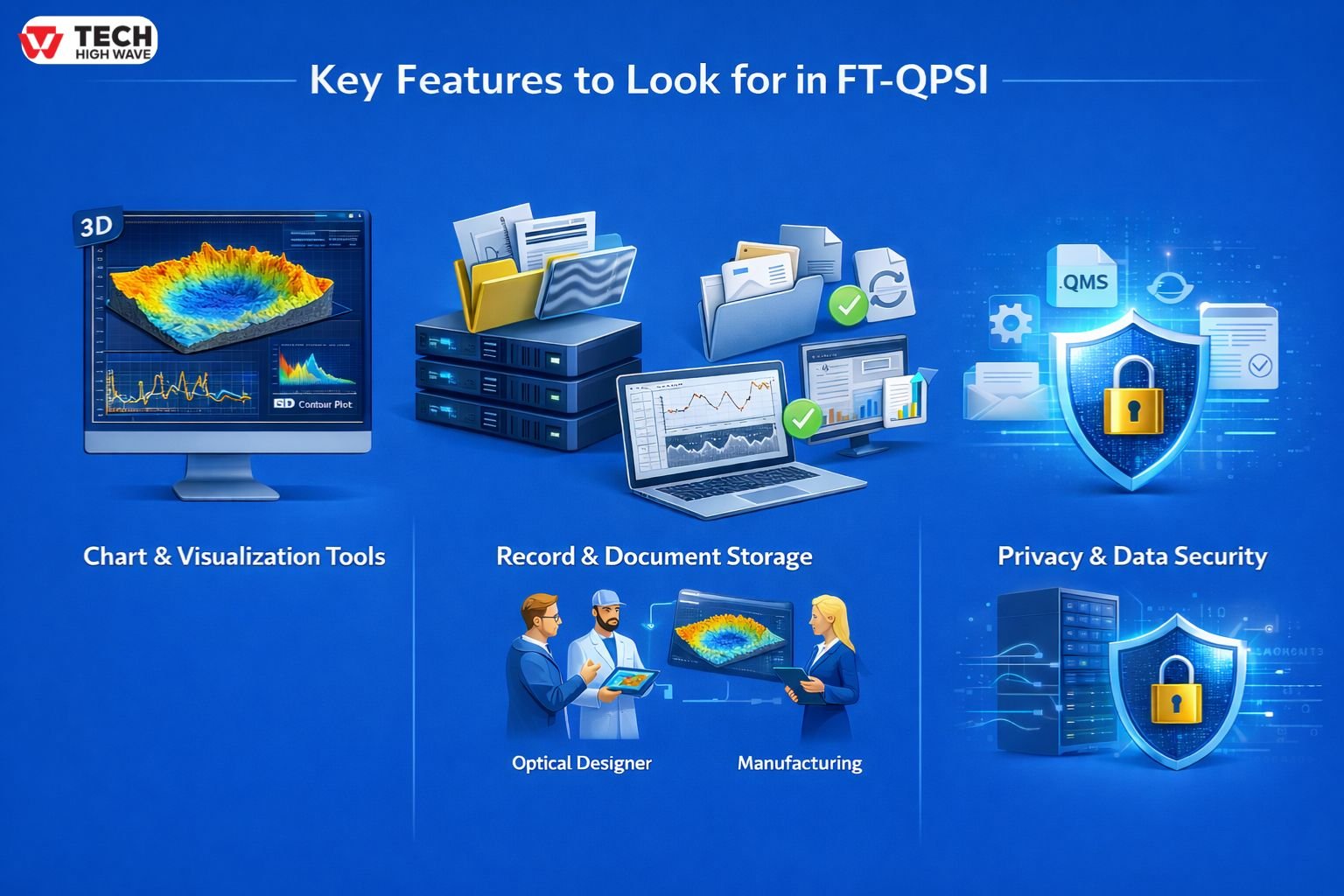
Chart & Visualization Tools
Advanced visualization is critical for interpreting FT-QPSI results.
Look for:
- 3D surface rendering
- Contour mapping
- Line profile extraction
- Power spectral density (PSD) plots
- Mid-spatial frequency analysis
In precision optics manufacturing, mid-spatial frequency errors often affect performance more than simple PV values.
Visualization clarity directly influences decision quality.
Record & Document Storage
Interferometric data must be traceable and auditable.
Robust implementations support:
- Timestamped measurement logs
- Raw fringe image retention
- Configuration traceability
- Version control
- Exportable reports for compliance
Industries governed by ISO surface standards or aerospace documentation requirements depend on complete traceability.
Collaboration & Sharing
Measurement data frequently moves between:
- Optical designers
- Manufacturing engineers
- Quality assurance teams
FT-QPSI outputs should integrate with:
- Standardized data formats
- Quality management systems
- Controlled document workflows
Clear documentation prevents reinterpretation errors during production scaling.
Privacy & Data Security
Optical surface geometries may represent proprietary intellectual property.
Security considerations include:
- Access control permissions
- Network security protocols
- Controlled export policies
- Data retention governance
In regulated sectors, data protection is not optional.
Also Check: What Is Smart Response Technology? How It Works, and Whether It Still Matters in 2026
Best Uses for FT-QPSI
Production Floor Interferometry
On manufacturing floors, vibration from equipment or airflow can introduce minor instability. FT-QPSI improves repeatability across shifts.
Large Optics Testing
Large apertures amplify environmental effects. FT-QPSI stabilizes phase extraction when minor disturbances occur.
Precision Flatness Verification
When verifying reference flats near single-digit nanometer tolerances, computational robustness reduces measurement drift.
Transmitted Wavefront Testing
Transmissive optics with lower fringe contrast benefit from quadrature-based extraction.
Process Development & Early R&D
Prototype setups often lack optimized environmental isolation. FT-QPSI mitigates moderate instability during early-stage experimentation.
Who Should Use FT-QPSI?
Optical Manufacturing Engineers
Those managing shift-to-shift consistency benefit from improved repeatability.
Quality Assurance Teams
When audit readiness and measurement reproducibility are critical, FT-QPSI strengthens confidence.
Metrology Specialists
Advanced users working in mixed environmental conditions gain the most measurable benefit.
Research Labs Without Full Isolation
Institutions operating without dedicated vibration isolation systems often rely on computational robustness.
Who May Not Benefit
- Labs with high-end active isolation
- Low-precision measurement environments
- Applications requiring minimal throughput latency
FT-QPSI adds computational overhead that may not be necessary in fully stabilized labs.
How to Choose the Right FT-QPSI Configuration
Environmental Stability Assessment
- Persistent vibration → Consider FT-QPSI
- Fully isolated lab → Classical PSI may suffice
Throughput Evaluation
- High-volume manufacturing → Confirm processing time impact
- Low-volume precision testing → Robustness often outweighs speed
Accuracy Requirements
- Nanometer-level tolerance → Stability becomes critical
- Micron-level tolerance → Standard PSI may be sufficient
Integration Compatibility
Confirm alignment with:
- Existing Zygo interferometer models
- Internal reporting workflows
- Quality management systems
Decision Checklist
- Is repeatability inconsistent?
- Are phase-step errors suspected?
- Does fringe contrast fluctuate?
- Are audit requirements strict?
If multiple factors apply, FT-QPSI is often justified.
Common Mistakes to Avoid
Assuming It Eliminates All Vibration
FT-QPSI reduces sensitivity to moderate instability. Severe mechanical shock still disrupts measurements.
Ignoring Calibration
Phase extraction robustness does not replace proper optical alignment or actuator verification.
Overlooking Fringe Contrast
Low-reflectivity surfaces may require additional optimization beyond FT-QPSI.
Neglecting Raw Data Archiving
Without stored fringe images, post-measurement verification becomes impossible.
Confusing It with Dynamic Interferometry
FT-QPSI is enhanced phase-shifting, not a fully dynamic real-time vibration-canceling method.
Future Trends in FT-QPSI (2026 Outlook)
Adaptive Phase Algorithms
Emerging implementations dynamically adjust reconstruction parameters based on fringe contrast and noise modeling.
Enhanced Noise Modeling
Improved environmental disturbance modeling increases stability without hardware modification.
Integration with Closed-Loop Polishing
Measurement outputs increasingly feed automated correction systems in precision polishing workflows.
Improved User Interface Design
Configuration tools are becoming more intuitive while retaining expert-level control.
Despite advances, optical alignment, calibration discipline, and environmental management remain foundational.
Frequently Asked Questions
Q1: What is FT-QPSI in VeriFire Zygo MX software?
FT-QPSI is a Fourier Transform–based quadrature phase-shifting method that improves robustness in interferometric phase extraction.
Q2: Is FT-QPSI more accurate than traditional PSI?
FT-QPSI improves repeatability under unstable conditions, though absolute accuracy still depends on calibration and alignment.
Q3: Does FT-QPSI replace vibration isolation?
FT-QPSI reduces sensitivity to moderate vibration but does not replace proper mechanical isolation.
Q4: Where is FT-QPSI enabled in Zygo MX software?
FT-QPSI is typically selectable within phase-shifting measurement configuration settings on compatible systems.
Q5: Does FT-QPSI increase measurement time?
FT-QPSI introduces additional computational processing, which may slightly increase cycle time depending on system configuration.
Q6: Is FT-QPSI suitable for production environments?
FT-QPSI is particularly valuable in production floors where environmental conditions are not perfectly controlled.
Final Thought
FT-QPSI in VeriFire Zygo MX software represents a meaningful evolution in phase extraction stability for precision interferometry. It does not replace sound metrology practice, nor does it eliminate environmental challenges. What it does provide is improved computational resilience in real-world conditions where measurement consistency matters.
When applied with proper calibration, traceability discipline, and environmental awareness, FT-QPSI strengthens confidence in high-precision optical surface characterization.
Also Read: ziimp .com tech: Complete Guide to Features, AI Tools, Pricing & 2026 Outlook