
Automotive technology has changed faster in the past decade than most people expected, and certainly faster than many workshops were prepared for. Vehicles that once depended almost entirely on mechanical systems now function as rolling computer networks, layered with sensors, modules, software logic, and constant data exchange. A technician today doesn’t rely only on sound, vibration, or instinct. A scan tool, a laptop, sometimes even remote manufacturer access, sits open beside the toolbox.
People researching automotive technology usually aren’t browsing casually. They’re trying to make decisions. Is it a stable career? What does the salary actually look like after five or ten years, not just at entry level? Is an associate degree worth the time, or is certification and apprenticeship enough? And what does the job really feel like, day after day?
This guide addresses those questions directly. It explains how automotive technology works in real environments, what skills truly matter, how salaries scale with specialization, what education paths involve, and where the industry is heading. It also acknowledges the less glamorous parts—tool costs, exam difficulty, physical demands, and the steady pressure to keep learning.
What Is Automotive Technology?
Automotive technology is the applied study of vehicle systems, combining mechanical engineering principles, automotive electronics, diagnostic software, and network communication protocols to design, maintain, and repair modern vehicles.
Years ago, the focus was almost entirely mechanical—engines, gearboxes, brake assemblies, suspension components. That foundation still matters. But today’s automotive technology also includes:
- Controller Area Network (CAN bus) systems
- Electronic control modules (ECMs)
- Hybrid and electric vehicle (EV) powertrains
- Advanced driver-assistance systems (ADAS)
- Battery management systems (BMS)
- Telematics and connected car platforms
- Sensor-based predictive diagnostics
In practical terms, automotive technology is about understanding how hardware and software interact. A throttle body isn’t just a mechanical valve anymore, it’s electronically controlled, constantly communicating with other modules.
Quick Recap
- Modern vehicles operate as integrated digital-mechanical systems.
- Automotive technology blends hands-on repair with data analysis.
- Electronics and software are no longer optional knowledge areas.
How Automotive Technology Works
Modern vehicles operate as layered systems, and those layers communicate constantly. A single faulty wheel speed sensor can affect braking, traction control, dashboard alerts, even transmission behavior.
The diagnostic process follows a logical structure, although in reality, it rarely feels perfectly linear.
-
Network Communication (CAN Bus & OBD-II)
Vehicles rely on CAN bus networks to allow modules to exchange information. When a fault occurs, OBD-II protocols log diagnostic trouble codes (DTCs). A technician retrieves those codes, but the code itself rarely tells the full story. It points to a system, not always the root cause.
-
Diagnostic Logic in Practice
A structured workflow might look like this:
If:
- Warning light ON + no noticeable performance drop → Scan OBD-II, review freeze-frame data
- Warning light + reduced engine power → Inspect sensor network, fuel-air readings, throttle response
- EV range unexpectedly dropping → Review BMS logs, check thermal management system
In theory, it’s straightforward. In practice, intermittent faults can stretch diagnostics into hours, sometimes days.
Many entry-level technicians are surprised to discover that interpreting data, not turning wrenches, consumes most of their time.
-
Automotive Mechatronics
Modern systems integrate mechanics and electronics so tightly that separating them conceptually no longer works. Electronic throttle control, adaptive suspension, regenerative braking—these are mechatronic systems. They respond to software commands in milliseconds.
-
Calibration & Programming
After certain repairs, especially collision-related ones, ADAS sensors must be recalibrated with precision equipment. A slightly misaligned radar sensor may still “work,” but it may not function safely.
That difference matters.
-
Software & Firmware Updates
Software-defined vehicles now receive over-the-air updates. Technicians must confirm compatibility, validate firmware integrity, and sometimes resolve conflicts between modules.
The profession has shifted. Gradually at first. Then quickly.
Quick Recap
- Diagnostics is data-driven and structured.
- Mechatronics defines modern vehicle behavior.
- Calibration accuracy directly affects safety systems.
Also Check: 2026 Ford F-150 Smart Tech: What’s New & What’s Worth It
Key Features to Look for in Automotive Technology
Programs & Systems
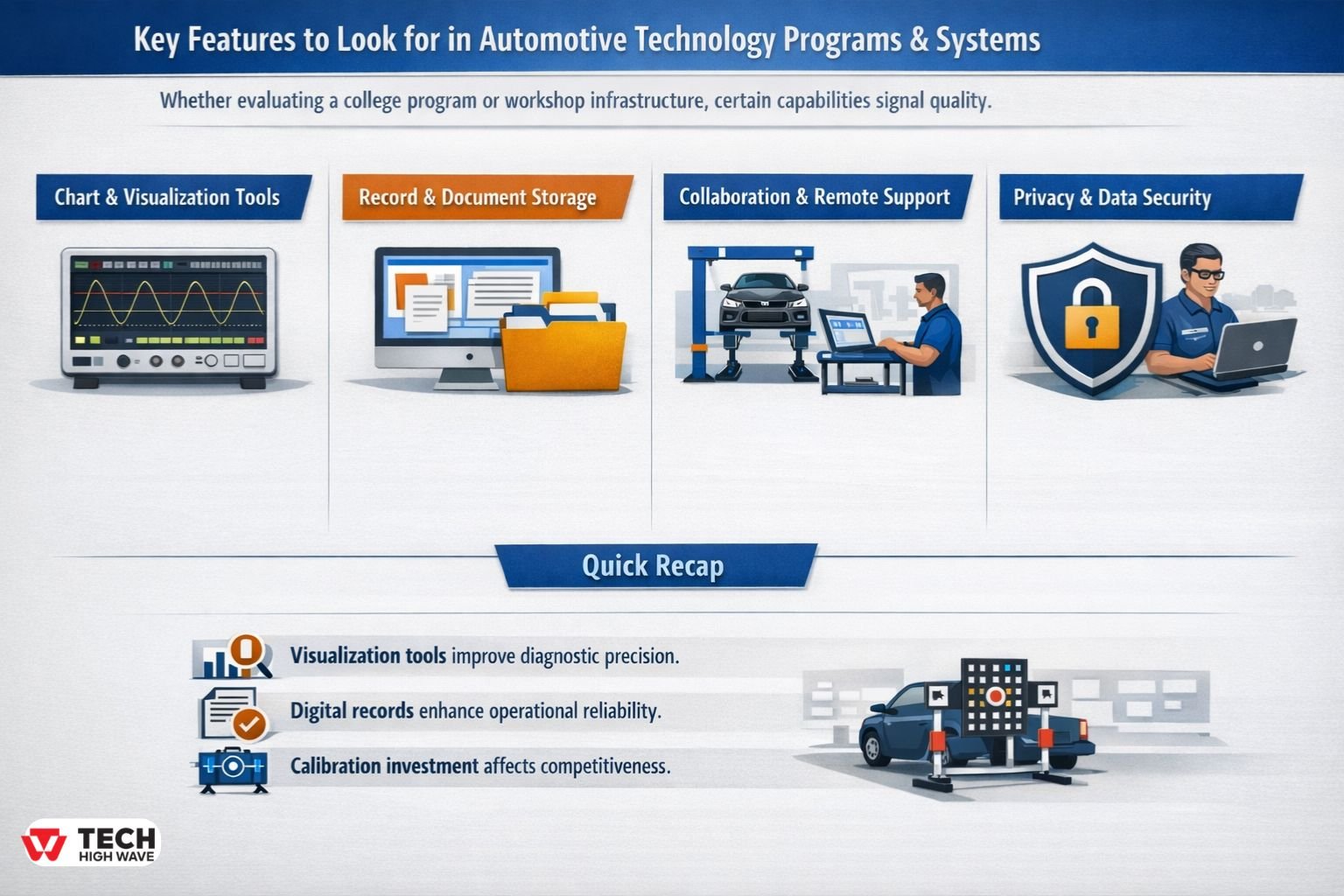
Whether evaluating a college program or workshop infrastructure, certain capabilities signal quality.
Chart & Visualization Tools
Strong diagnostic platforms convert raw data into waveforms, graphs, and comparative metrics. Voltage irregularities become visible. Timing inconsistencies become obvious.
Without visualization tools, subtle faults can hide in plain sight.
Record & Document Storage
Professional environments maintain digital repair histories, manufacturer bulletins, warranty documentation, and compliance logs. Organized documentation reduces repeat failures and protects both technician and customer.
Collaboration & Remote Support
Advanced systems allow remote diagnostics support and shared troubleshooting databases. This matters in EV and ADAS work, where experience gaps can delay repairs.
Shops that avoid investing in calibration tools, particularly ADAS rigs, increasingly lose insurance-referred repair work. That’s not theoretical—it’s happening.
Privacy & Data Security
Connected vehicles collect driving behavior, location data, and telematics information. Secure firmware handling is no longer an IT issue. It’s a service issue.
Quick Recap
- Visualization tools improve diagnostic precision.
- Digital records enhance operational reliability.
- Calibration investment affects competitiveness.
Automotive Technology Salary & Career Outlook
Salary depends heavily on specialization, certification, and region.
Automotive Technology Career Path Overview
| Role | Education | Avg Salary Range | Growth Demand |
| Entry-Level Technician | Certificate or AAS | $35,000–$45,000 | Steady |
| Certified Technician | ASE + Experience | $45,000–$65,000 | Strong |
| Master Technician | Advanced Certification | $65,000–$90,000+ | High |
| EV / ADAS Specialist | EV & Calibration Training | $70,000–$100,000+ | Rapid |
EV and ADAS specialists often command higher wages because fewer technicians are fully trained in those systems.
Career Progression
- Apprentice or lube technician
- Certified automotive technician
- Master technician
- Shop foreman or service manager
- Manufacturer technical specialist
The ladder is clear. Advancement depends on skill, certification, and consistency.
Work conditions are practical realities. Long hours standing. Occasional heavy lifting. Cold mornings in open bays. It’s not a desk job.
Quick Recap
- Specialization significantly increases earning potential.
- Certification supports wage growth.
- Physical stamina and technical reasoning both matter.
Automotive Technology Degree vs Certification
Choosing an education path depends on long-term goals.
Associate Degree (AAS)
- Approximately 2 years
- Includes theory, lab training, general coursework
- Prepares for ASE certification exams
- Broader technical foundation
Certificate Programs
- 6–12 months
- Skill-focused training
- Faster workforce entry
- Limited theoretical depth
Apprenticeships
Apprenticeships combine structured instruction with paid work experience. Many employers value hands-on apprenticeship experience as highly as classroom education.
ASE certification exams are rigorous. Preparation matters. Experience matters more.
Cost Considerations
Tuition, certification fees, and tool investments can exceed several thousand dollars over time. Tool collections are rarely purchased all at once. They accumulate, slowly.
Quick Recap
- Degrees offer depth.
- Certificates offer speed.
- Apprenticeships offer immersion.
Real-World Scenarios in Automotive Technology
A technician troubleshooting intermittent EV battery faults may spend hours reviewing battery management system data, checking thermal patterns, and ruling out sensor drift before identifying a minor imbalance.
A student choosing between diesel specialization and EV training might initially lean toward diesel for familiarity, only to reconsider after reviewing EV growth projections and salary differentials.
The industry is shifting, sometimes unevenly, but noticeably.
Common Challenges & Industry Realities
- Continuous learning is required, not optional.
- Tool investments grow over time.
- Certification exams demand preparation and discipline.
- Automation assists diagnostics but does not replace skilled reasoning.
Automation risk is frequently overstated. Vehicles still require physical inspection, calibration, and human interpretation.
Future Trends in Automotive Technology (2026 Outlook)
Automotive technology is no longer changing gradually. It is accelerating, and technicians feel that shift every year in the workshop.
Electrification Growth
Battery density improvements and expanded charging infrastructure are driving demand for EV-trained professionals.
ADAS Standardization
Calibration expertise is becoming expected, not specialized.
Connected Vehicle Ecosystems
Telematics and predictive diagnostics influence maintenance scheduling and fleet operations.
AI-Supported Diagnostics
Machine learning tools assist in identifying fault patterns, but they rely on skilled interpretation.
Quick Recap
- Electrification increases specialization demand.
- Software-defined vehicles require firmware literacy.
- Diagnostic tools are becoming more intelligent, not autonomous.
Frequently Asked Questions
Q1: What is automotive technology?
Automotive technology is the application of mechanical, electronic, and software systems used to design, diagnose, maintain, and repair modern vehicles operating on integrated communication networks.
Q2: Is automotive technology a good career?
Automotive technology provides stable employment and growth potential, especially for technicians specializing in EV systems, advanced diagnostics, or ADAS calibration where demand continues increasing.
Q3: How much does automotive technology make?
Entry-level technicians typically earn $35,000–$45,000 annually, while experienced master technicians and EV specialists may earn $70,000–$100,000 or more depending on region and certification level.
Q4: How long does an automotive technology degree take?
An associate degree generally requires two years, while certificate programs typically range from six to twelve months depending on program structure.
Q5: Is automotive technology physically demanding?
Yes. The profession involves standing for extended periods, lifting components, and working in workshop conditions alongside detailed diagnostic work.
Q6: Are automotive technology jobs at risk from automation?
Automation improves diagnostic efficiency but does not eliminate the need for skilled technicians who perform repairs, calibrations, and complex system troubleshooting.
Q7: What certifications matter most in automotive technology?
ASE certification is widely recognized, and manufacturer-specific EV or ADAS credentials can significantly improve advancement opportunities.
Key Takeaways
- Automotive technology blends mechanics, electronics, and software systems.
- EV and ADAS specialization offers strong earning potential.
- Certification and hands-on experience remain critical.
- The learning curve is real, but manageable with structured training.
- The field continues evolving, quickly, but in practical, measurable ways.
Automotive technology sits at the intersection of engineering precision and applied skill. It demands adaptability, patience, and ongoing education. For those willing to commit to that process, it offers a defined career path, increasing specialization opportunities, and a direct role in maintaining—and advancing—the vehicles that keep modern transportation moving.
Also Read: ziimp .com tech: Complete Guide to Features, AI Tools, Pricing & 2026 Outlook